
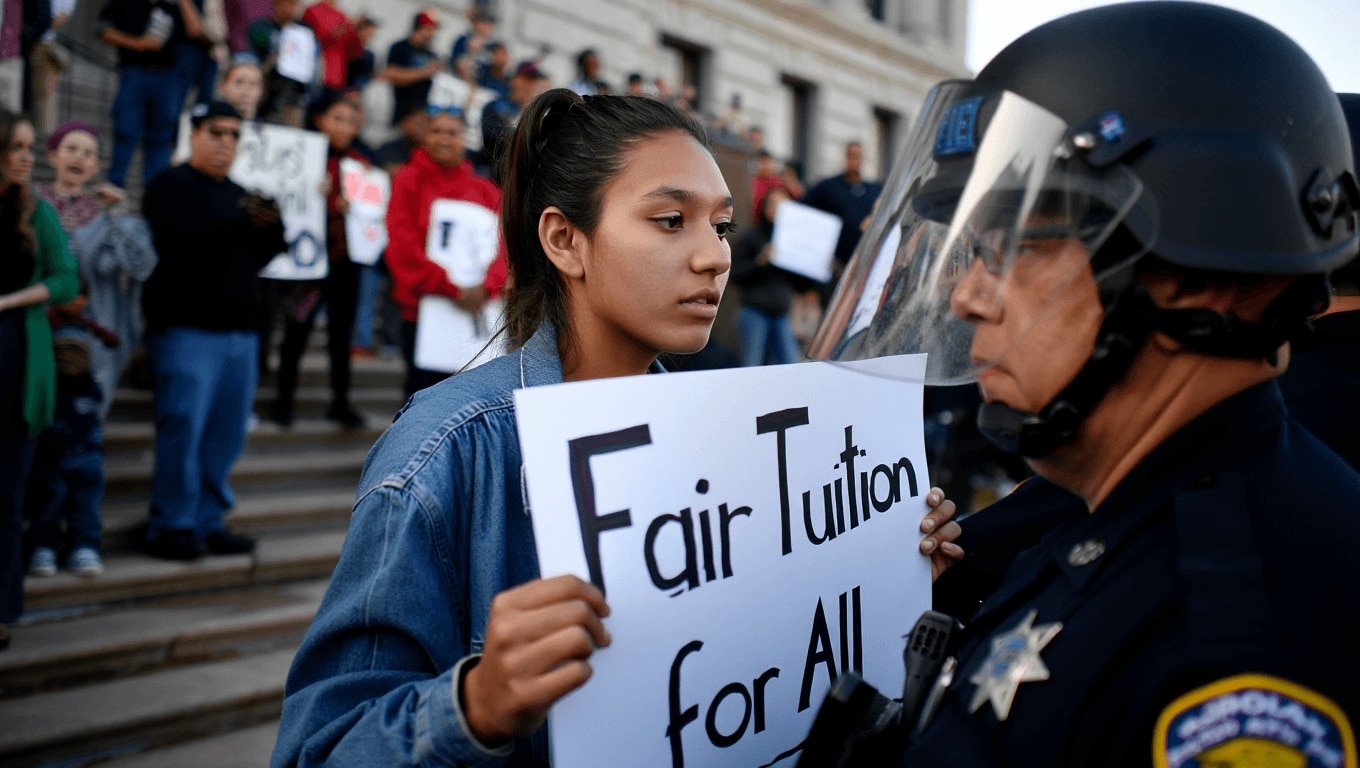
A widening legal and political fight over whether undocumented students can access lower public college rates is reshaping higher education across the United States. New federal guidance and a wave of state rollbacks have suddenly put many students’ futures — and the cost of college itself — on uncertain ground.
How the landscape changed
For more than 20 years, some states let students regardless of immigration status qualify for in-state tuition at public colleges if they met residency and school-attendance rules. That pathway, often used by people protected under the Deferred Action for Childhood Arrivals program — commonly called DACA — helped students who might otherwise be priced out of postsecondary education.
Texas led the way with a 2001 law that created a model other states copied. Over time, about two dozen states plus the District of Columbia adopted similar measures. But in the last year several states have rescinded those benefits, and the U.S. Department of Education issued a rule in July tightening access to certain federal-funded programs — a change that has intensified the debate.
- States and access: At least 22 states and Washington, D.C., currently have policies that can allow undocumented students to pay in-state rates.
- Typical eligibility: Requirements usually include attending a high school in the state for a number of years and graduating from that school.
- Cost gap: For 2025–26 the average in-state tuition and fees at four-year public colleges were about $11,950; out-of-state costs averaged roughly $31,880.
- Federal limits: The Department of Education’s recent rule clarifies federal student aid programs remain unavailable to undocumented students, affecting eligibility for need-based grants and federal loans.
What it means for students
When some states remove the in-state rate, students facing out-of-state charges can see their annual bills triple. That shift forces many to pause or abandon four-year degrees, transfer to community colleges, or take on untenable debt.
Juan, a 21-year-old senior and accounting major, described the moment Texas rolled back its policy last summer as “anxious.” He was a year from finishing and feared his family could not cover out-of-state tuition. Because of his active DACA status, he was still able to pay in-state rates and expects to graduate this spring. He said he plans to pursue accounting certification and later law school, hoping to work in civil rights or immigration law.
Advocates warn the pain will fall hardest on students from lower-income and nonwhite communities, narrowing the talent pipeline for professions that depend on diverse graduates.
Federal action and state-by-state fights
The Department of Education’s July rule reiterated that certain federal programs — including need-based grants and federal student loans — are not available to undocumented people. The department framed the move as ensuring federal funds go to those who meet legal eligibility standards.
At the same time, the Departments of Justice and Education have begun legal challenges to state policies that extend in-state rates to undocumented residents. In Virginia, a federal challenge to the state’s in-state tuition law is pending before a judge. State-based advocates say they are cautiously optimistic the law will survive, noting many scholarship recipients depend on those lower rates.
Zuraya Tapia-Hadley, CEO of a Virginia nonprofit that supports immigrant students, said most of the organization’s scholars rely on in-state tuition. She warned that if students lose those rates, the immediate effect would be a steep rise in college costs—and a broader loss for local workforces and communities that would miss out on educated talent.
Why the issue matters now
The combination of federal clarification and state rollbacks means decisions made this year will shape enrollment, completion rates, and the makeup of the future workforce. Colleges, families and lawmakers are being forced to weigh short-term budget choices against long-term economic and civic consequences.
Policymakers and advocates are debating whether restoring or preserving access is an investment in the state economy or an inappropriate use of taxpayer money—an argument that has moved from legislatures to courts and the federal bureaucracy.
How these cases resolve will determine whether thousands of students keep a route into four-year degrees or face substantially higher bills and tougher choices.
Correction: This article was updated to clarify that the Department of Education’s July rule confirmed that certain postsecondary programs, including Pell Grants and federal student loans, continue to be inaccessible to undocumented students. An earlier version misstated the rule’s determination on those programs.
Similar Posts
- Federal student loans: court blocks Trump-era cap affecting grad students
- Student loan cap lawsuit threatens to worsen nursing shortage
- Community college enrollment surges as graduates shift toward two-year degrees
- Graduate loan limits raised by Trump administration: more degrees qualify for larger loans
- International student numbers tumble as U.S. visa rules tighten: campuses brace for losses

Jordan Keller specializes in analyzing the US financial markets. With concrete recommendations, he helps you secure and boost your investments by providing strategies that adapt to market fluctuations.