
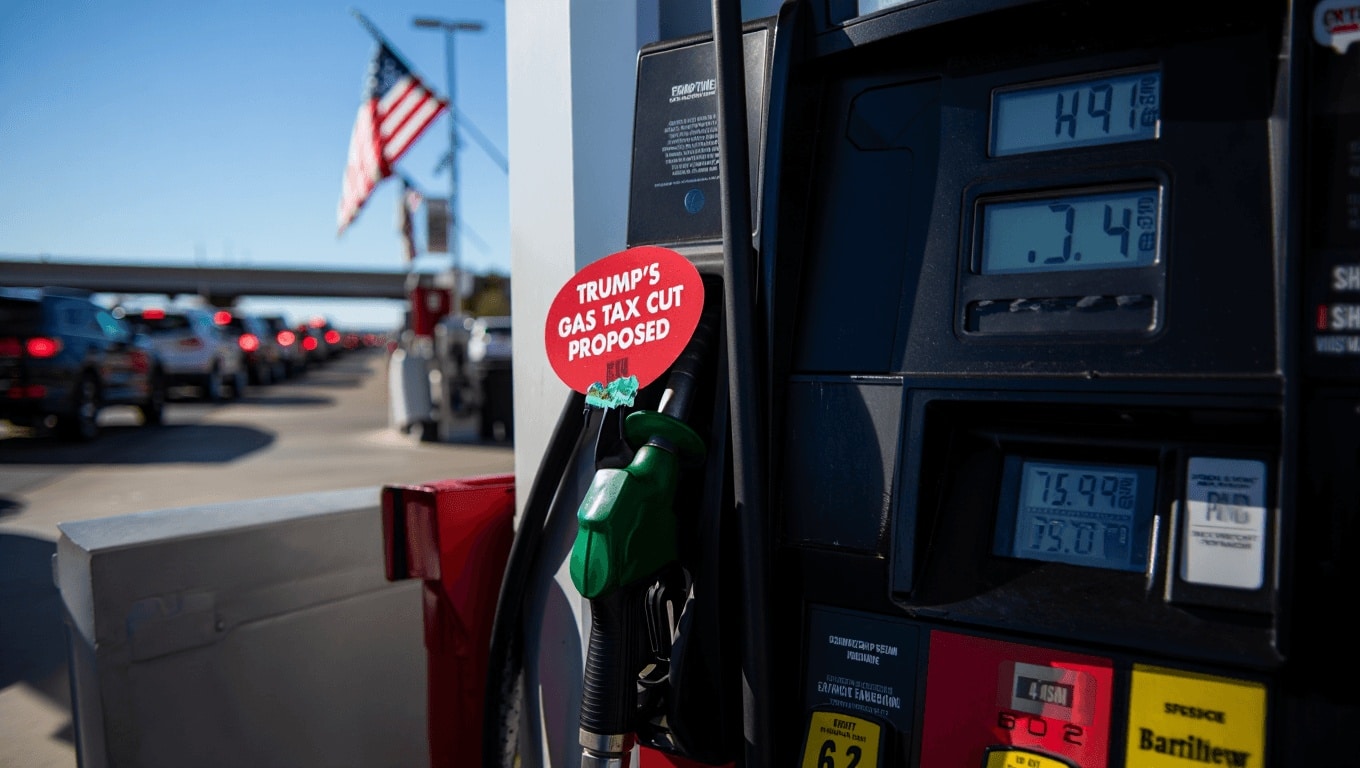
President Donald Trump’s recent Oval Office comments reviving a plan to suspend the federal gas tax have reignited a national debate on whether temporary relief at the pump is worth risking funding for roads and bridges. Lawmakers moved quickly to propose short-term suspensions, but analysts warn any savings for drivers would likely be modest while the Highway Trust Fund faces growing shortfalls.
Trump told reporters he wants to pause the federal levy “for a period of time,” asking Congress to act. Within hours, Republican senators and House members filed bills to halt collection for weeks or months, and some states are already taking their own steps to ease fuel costs ahead of the summer driving season.
What a federal pause would actually do at the pump
The federal excise tax on gasoline now stands at 18.4 cents per gallon; diesel is taxed at 24.4 cents per gallon, according to the U.S. Energy Information Administration. That tax is collected separately from state levies, which range widely across the country.
Even if Washington suspended the federal tax immediately, economists say the cut at the pump would be far from dramatic. Retailers and distributors typically add margins and local fees, so only a portion of any federal tax holiday tends to show up in consumer prices.
- Estimated consumer savings: Analysts put likely reductions at roughly 10–12 cents per gallon once middlemen keep their typical margins.
- Duration proposals: Legislative ideas on the table range from a 90-day pause to temporary measures tied to the summer travel season.
- State actions: Several states, including Georgia, Indiana, Kentucky and Utah, have already moved to offer their own short-term relief.
- Broader price pressures: U.S. pump prices have climbed sharply since the Iran conflict began, adding strain to household budgets and denting consumer confidence.
Who’s pushing bills and what they propose
Sen. Josh Hawley, Republican of Missouri, filed legislation to suspend the federal fuel tax for at least 90 days. Rep. Anna Paulina Luna, Republican of Florida, announced plans to introduce a companion measure in the House. Earlier this year, Senators Mark Kelly and Richard Blumenthal proposed a temporary suspension running through Oct. 1, but that proposal has not advanced in the Senate Finance Committee.
Any change to the federal excise rate would need congressional approval and, if passed, could be implemented quickly. Still, lawmakers face a choice between providing immediate relief and protecting dedicated infrastructure revenues.
Why infrastructure funding is central to the debate
The federal gas tax feeds the Highway Trust Fund, the main federal account that pays for interstate repairs, bridge work and state transportation projects. Experts warn that pause measures reduce revenue flowing into that fund at a time when project costs are rising.
“A temporary pause gives drivers a small break but removes money meant to maintain roads,” said Adam Hoffer of the Tax Foundation, noting the trust fund already struggles to cover scheduled projects. Reduced receipts could force short-term transfers from the general fund or push states to delay work.
Financial planners raise a similar point: short-term savings at the pump may be offset by higher long-term costs if deferred maintenance makes repairs more expensive later.
How much difference will drivers feel?
Moody’s chief economist Mark Zandi and others estimate that, after markups, a federal pause would translate into a price drop in the neighborhood of a dime per gallon for most consumers — helpful, but small compared with overall retail price swings. With national averages elevated and seasonal demand rising, the political appeal of a tax holiday is obvious even if the practical impact is limited.
Data firm AAA reports average pump prices remain well above recent norms, a reality that has prompted some lawmakers to look for quick fixes before summer travel peaks.
Trade-offs and the outlook
Suspending the federal gas tax offers a visible, immediate gesture to voters, but the move carries trade-offs: modest short-term relief for drivers versus potential shortfalls in funding for highways, bridges and transit. If Congress chooses a temporary suspension, expect pressure to identify replacement revenue or a plan to replenish the Highway Trust Fund.
In the coming weeks, watch for committee hearings and scorekeeping from budget analysts that will quantify the revenue loss and any offsets. For drivers, the likely outcome is a measurable but limited price cut — while state and local officials scramble to keep infrastructure projects on schedule.
Similar Posts
- Gas prices could fall soon if ceasefire holds: experts expect gradual relief at the pumps
- Gas prices top $4 nationwide: drivers face tighter budgets and longer commutes
- Gas prices climb above $4 a gallon: Labor Day travelers face record fuel bills
- Trump approves $500 Obamacare refunds for about 1 million people: who qualifies
- Fed pause expected: new leadership could reshape borrowing costs and your savings

Jordan Keller specializes in analyzing the US financial markets. With concrete recommendations, he helps you secure and boost your investments by providing strategies that adapt to market fluctuations.