
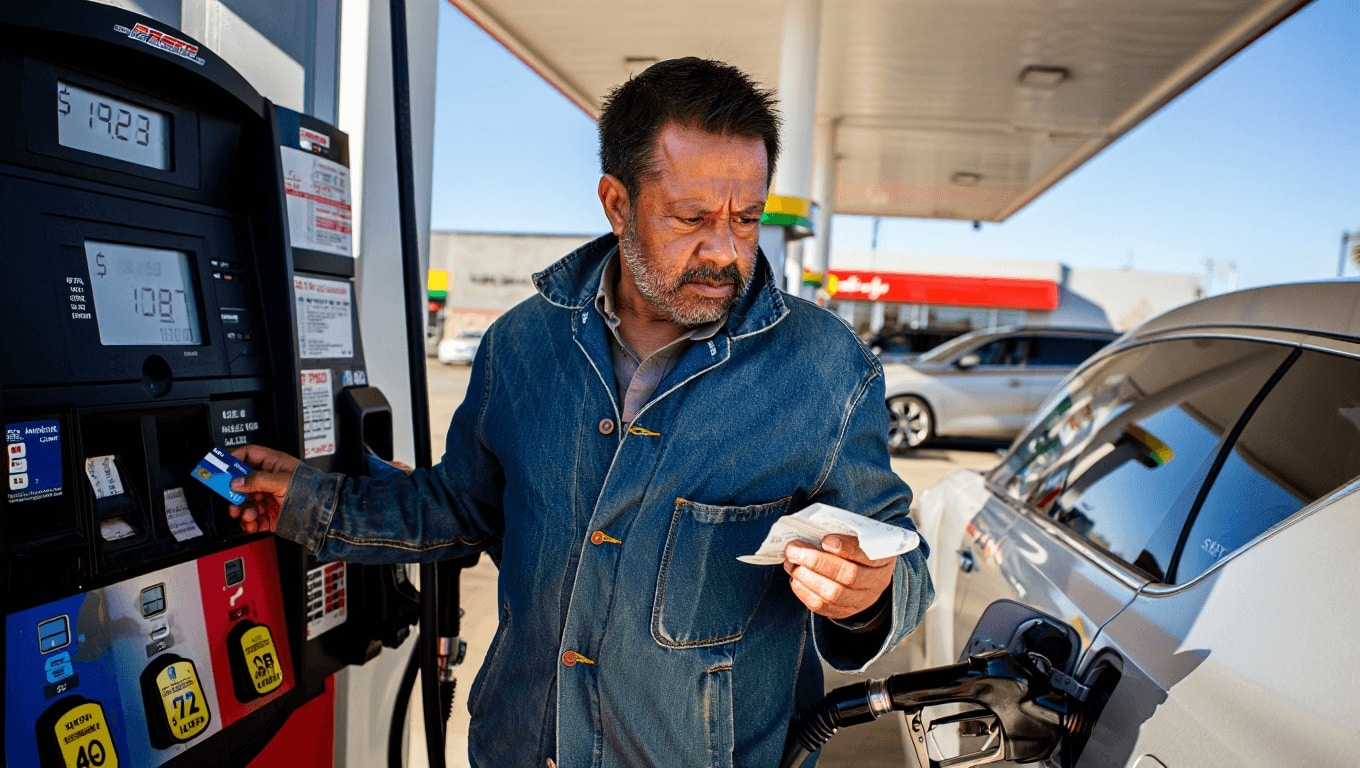
Gasoline prices have climbed past $4 a gallon across most of the United States, forcing many drivers to alter routines and budgets already stretched thin. The rise — tied to higher crude prices amid global tensions — is reshaping commutes, household spending and even how some employers schedule work.
Nationally, the American Automobile Association reports a jump of nearly $1 per gallon since early March, bringing the national average to about $4.14 as of early April. Analysts say the increase reflects higher oil costs and the growing risk of supply disruptions due to ongoing geopolitical tensions involving Iran.
New York area: costs ripple through daily life
In Brooklyn, prices at some pumps hovered below $4 for cash customers but topped $4 for credit — a split motorists are noticing at the pump. Restaurant worker Miranda Alcalá, who travels between Queens, Brooklyn and Long Island for two jobs, says her fill-ups have nearly doubled in price. What used to be a $20‑$25 tank now runs about $40, she said, and taking transit isn’t a workable option for her late shifts.
Other drivers in the area report similar strain. A Queens parent who routinely ferries children to practices and games said higher prices mean more frequent stops to top off the tank. Some raise the same concern: gas is nonnegotiable for work and family logistics, so it’s absorbed into the monthly budget.
Washington region: fewer discretionary trips, tighter budgets
In the D.C. area, regular gas commonly listed around $4.09 a gallon, with premium near $4.79. Commuters with inflexible schedules say they have little choice but to keep driving; others are trimming nonessential trips. One commuter who works late several nights a week said she is reluctant to switch to public transit because it won’t fit her hours.
Retirees and leisure drivers are scaling back. Some are combining errands or avoiding long outings; government employees and hourly workers are reviewing household budgets to find places to cut back if prices keep climbing.
Smaller cities and suburbs: tradeoffs and route changes
Outside major metros, drivers are making pragmatic adjustments. Some avoid toll roads and take slower back routes to save fuel, while others consolidate errands to reduce trips. A semi‑retired social services worker in Delaware said she now chooses side streets over the freeway to skip tolls and conserve gas.
At family level, the impact varies: those who must drive for work absorb the cost, while others cut discretionary travel or consolidate stops to stretch each tank.
Los Angeles: sticker shock on the West Coast
Southern California stands out. In downtown Los Angeles, one station listed regular gasoline near $7 a gallon for cash and higher on card — levels many drivers said felt jarring after moving from regions where fuel costs were roughly $4.20–$4.30.
Contractors and tradespeople described workplace changes: managers urging crews to finish tasks in a single visit to avoid return trips and preserve profit margins. Young drivers say they think twice before heading out for social plans or nonessential purchases.
- Immediate effects: More frequent budgeting decisions, fewer discretionary trips, and added pressure on hourly and gig-workers who pay their own fuel costs.
- Workplace shifts: Employers encourage route consolidation and single-visit job completions to reduce fuel use.
- Behavioral changes: Drivers take back roads to avoid tolls, limit errands, and shop for cheaper stations.
- Potential knock-on costs: Higher fuel prices can feed into goods and services as transportation costs rise.
| Location | Typical listed price (regular) |
|---|---|
| National average (AAA) | $4.14 |
| Brooklyn (some pumps) | $3.89 (cash) / $4.09 (card) |
| Queens BP | $4.09 (cash) / $4.19 (card) |
| Washington, D.C. | $4.09 (regular) / $4.79 (premium) |
| Nashville area | $3.89 |
| Delaware / Cecilton, Md. | $3.89–$3.99 |
| Kennedyville, Md. | $4.19 |
| Los Angeles (downtown) | ~$6.99 (cash) / $7.19 (card) |
| Lincoln Heights, L.A. | $5.79 |
Across cities, the common refrain is that fuel is an unavoidable expense for many households. Some people are shifting where they spend — choosing home-cooked meals over dining out, combining trips, or refilling at lower-cost stations even if it means a short detour — but for others there is little room to cut back without affecting work or family obligations.
What to watch next: if crude prices remain elevated because of geopolitical risks, consumers can expect further pressure at the pump, which could cascade into higher costs for goods and services that rely on road transport. For now, drivers are adapting however they can, one tank at a time.
Similar Posts
- Gas prices climb above $4 a gallon: Labor Day travelers face record fuel bills
- Credit card debt falls to $1.25 trillion: recovery remains split between rich and poor
- Oil prices spike after Iran conflict: consumers could face steep fuel bills, economist warns
- Speeding trims commute time by mere seconds, study finds
- April 2026 inflation: what rose and what fell in a single chart

Jordan Keller specializes in analyzing the US financial markets. With concrete recommendations, he helps you secure and boost your investments by providing strategies that adapt to market fluctuations.