
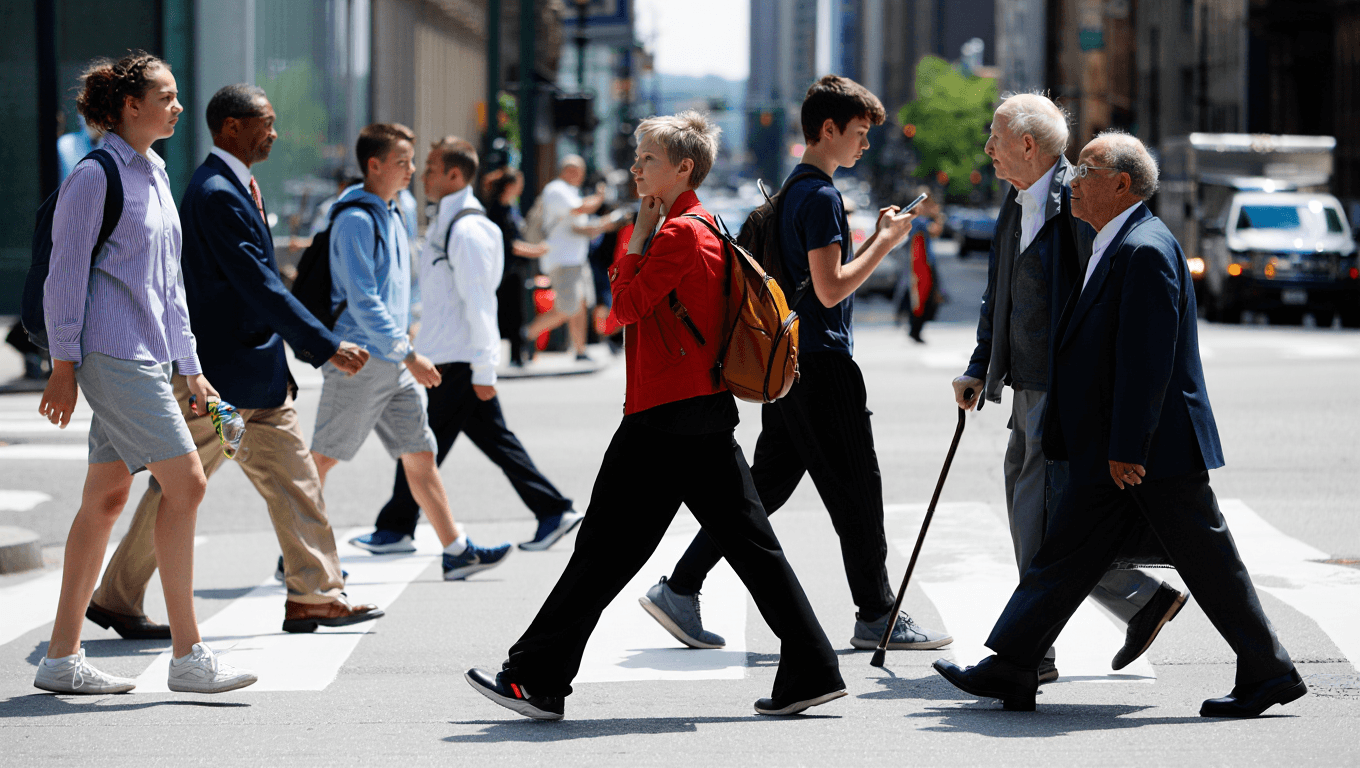
New research suggests most people naturally drift to the left when they walk, a subtle bias that shows up within seconds and across ages and settings. The pattern, documented in a study published in Nature Communications, could influence how planners design everything from evacuation routes to crowded retail spaces.
From a casual observation to a five-year project
The finding began when applied physicist Iñaki Echeverría-Huarte of the University of Navarra noticed a consistent leftward tendency while watching video of people moving through public spaces. That curiosity grew into a sustained investigation that pooled data from multiple experiments.
Across the study, researchers tracked the movement of 573 participants in varied environments and conditions. Regardless of age, background or soundtrack — silent walking, talking, or listening to music — roughly 75–80% of people began shifting left within moments of starting to walk.
What might explain a leftward bias?
Scientists don’t have a definitive answer yet. One plausible idea is that small asymmetries in the body and how the brain coordinates balance create a tiny preference for one direction that becomes noticeable over time or distance.
Other explanations — cultural habits, dominant-foot effects or local spatial layouts — have been discussed but not confirmed. The dominance of leftward drift over rightward drift remains particularly puzzling to the team.
- Robotics and autonomous navigation: Understanding human directional bias could help robots and self-driving carts move more smoothly among pedestrians.
- Evacuation planning: Predictable crowd tendencies can improve routing and reduce bottlenecks in emergencies.
- Retail and museum design: Circulation patterns might be optimized to guide visitors more efficiently through displays or product aisles.
- Transit hubs and public plazas: Small design adjustments — entrances, signage, barrier placement — could align with natural flow to ease congestion.
Practical consequences and next steps
The study’s authors point out that this is not a trivial curiosity: a consistent bias in pedestrian motion can compound at scale, affecting the safety and efficiency of crowded spaces. For architects, transport authorities and emergency planners, such behavioral regularities are actionable data.
Follow-up work will need to test more diverse populations and varied built environments, and to measure subtle physiological or neurological factors that might underlie the effect. Controlled experiments that manipulate signage, floor markings or entry points could show whether human flow can be nudged away from its default tendency.
For now, the research offers a practical tip: when designing or managing shared spaces, account for a quiet but persistent human tendency to favor the left — and consider how that preference might shape movement on a busy day.
Similar Posts
- AI Bias Alert: Humans Losing Out as Artificial Intelligence Plays Favorites
- Neanderthal interbreeding reshaped human ancestry for hundreds of thousands of years
- Human chin explained: the surprising reason only our species has one
- Sperm counts fall after common habit: new study warns fertility may suffer
- Parrots learn your name: scientists warn they’ll use it to demand attention

Miles Harper focuses on optimizing your daily life. He shares practical strategies to improve your time management, well-being, and consumption habits, turning your routine into lasting success.