
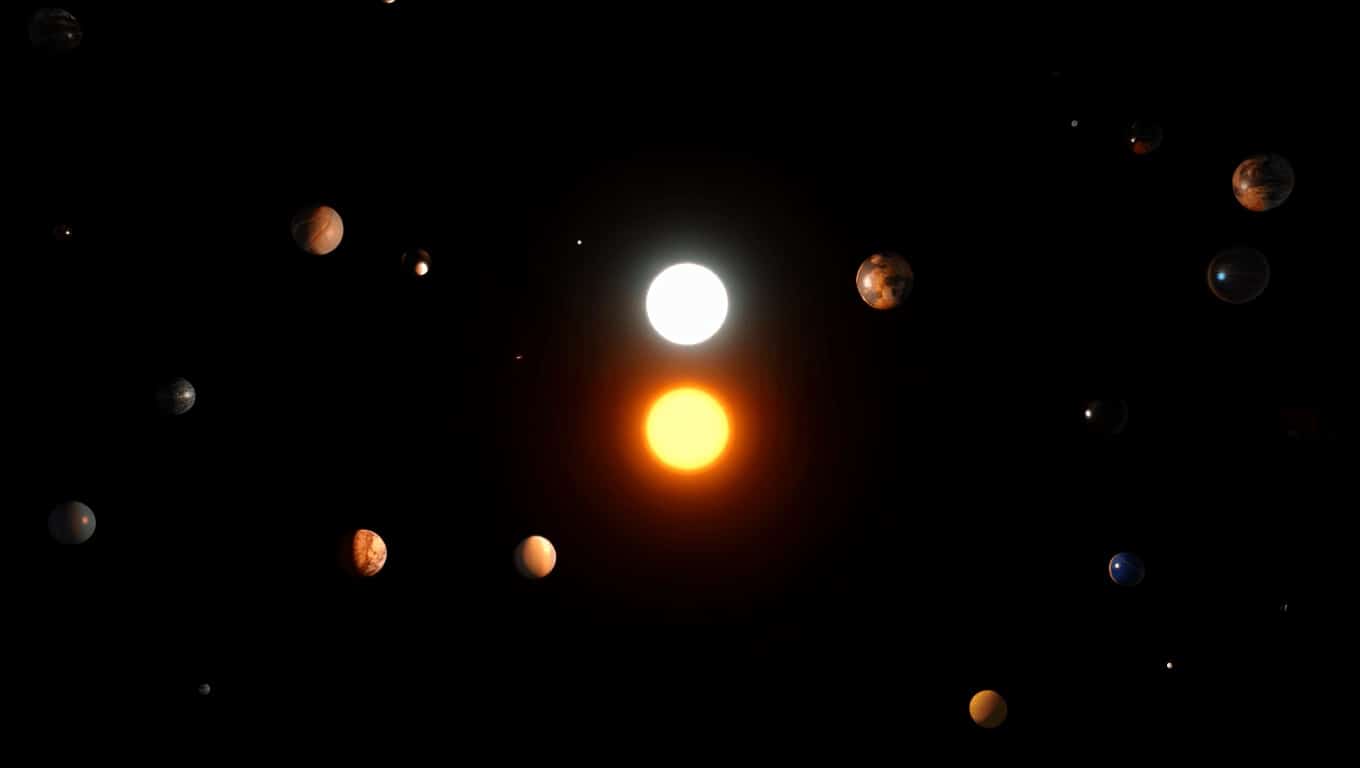
The idea of planets orbiting two suns jumped from fiction to front-page science this week: researchers say they’ve identified 27 candidate worlds circling binary stars, a finding that could reshape how astronomers search for and count exoplanets. If confirmed, these objects would dramatically increase the known population of circumbinary planets and offer new clues about planet formation around paired stars.
How the candidates were found
The team analyzed light curves from NASA’s Transiting Exoplanet Survey Satellite, but they did not rely on the usual transit dips that reveal single-star planets. Instead, they examined tiny variations in the timing of stellar eclipses — a technique known as eclipse timing or ETVs — looking for irregularities that a third body could produce.
Out of roughly 1,600 eclipsing binary systems scanned, 36 showed unexplained timing disturbances. Follow-up analysis flagged 27 of those as plausible planet-hosting systems. The candidate bodies would range roughly from the size of Neptune up to modestly larger than Jupiter; none are confirmed at this stage.
What this could mean for exoplanet science
So why does this matter now? Confirming even a portion of these candidates would more than double the catalog of known circumbinary planets, a rare class that has previously included fewer than 20 verified systems. By expanding that sample, astronomers can test models of how planets form and survive in the gravitationally complex environment around two stars.
Planet formation theories developed for single-star systems don’t always translate to binaries. Increased numbers of circumbinary systems would let researchers compare orbital architectures, migration histories, and the role of stellar mass ratios in shaping planetary systems.
- Dataset: TESS light curves covering ~1,600 eclipsing binaries.
- Candidates: 27 promising systems identified among 36 with timing anomalies.
- Estimated sizes: roughly Neptune-sized up to slightly larger than Jupiter.
- Publication: results reported in Monthly Notices of the Royal Astronomical Society.
- Next steps: spectroscopic follow-up, radial-velocity measurements, and targeted photometry to confirm planetary nature and rule out brown dwarfs or other causes.
The discovery underscores a broader lesson in exoplanet science: the method you use determines the planets you find. Conventional transit searches favor planets that cross a single star’s disk, which can miss worlds that influence a binary pair in subtler ways. ETV analysis opens a complementary window on systems that would otherwise remain hidden.
Habitability and the realities of twin-sun worlds
Popular culture often imagines twin-sun planets as idyllic desert worlds beneath two setting suns, but the physics paints a more complicated picture. Planets orbiting a binary face fluctuating radiation, variable tidal forces, and dynamical instabilities that can pump eccentricity and climatic extremes.
That said, a broader sample could reveal exceptions: configurations in which orbital stability and moderate irradiation create temperate zones. Determining whether any circumbinary planet occupies such a “sweet spot” will require careful characterization of orbital distances, atmospheres and energy input from both stars.
Practically, these candidates also matter for planning future observations. Confirmed circumbinary planets become priority targets for large telescopes and next-generation instruments aiming to measure atmospheres and search for biosignatures in a variety of stellar environments.
Where researchers go from here
Confirming the candidates will be a multi-step process: higher-precision photometry can check for transits; radial-velocity monitoring can detect gravitational tug on the stars; and detailed modeling can separate planetary signals from stellar activity or unseen stellar companions. Some systems may turn out to host brown dwarfs or low-mass stars rather than planets, which is itself informative about binary system dynamics.
For now, the result is a reminder that our inventory of nearby planetary systems remains incomplete. New methods and large-scale surveys continue to reveal unexpected architectures, and these 27 candidates — if validated — will expand the kinds of worlds astronomers must explain.
Regardless of whether any of these turns out to be an exact analog of well-known fictional worlds, the potential uptick in circumbinary detections will push scientists to refine theories about how planets form and survive when two suns dominate the sky.
Similar Posts
- Astronomers spot inverted planetary system: planet formation theories upended
- Sun unlikely to engulf Earth: new simulations calm doomsday fears
- Middle-earth, Westeros climate tested: study shows whether fantasy weather could exist
- Supernova Alert: Witness a Star Explode This Week—Find Out How!
- Jupiter Outshines All Stars This Weekend: Best Tips to Witness the Spectacle

Miles Harper focuses on optimizing your daily life. He shares practical strategies to improve your time management, well-being, and consumption habits, turning your routine into lasting success.