
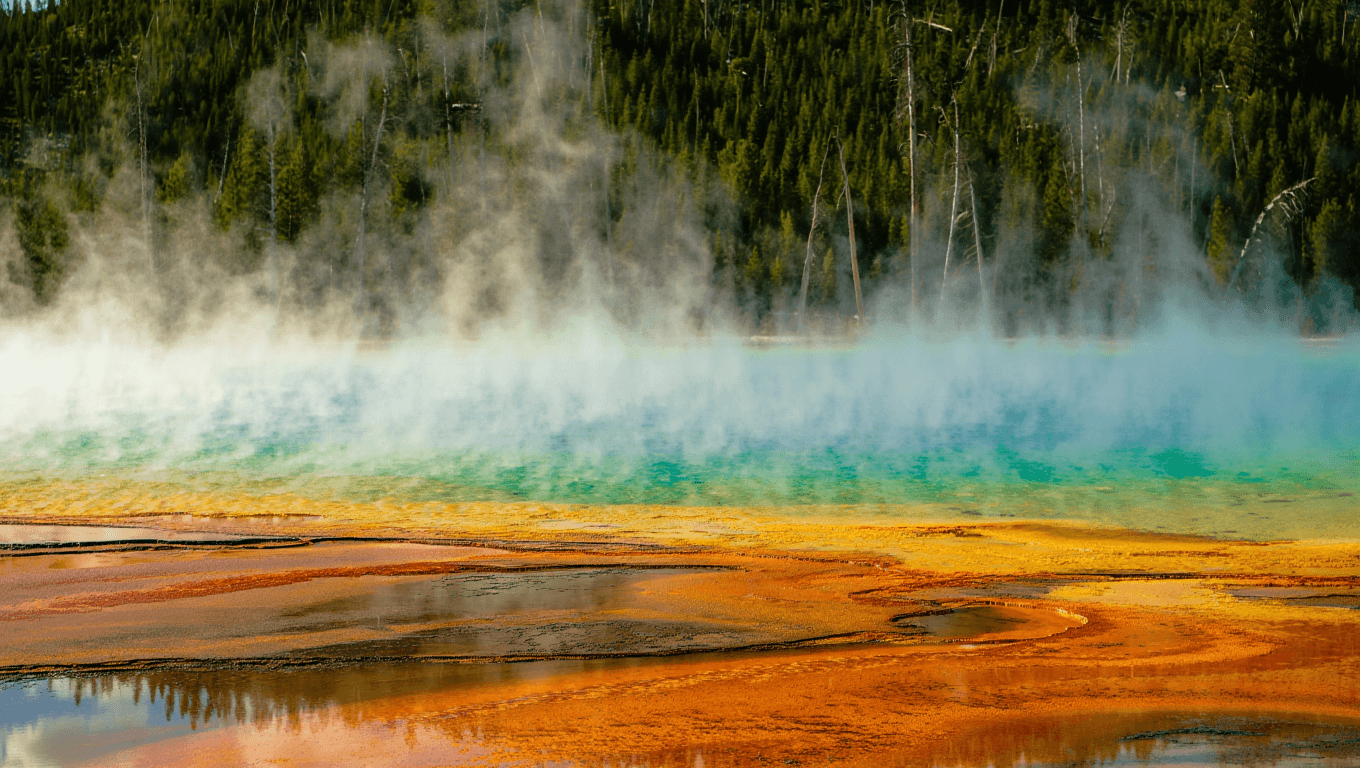
A new study in Science challenges the long-standing idea that Yellowstone’s heat comes from a single, deep plume rising from the planet’s interior. Researchers say the park’s thermal activity may instead be sustained by a network of shallow magma pathways fed and shaped by the Earth’s crust being pulled apart—an insight that changes how scientists think about heat flow under one of the world’s most scrutinized volcanic regions.
What the new research shows
Using a three-dimensional numerical model that includes the Yellowstone Caldera and the adjacent Eastern Snake River Plain, the team from the Chinese Academy of Sciences simulated how rock melts and where magma migrates beneath the surface. Their results point to melt generation in the upper mantle—within the asthenosphere—and lateral movement of that melt along cracks and shallow reservoirs created by ongoing tectonic extension.
That pattern contrasts with the simpler “vertical plume” picture in which a single column of hot material rises from great depth to feed the volcano. Instead, the model favors a diffuse, branching subsurface plumbing system that distributes heat across a broad area and helps power Yellowstone’s geysers, hot springs and fumaroles.
How scientists reached this conclusion
The team combined geological constraints with physics-based simulations of melting and magma transport. By varying the stress regime and physical properties of rock, the model reproduced features consistent with seismic and geodetic observations around Yellowstone—suggesting that shallow melt migration can explain surface heat and deformation without invoking a dominant deep-source plume.
In plain terms, the landscape’s thermal behavior may arise from many interconnected shallow pathways rather than one single deep source.
- Where melt forms: Model points to the upper mantle/asthenosphere rather than deep mantle roots.
- How melt moves: Lateral migration through faults and transient storage in crustal reservoirs.
- What it powers: Distributed heat that sustains geothermal features across the park.
- Model basis: 3D numerical simulation tied to observed seismic and surface-change data.
Why this matters now
Yellowstone is not just a national park—it’s one of roughly two dozen known supervolcanic systems on Earth, and its last major caldera-forming eruption occurred about 630,000 years ago. Understanding the source and pathways of subsurface heat changes how scientists interpret monitoring signals such as seismic swarms, ground uplift, and changes in hydrothermal output.
That matters for hazard assessment: a distributed, shallow system has different precursors and behavior than a single deep plume. The new model does not mean an eruption is imminent—researchers continue to emphasize that large-scale eruptions are rare and that current measurements show no signs of an approaching supereruption—but it does refine the physical scenarios that scientists should watch for.
Implications for monitoring and research
The study suggests several practical shifts for scientists and agencies tracking Yellowstone:
- Broader focus on shallow crustal processes and fault-controlled melt migration when interpreting seismic and geodetic data.
- Increased value of high-resolution imaging and local-scale experiments to map transient magma reservoirs.
- Reassessment of how changes in surface hydrothermal activity reflect subsurface redistribution of heat rather than only deeper magmatic pulses.
Ultimately, the work reframes Yellowstone’s subsurface architecture as more complex and interconnected than earlier plume-dominated models allowed. That complexity makes precise prediction challenging, but it also gives researchers more concrete features—shallow reservoirs, fault zones, and lateral channels—to monitor and study.
The new findings add a fresh layer to our understanding of one of Earth’s most closely watched volcanic systems, and they underscore why continued observation and improved imaging of shallow crustal processes are essential for long-term hazard assessment.
Similar Posts
- Utah earthquakes explained: researchers pinpoint cause after decades
- Massive 250-Mile Mystery Blob Targets New York City: What Is It?
- Bison Attack in Yellowstone: Florida Man Gored in Shocking Encounter!
- Venus lava tubes confirmed: scientists detect a massive underground tunnel
- Giant Deep-Sea Volcano Eruption Delayed Until 2026: Scientists Reveal

Miles Harper focuses on optimizing your daily life. He shares practical strategies to improve your time management, well-being, and consumption habits, turning your routine into lasting success.