
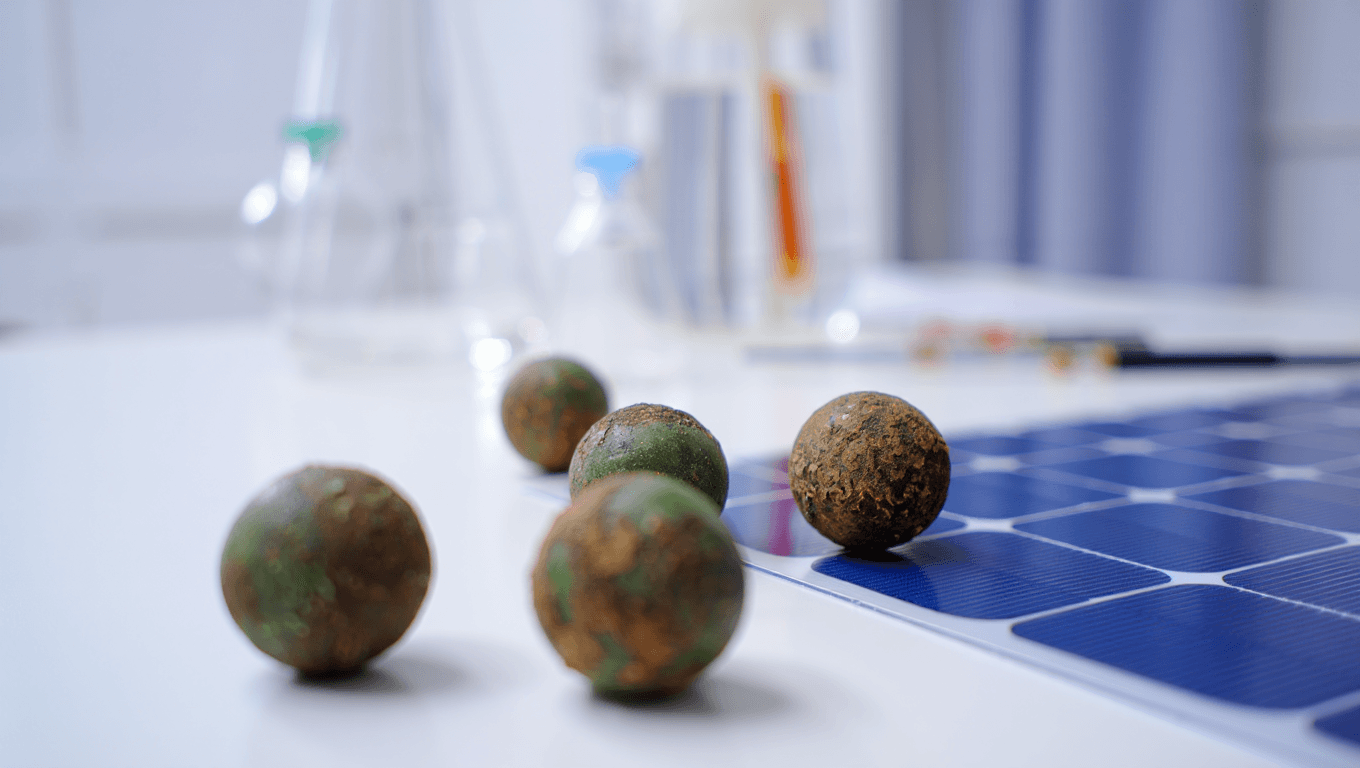
Centuries-old lead waste — even corroded musket balls recovered from the 16th and 17th centuries — could be repurposed to build next-generation solar cells, researchers report. A team at Germany’s Jülich Research Centre says contaminated lead can be converted into high-purity lead iodide, a critical ingredient for promising perovskite solar technology, potentially cutting the need for fresh mining and turning hazardous waste into power.
The development, described in a paper in Cell Reports Physical Science and summarized by Gizmodo, does not claim an immediate industrial breakthrough. But it does point to a practical recycling route that could reduce environmental harm and lower material costs for perovskite panels if scaled safely.
How the recycling process works — in plain terms
Rather than refining new lead from ore, the researchers start with recovered lead metal of widely varying quality. The contaminated material is reshaped into electrodes and immersed in a chemical bath. Applying an electric current drives a reaction that yields purified lead iodide crystals suitable for perovskite formation.
To demonstrate robustness, the team processed heavily corroded musket balls. That extreme test suggests the method could handle common industrial lead waste streams, not just clean scrap.
What the experiments produced
Solar cells built from the recycled lead reached roughly 21 percent conversion efficiency in the lab, according to the paper — below the record perovskite cells but close enough to be meaningful for further development. For context, top laboratory perovskite devices have approached the high 20s in percentage efficiency, while commercial silicon panels typically sit lower than the best lab results.
- Source material: Corroded historical musket balls and other contaminated lead.
- Key product: High-purity lead iodide used to grow perovskite layers.
- Demonstrated efficiency: About 21 percent in prototype cells.
- Primary benefit: Potential to reduce new lead mining and divert hazardous waste.
- Primary challenges: Scaling the process, ensuring safety and regulatory compliance, and matching top-end device performance.
Why this matters now
Perovskite solar cells are one of the most watched routes for cheaper, higher-efficiency photovoltaics. But the technology relies on lead compounds, raising environmental and regulatory concerns. Finding ways to source that lead from existing waste rather than fresh mining addresses both supply-chain and pollution questions.
Repurposing legacy lead would have several concrete implications: fewer mining emissions, reduced pressure on refining infrastructure, and the removal of toxic material from landfills and contaminated sites. That said, the approach must overcome safety hurdles to prevent lead exposure during recycling and manufacturing.
Policy and public-health frameworks will play a big role in determining whether this idea moves beyond the lab. Safe handling, emissions controls and end-of-life management for perovskite modules are essential to ensure recycled lead does not create new contamination pathways.
Where this fits in the energy transition
The study is a step toward integrating circular-economy thinking into emerging energy technologies. If further research confirms the method’s viability at scale, modular factories could take in industrial lead waste or legacy brass and bullet fragments and produce material for near-commercial perovskite panels.
But several stages remain: repeated demonstrations with larger batches, lifecycle analyses to quantify environmental gains, and pilot production runs designed to meet health and safety rules. Investors and regulators will need data on long-term stability, recycling losses, and any added costs for safe processing.
For now, the work from Jülich underscores a simple but powerful idea: material once used — even material that poses a hazard — can sometimes be reimagined as part of a cleaner energy future. Turning toxic legacy lead into components for solar cells won’t be effortless, but it could change the calculus on both resource use and pollution if the technical and regulatory pieces fall into place.
Similar Posts
- Green economy exceeds $10 trillion: now rivals the world’s third-largest industry
- Spain rare-earth mine could meet 33% of Europe’s demand: reshaping green geopolitics
- Rare earths: Sweden’s 2.2 million-ton Per Geijer find threatens China’s processing monopoly
- Victoria antimony boom: state now supplies 5% of world output
- Scientists Use Poop to Rescue Endangered Animals: Innovative Conservation Efforts Unveiled!

Miles Harper focuses on optimizing your daily life. He shares practical strategies to improve your time management, well-being, and consumption habits, turning your routine into lasting success.