
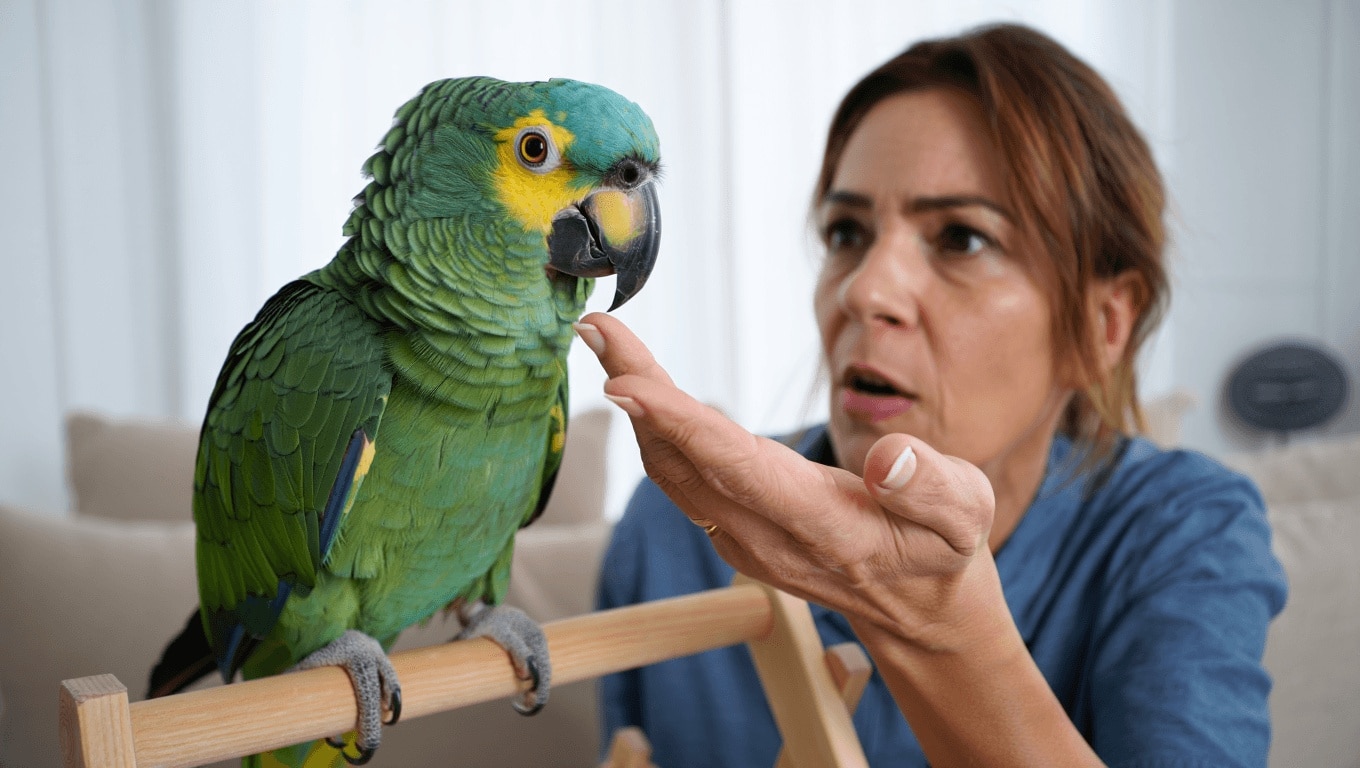
Recent research suggests parrots may do more than mimic human speech — they sometimes use labels the way we do. A survey of nearly 900 pet parrots indicates many birds attach specific sounds to particular individuals, a finding that could shift how scientists view avian communication and what pet owners expect from their feathered companions.
An international team published the results in PLOS ONE, collecting owner reports on dozens of parrot species. Rather than treating talking parrot videos as novelty, the study treats these vocalizations as potential elements of social naming: parrots calling particular humans, other birds, or even household pets by distinct, repeatable labels.
Not just parroting — signs of targeted labels
Observers reported that about half of the birds in the survey used consistent labels in ways that resemble names. Many birds appeared to direct these sounds to a single, identifiable individual, and some used them to seek attention or to acknowledge that person was absent.
- Sample size: nearly 900 companion parrots across dozens of species.
- Reported name use: roughly 47 percent of birds were said to use stable labels.
- Contexts: greeting, calling when someone is out of the room, and correcting human mistakes.
- Notable species: gray parrots most often associated labels consistently with individuals.
Not every case was the same. Some birds simply repeated phrases without apparent connection to people or situations, while others showed clear, repeated links between a particular sound and a particular individual.
What owners observed
Several anecdotes from the data illustrate the behavior: a bird reportedly corrected a caregiver who used the wrong name, while others used distinct calls to quiet household dogs or to summon specific people. Some parrots persisted in calling for absent family members, suggesting they recognize the person’s ongoing existence beyond the immediate environment.
These behaviors are compelling because parrots can reproduce humanlike sounds with remarkable fidelity. That vocal flexibility gives them the raw material for creating stable, individual-directed labels in ways animals that lack human-speech mimicry cannot.
How this fits with other species
Researchers relate the findings to naming-like signals in other animals. Dolphins use signature whistles, and some primates and elephants produce individualized calls. Parrots are distinct, however, because of their ability to copy portions of human language and embed those borrowings into social use.
Why the research matters
The study matters for several reasons: it advances understanding of animal cognition, it reframes common assumptions about “talking” pets, and it raises practical questions for owners and researchers about communication and welfare. If parrots attach stable labels to people or animals, those labels can shape social interactions in the household and influence how caregivers respond.
Scientists also see parallels with early stages of human language development. Some parrots reportedly use their own names to attract attention before demonstrating pronoun-like behavior, a pattern that mirrors how toddlers initially refer to themselves.
Although these findings do not prove parrots grasp the full concept of a name—its grammar and social complexities—they do indicate a surprising level of social awareness. The study nudges open a door to how nonhuman animals form and use consistent vocal labels, and it invites follow-up work using controlled observation and acoustic analysis to verify owners’ reports.
For now, the takeaways are practical and intellectual: pet owners may be listening to more than mimicry, and researchers have another promising avenue to explore in the study of language-like behavior beyond humans.
Similar Posts
- Hummingbirds guzzle fermented nectar: study tests whether they become intoxicated
- Amazon animals tap a natural wireless network to communicate: what researchers uncovered
- Disabled parrot takes over circus: rescued bird now leads the troupe
- Scientists Use Poop to Rescue Endangered Animals: Innovative Conservation Efforts Unveiled!
- Dog owners’ odd habits sparking neighbor complaints: what it means for you

Miles Harper focuses on optimizing your daily life. He shares practical strategies to improve your time management, well-being, and consumption habits, turning your routine into lasting success.