
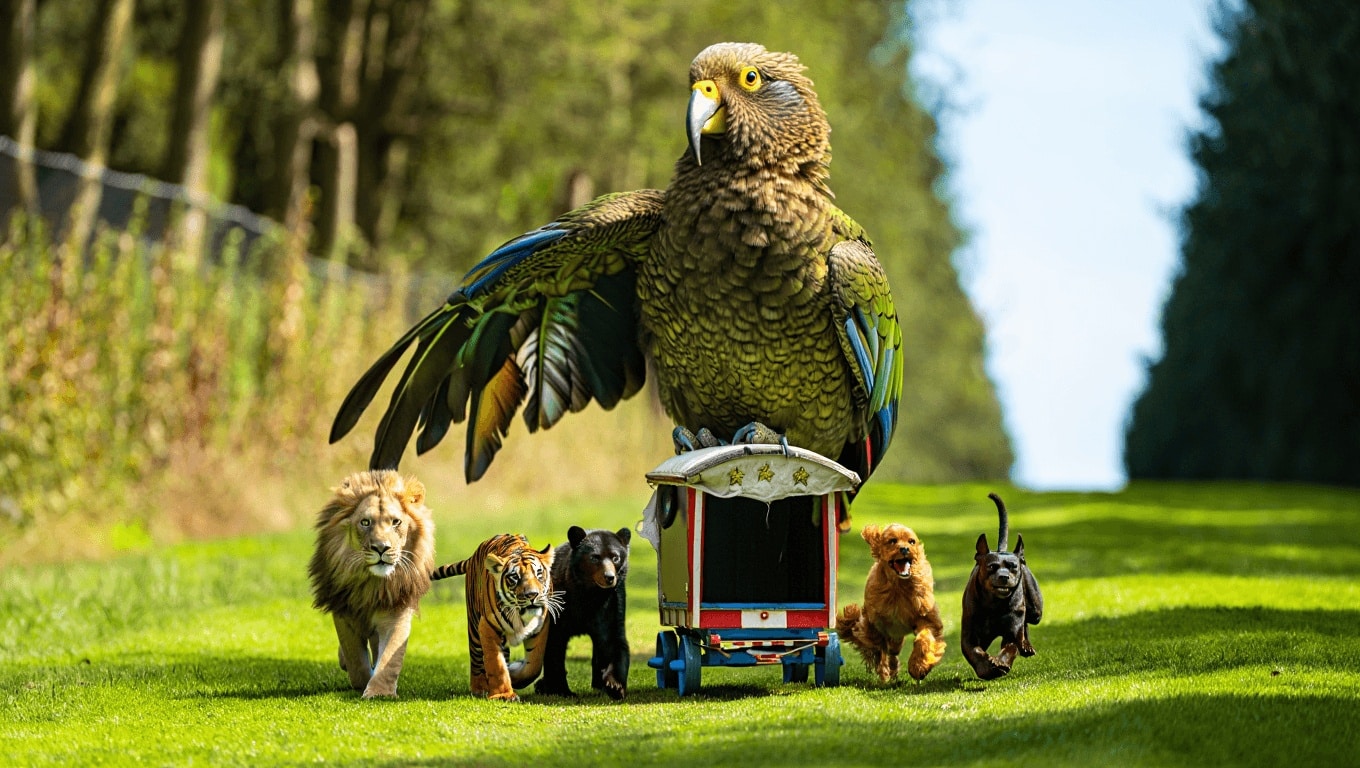
A recent study in Current Biology sheds new light on how one disabled kea parrot reinvented the rules of social combat and rose to the top of his flock. At Willowbank Wildlife Reserve in New Zealand, a bird known as Bruce uses an improvised fighting style and surprising problem-solving skills to dominate his peers — offering fresh evidence of animal resilience and social intelligence.
Keas, the alpine parrots native to New Zealand, gather in loose social groups researchers call a “circus.” That playful label belies complex social hierarchies where access to food, mates and grooming is competitive and meaningful.
Bruce lacks his entire upper beak — a severe handicap for a species that typically bites rivals around the neck to assert rank. Rather than withdrawing, he developed a different tactic: charging forward to strike opponents with his lower beak and following up with kicks and aerial moves. Researchers describe the approach as a kind of bird-to-bird “jousting.”
The results are striking. Observations recorded at Willowbank indicate Bruce rarely, if ever, loses confrontations. His physiology backs up the behavior: measured stress indicators place him below other males in the group, a biological signature commonly associated with dominant status.
- Unconventional combat: Bruce substitutes a lower-beak charge plus kicking for the usual bite-and-hold technique.
- Low stress markers: Hormone readings suggest he experiences less physiological stress than his peers.
- Social rewards: High rank brings priority food access and grooming from other keas.
- Tool use: Researchers previously reported Bruce using pebbles to preen — a compensatory behavior not seen in his flockmates.
That pebble-using behavior appears to be independently developed and tailored to his particular disability, reinforcing the idea that keas are inventive problem-solvers. Tool use plus an adapted fighting style indicate Bruce isn’t just coping; he’s optimizing his social position around his limitations.
What this means beyond one bird
These findings matter to anyone studying animal cognition, conservation, or captive-animal welfare. They demonstrate that disability does not necessarily preclude leadership or social success in wild and semi-wild populations. For caretakers and conservationists, recognizing such behavioral flexibility can inform enclosure design, enrichment programs and social grouping decisions.
At a broader level, Bruce’s case adds to growing evidence that parrots — and other birds long dismissed as instinct-bound — can rapidly invent context-specific strategies. That matters for how scientists interpret interactions seen in the field and how rehabilitators assess the potential of injured animals to reintegrate into social groups.
Researchers emphasize caution: Bruce’s story is compelling but not definitive. It documents a single, well-observed individual and raises questions about how common such adaptations are across kea populations and other species. Follow-up studies comparing multiple groups and environments would help determine whether Bruce is exceptional or illustrative of a larger pattern.
For now, the parrot at Willowbank offers a clear, modern example of adaptability: a bird turned apparent disadvantage into a social advantage, reshaping expectations about disability and agency in animal communities.
Similar Posts
- Parrots learn your name: scientists warn they’ll use it to demand attention
- Cows may recognize human faces: research could make summer grilling awkward
- Oldest animal status challenged by new study: iconic fossils may not be animals
- Get $78.60 Weekly in 2025: Key Dates for NZ Disability Payments Unveiled!
- Lobsters zapped by researchers to develop more humane slaughter methods

Miles Harper focuses on optimizing your daily life. He shares practical strategies to improve your time management, well-being, and consumption habits, turning your routine into lasting success.