
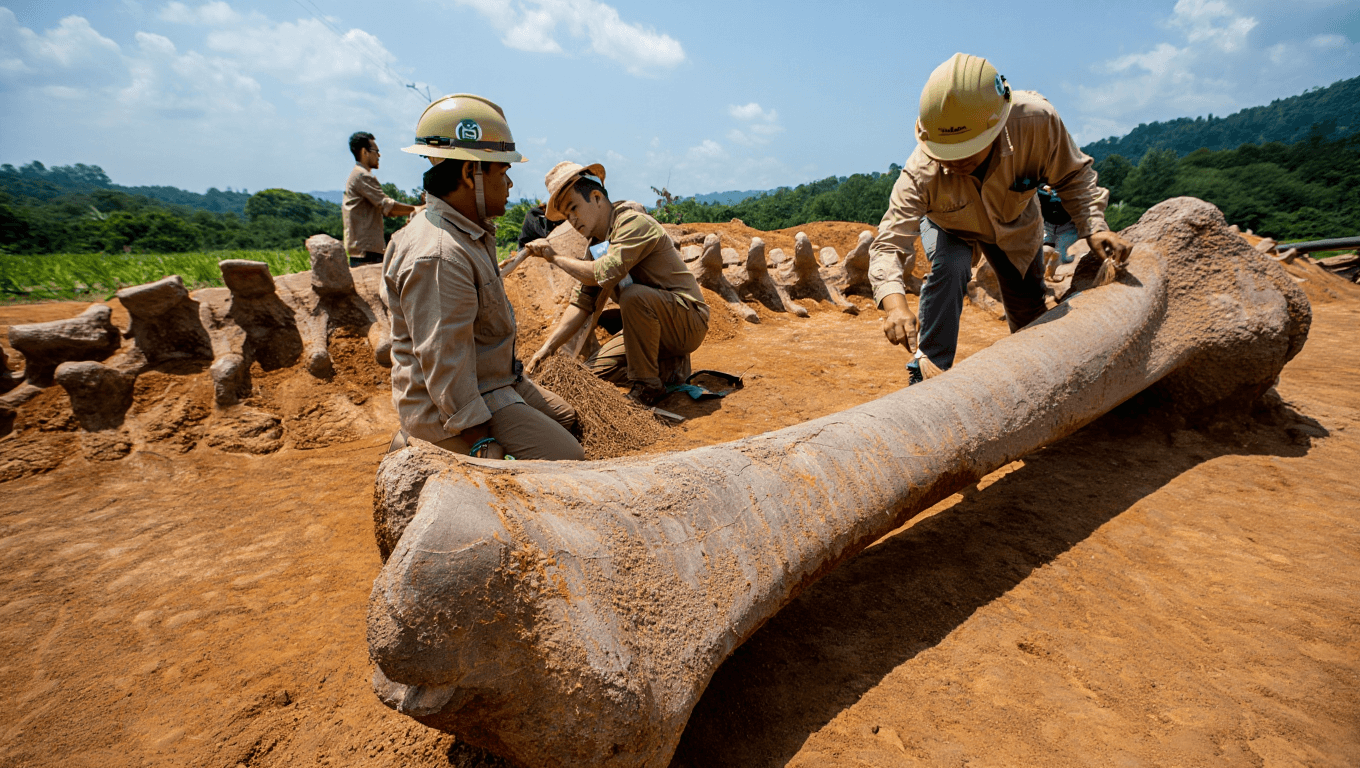
A newly described giant sauropod from Thailand could be the largest dinosaur yet identified in Southeast Asia, according to a paper published this week in Scientific Reports. The find reshapes how scientists think about regional dinosaur size and provides a rare window into an ecosystem that vanished beneath a shallow sea more than 100 million years ago.
Scientists named the species Nagatitan chaiyaphumensis, after combining a local mythic creature with a nod to the animal’s enormous scale. The team estimates the animal measured nearly 90 feet long and weighed roughly 30 tons — dimensions comparable to multiple adult elephants bundled together into a single herbivore.
The bones were first spotted almost a decade ago in Chaiyaphum province by a local resident, but formal excavation stalled when funding ran out. Work resumed in 2024, and subsequent digs turned up vertebrae, pelvic fragments, ribs and limb bones. One forelimb element alone approaches six feet in length, allowing researchers to generate a conservative size estimate.
Published illustrations accompanying the study portray the sauropod as a long-necked, heavy-set grazer. Researchers say the specimen links Southeast Asian titanosaur relatives with the supersized sauropods that later appeared in South America and East Asia, suggesting a stepwise increase in body size in different continental lineages.
Why this matters now: the discovery fills an important geographic gap in the fossil record and strengthens evidence that extremely large sauropods evolved repeatedly in separate regions. It also highlights the importance of local discoveries and sustained funding for excavation and analysis.
- Species: Nagatitan chaiyaphumensis
- Estimated length: ~90 feet (about 27 meters)
- Estimated mass: ~30 tons
- Age: Early Cretaceous, roughly 100–120 million years ago
- Location of discovery: Chaiyaphum province, Thailand
- Key remains found: vertebrae, pelvis, ribs, limb bones (one forelimb bone ~6 feet)
- Published in: Scientific Reports (2026)
Lead researcher Thitiwoot Sethapanichsakul, a Ph.D. student at University College London, says the geological layer that yielded the bones may represent some of the youngest dinosaur-bearing deposits in Thailand. If so, the specimen helps fill a late chapter in the country’s Mesozoic record before rising seas erased that terrestrial landscape.
The discovery also underscores practical challenges in paleontology: local finds often depend on intermittent funding and volunteer time. In this case, renewed support in 2024 proved decisive, allowing teams to extract sufficient material to identify a new species.
Going forward, researchers plan more detailed anatomical studies and comparisons with large titanosaurs elsewhere. Those analyses will test where the Thai sauropod fits on the family tree and how its growth and body plan compare with the more famous giants of South America and China.
For now, Nagatitan adds a new heavyweight to Southeast Asia’s fossil record and offers fresh evidence that periods of dramatic body-size increase occurred across multiple continents — a pattern that reshaped dinosaur ecosystems long before the region was submerged beneath a shallow sea.
Similar Posts
- Dinosaur Mating Battles Unlock Gender Secrets: Discover How!
- Scientists Discover Youngest Mammoth Bones Ever: They Turned Out to Be Whales!
- Giant Anaconda Fossils Unearthed: See What These Monsters Looked Like 12 Million Years Ago!
- Mysterious Jellyfish Wall Discovered in Deep Sea: Experts Baffled!
- Rarest mineral confirmed: a single 0.011 oz specimen reveals gaps in Earth’s catalog

Miles Harper focuses on optimizing your daily life. He shares practical strategies to improve your time management, well-being, and consumption habits, turning your routine into lasting success.