
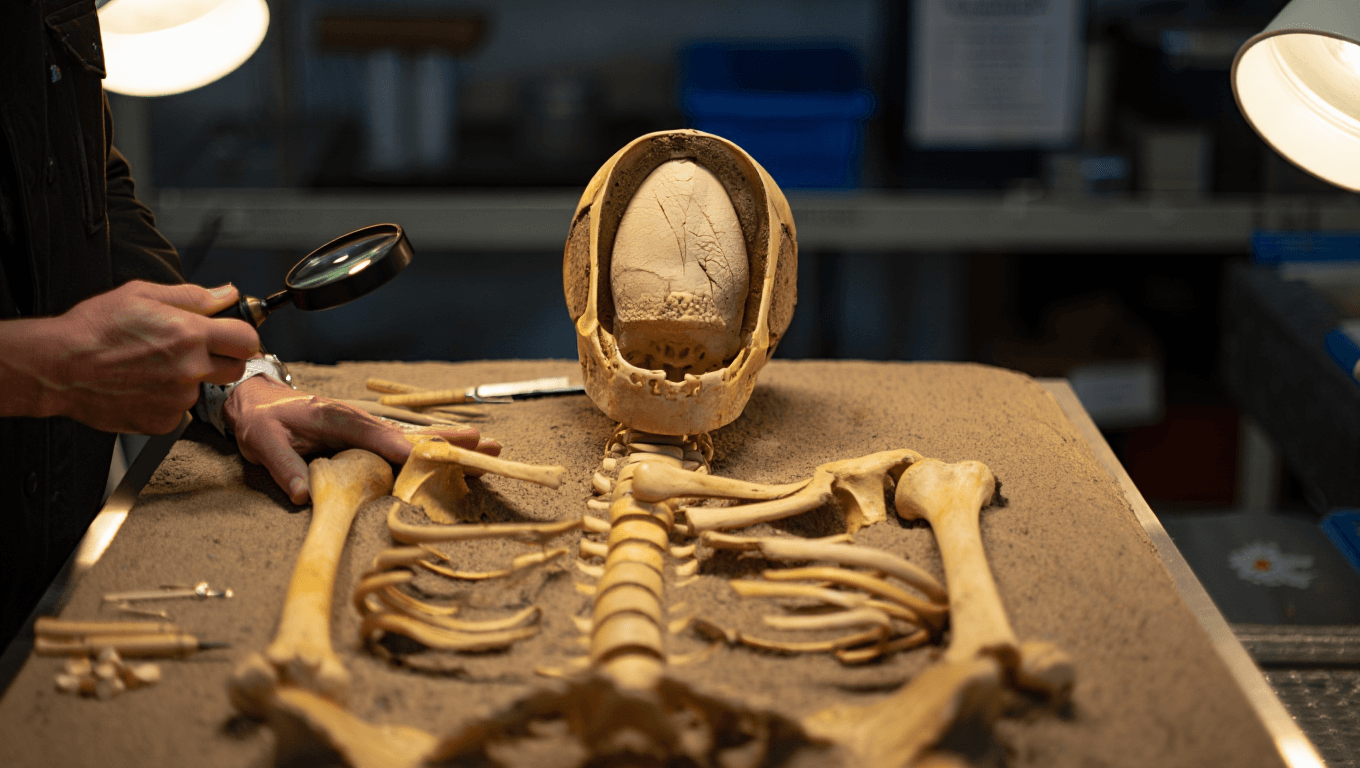
A fresh analysis of bones excavated nearly two decades ago in northern Scotland has revealed a startling Iron Age mortuary practice: the deliberate removal of the brain and the reshaping of bones before careful reassembly and burial. The study, published this month in Antiquity, offers new evidence that ancient communities performed complex funerary procedures that blend ritual intent with technical skill.
The remains were first recovered near Loch Borralie in 1998, beneath a stone cairn that contained the skeletons of an adult woman and a teenage boy. Radiocarbon dating places both individuals at roughly 2,000 years old, in the later Iron Age. For years the pair rested in museum collections as routine finds; only now, with modern laboratory methods, have their bones started to tell a more detailed story.
Researchers applied a suite of contemporary approaches — including ancient DNA sequencing, isotope analysis and microscopic forensic examination — to reassess the skeletons. Those techniques exposed patterns that were invisible to earlier investigators and reframed how the burials should be interpreted.
The most striking results center on the woman’s remains. Her skull shows concentrated scrape marks and damage toward the base, consistent with deliberate access to the cranial cavity after death. Investigators conclude the pattern is most compatible with purposeful brain removal, an intervention that may have been part of a ritual practice or an effort to preserve the skull.
Four long bones from the same individual were also modified: several shafts were intentionally fractured or refashioned, with working traces that suggest they were shaped into implements or symbolic objects. Crucially, those altered elements were later returned to their anatomical positions before burial — evidence of meticulous reconstruction rather than casual disposal.
That reassembly changes how the sequence is read. The bones were not scattered or tossed aside; they were repositioned with care, implying the procedures were integrated into the burial ritual itself.
- Location: Loch Borralie, northern Scotland (excavated 1998)
- Period: Iron Age, ~2,000 years ago
- Main findings: postmortem cranial access, removal of brain tissue; long bones intentionally broken and sharpened; bones returned to anatomical positions
- Associated individual: teenage boy buried nearby showed no signs of modification
- Biological link: DNA indicates they were likely maternal second cousins, pointing to kinship ties within a wider coastal network
The teenage boy’s skeleton lacks the kinds of alterations seen on the woman. Ancient DNA recovered from both burials suggests a familial connection, probably through the maternal line, and isotope signatures indicate lifeways tied to coastal regions — supportive of broader social networks that linked communities across mainland Scotland and the Orkneys.
Why this matters now: the findings expand what archaeologists understand about Iron Age mortuary behavior in Britain. Rather than treating postmortem mutilation as straightforward desecration, the evidence here reveals a deliberate, technically skilled set of practices that combined bodily modification with ceremonial care.
These discoveries also have methodological implications. They show how reexamining museum collections with modern biomolecular and forensic tools can overturn older assumptions and reveal previously hidden cultural behaviors. Similar reanalyses elsewhere may expose other overlooked rituals.
Researchers are cautious about interpreting intent where direct evidence is limited. The study presents strong material indicators but stops short of claiming a single, universal explanation for the actions. Instead, it frames the Loch Borralie burials as a localized ritual expression that likely reflected regional beliefs and social ties.
Future work will aim to place these burials in a wider archaeological context by comparing them with contemporaneous sites and looking for patterns of postmortem treatment across the region. For now, the Loch Borralie case underscores how even well-studied collections can yield unexpected insights when examined with new techniques and fresh questions.
Similar Posts
- War elephants unearthed in Spain: bones tied to 2,200-year-old conflict
- Ancient humans habitually sucked nuts 25,000 years ago: dental evidence
- Scientists Discover Youngest Mammoth Bones Ever: They Turned Out to Be Whales!
- Ancient Skulls Reveal Iron Age Rituals: Mysterious Nailed-Head Ceremonies Uncovered!
- Medieval skeleton unearthed with mysterious object clamped in jaw

Miles Harper focuses on optimizing your daily life. He shares practical strategies to improve your time management, well-being, and consumption habits, turning your routine into lasting success.