
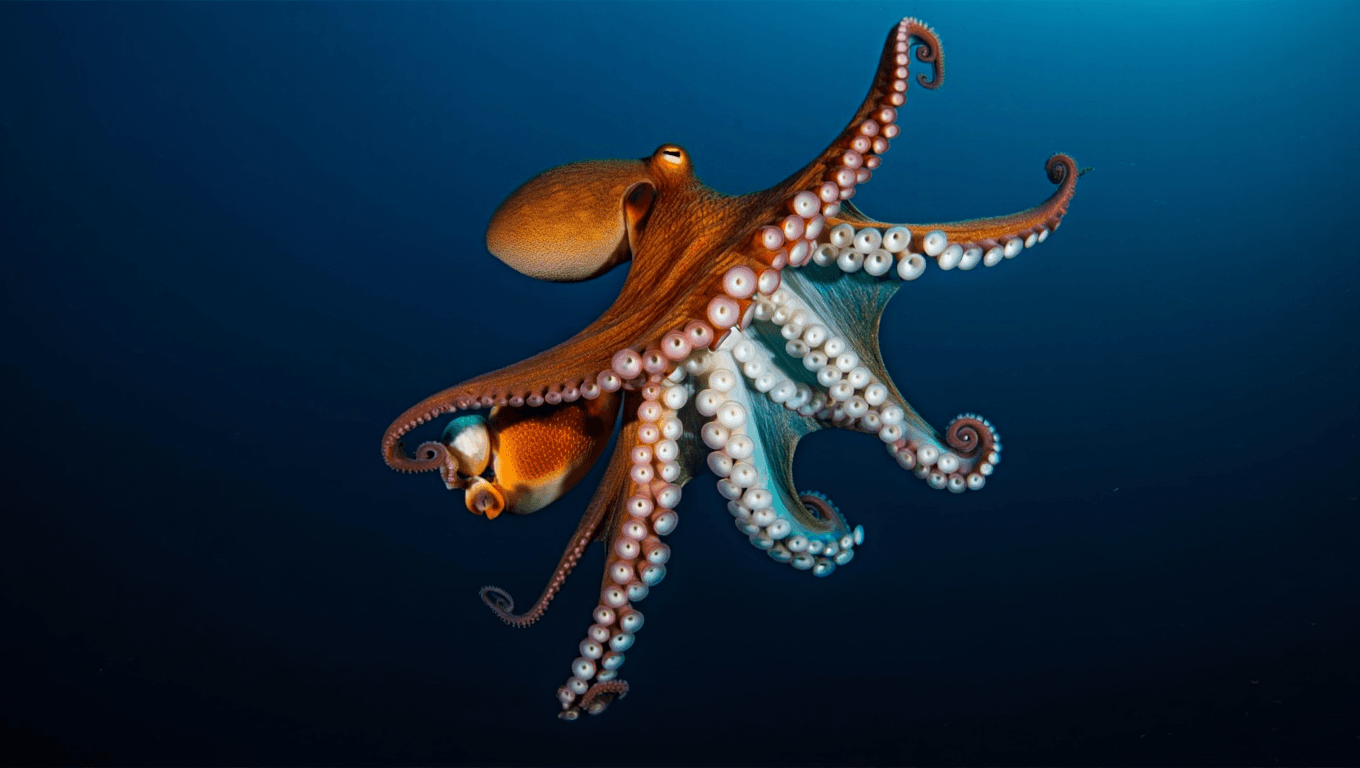
A new study in Science reveals male octopuses can find and mate with females without seeing them, using chemical sensors built into their arms. The discovery sheds fresh light on how these solitary cephalopods coordinate reproduction and highlights an uncommon form of distributed sensing that matters for understanding animal behavior and nervous-system evolution.
The research focused on how males locate a female’s reproductive cavity and transfer sperm with a specialized arm. What began as a question about mating mechanics turned into evidence that octopus limbs are both motor and sensory organs, able to detect specific chemical cues at close range.
What the experiments showed
In controlled trials, male and female octopuses were kept apart by partitions that blocked sight and most contact. Despite these barriers, males repeatedly extended a single arm through small openings, probed the space where the female’s mantle cavity would be, and completed sperm transfer.
When researchers replaced the female with a simple tube coated in the hormone progesterone, males behaved nearly the same way—approaching and attempting to mate with the progesterone-treated object. That response indicates the arm is detecting chemical signals and using them to guide mating behavior.
More than a delivery tool
The mating arm—called the hectocotylus—was long assumed to be primarily a sperm-delivery device. This study shows it also acts as a local chemosensory organ. Octopus arms host thousands of highly sensitive receptor cells and a large fraction of the animal’s neurons, so they can process information independently of the central brain.
When a male’s hectocotylus was severed during experiments, the detached limb continued to reach for the progesterone source, demonstrating a strong, locally generated motor response tied to chemical detection. The behavior highlights how much processing occurs peripherally in cephalopod limbs.
- Chemical guidance: Males use chemical cues, not sight, to locate the female’s reproductive opening.
- Dual function: The hectocotylus transfers sperm and senses hormones simultaneously.
- Distributed processing: Many neurons are embedded in the arms, enabling local decision-making and reflexes.
- Experimental proof: Progesterone-coated decoys elicited mating attempts comparable to those with real females.
- Evolutionary logic: The system supports quick, low-contact mating in a species that favors solitude.
These findings refine our picture of octopus biology: their limbs are not merely extensions controlled from a central brain but active, semi-autonomous processors. That arrangement likely evolved to support rapid, low-risk interactions—important for an animal that generally avoids conspecific contact.
Beyond natural history, the results have broader relevance. They inform how scientists think about decentralized nervous systems and sensory-motor integration, with potential lessons for soft robotics and bioinspired sensors that need to operate without centralized control.
While the study adds concrete detail about reproductive behavior, it also raises new questions about how chemical signaling and local neural circuits interact across other cephalopod behaviors. Future work may map the receptor types in the arms and explore whether similar peripheral processing exists in other species.
Similar Posts
- Animal reproduction: 9 species with shocking breeding tactics
- Dinosaur Mating Battles Unlock Gender Secrets: Discover How!
- Fish reproduces asexually without genetic flaws: study upends cloning concerns
- Oldest octopus record overturned: specimen isn’t an octopus
- Y Chromosome Vanishing: What Does This Shocking Revelation Mean for Us?

Miles Harper focuses on optimizing your daily life. He shares practical strategies to improve your time management, well-being, and consumption habits, turning your routine into lasting success.