
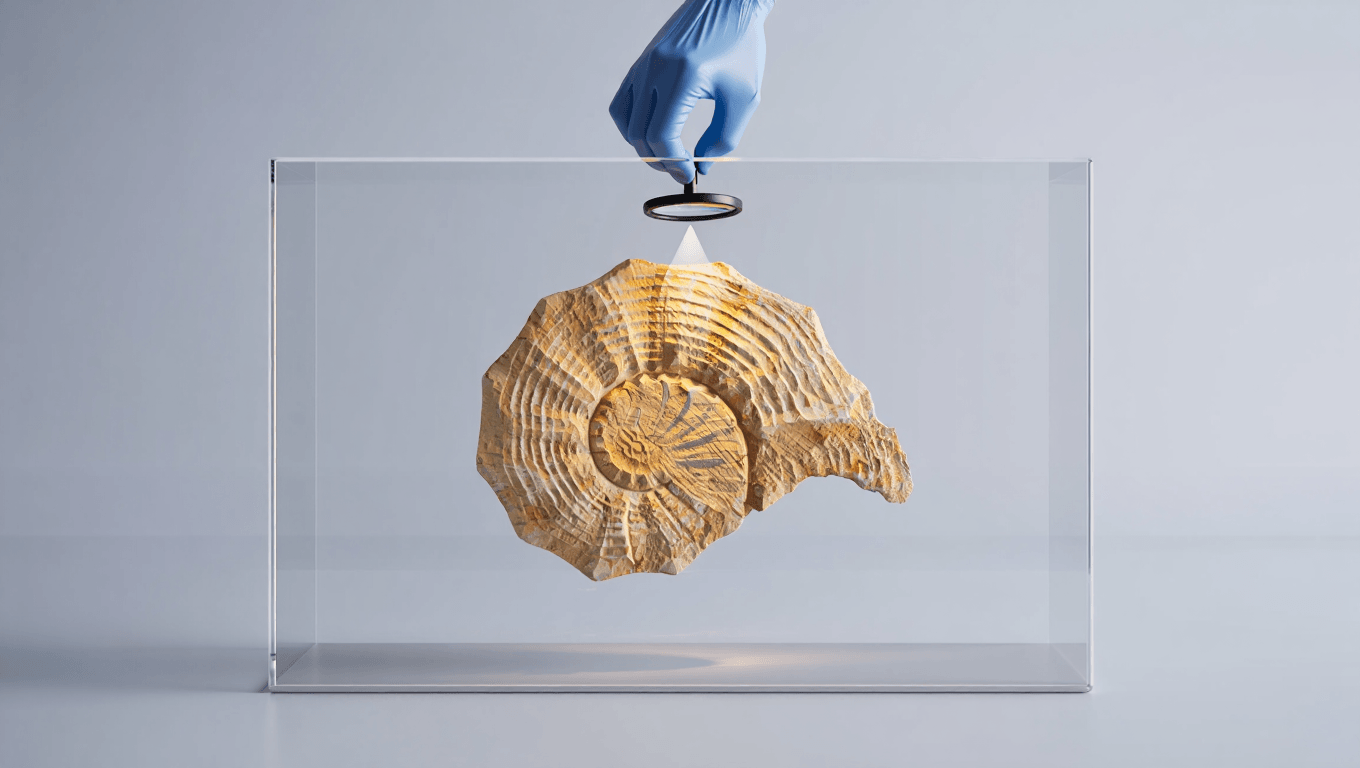
For a quarter-century, a flattened fossil from Illinois carried the title of the planet’s oldest octopus. A new paper in Proceedings of the Royal Society B now shows that the specimen is not an octopus at all but a shelled relative of modern nautiluses—a correction that changes how scientists date early cephalopod evolution.
The fossil, discovered in the Mazon Creek lagerstätte in 2000, arrived at the lab already badly decomposed. Early researchers interpreted features that looked like eight arms, two eyes and an ink sac and concluded it was a primitive octopus. That conclusion held sway for years, appearing in textbooks and lists of remarkable fossils.
Small teeth, big difference
New imaging tools provided a closer look. Using synchrotron imaging—an X-ray method far brighter than conventional scans—researchers from the University of Reading detected a series of tiny tooth-like structures inside the animal. These are part of a ribbon-like feeding organ called the radula, which varies in tooth number and shape across mollusks.
The configuration didn’t match octopuses. Instead, the radula’s form and composition aligned with known nautiloid fossils from the same site, meaning the specimen is best interpreted as a nautiloid, not a distinct octopus species.
- Octopuses: typically 7 or 9 elements per radula row
- Nautiloids: often 13 elements
- Pohlsepia specimen: 11 elements, morphology closer to nautiloids
That middle count—11—was the crucial clue. Combined with the absence of preserved ink pigments and a match to the radula of the known nautiloid Paleocadmus pohli, the evidence points to a misidentified, decomposed nautiloid rather than a new octopus.
Lead author Thomas Clements and colleagues emphasize that decay can dramatically alter soft anatomy. In their words, the specimen’s rotting before burial is what made it resemble an octopus, not genuine octopod anatomy.
The correction has two clear consequences for the fossil record. First, documented nautiloid soft-tissue preservation now extends farther back in time than researchers previously realized. Second, the earliest confirmed octopus fossils are pushed forward by roughly 150 million years, narrowing the window for when true octopuses first appeared.
This case is a reminder of how technological advances reshape paleontology. The team that described the fossil in 2000 worked with the best available methods then; the team publishing now used higher-resolution imaging that can reveal microscopic structures previously invisible.
For readers, the takeaway is straightforward: scientific reputations—even a celebrated fossil—can change with new evidence, and modern imaging continues to rewrite deep-time biological histories. As tools improve, paleontology is likely to revise other long-standing identifications, refining our picture of early animal evolution.
Similar Posts
- Oldest animal status challenged by new study: iconic fossils may not be animals
- Shark fossils in Arkansas turn the state into a skeleton hotspot
- Giant Anaconda Fossils Unearthed: See What These Monsters Looked Like 12 Million Years Ago!
- Octopus mating: males risk death with extreme reproductive tactics
- Scientists Discover Youngest Mammoth Bones Ever: They Turned Out to Be Whales!

Miles Harper focuses on optimizing your daily life. He shares practical strategies to improve your time management, well-being, and consumption habits, turning your routine into lasting success.