
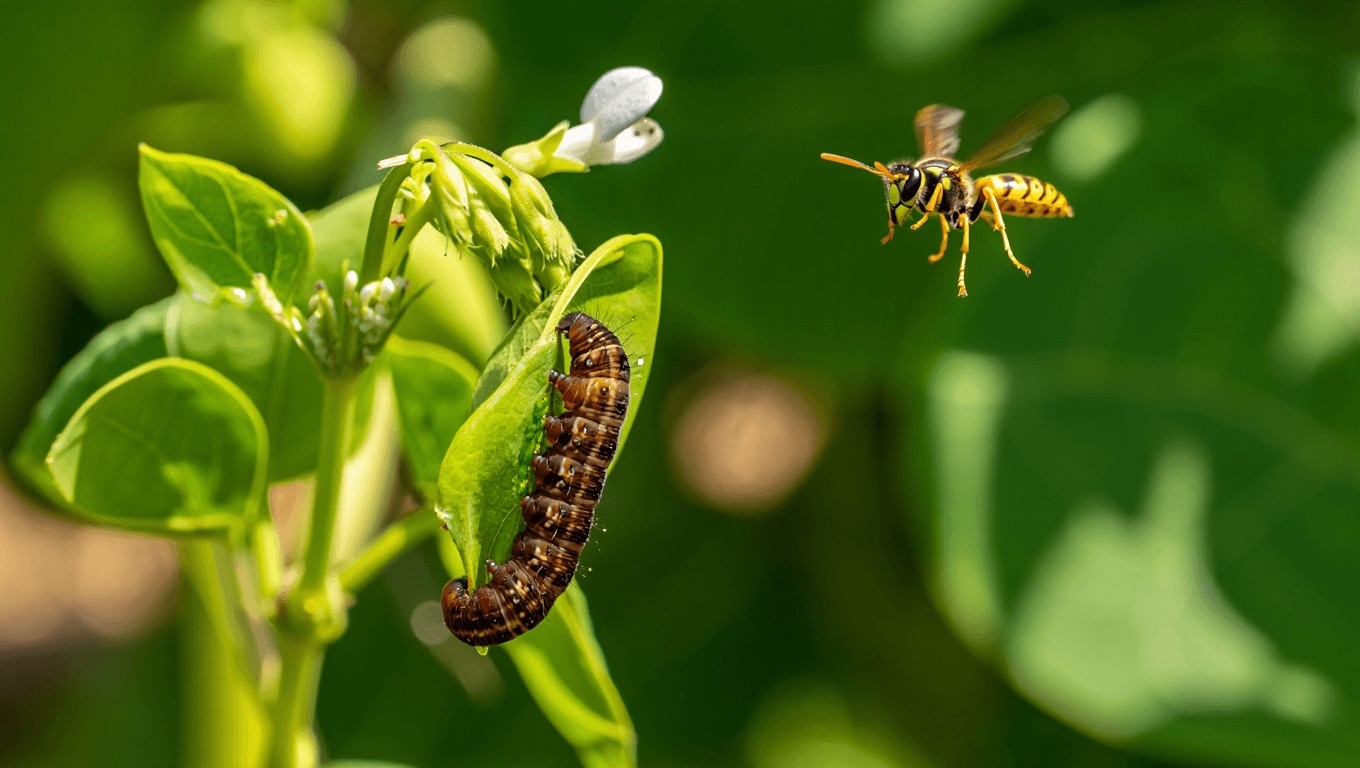
A new study reveals that common bean plants don’t just sit and take caterpillar bites — they send out an audible-to-wasps SOS. Scientists reporting in Science Advances show beans detect insect chewing and emit airborne cues that lure predatory wasps to attack the herbivores, a discovery with clear implications for cutting pesticide use in the field.
How the plant recognizes an attack
Field and laboratory work in Oaxaca, Mexico, traces the defense to a protein on the surface of bean cells known as the inceptin receptor. When caterpillars feed, molecules from the insect’s mouthparts land on wounded tissue. The receptor recognizes a specific peptide in that material — a chemical fingerprint that signals “this damage was caused by an herbivore.”
Once activated, the plant responds by releasing a blend of volatile chemicals. Those airborne compounds act like a dinner bell for insects that prey on caterpillars, drawing them to the damaged plant where they reduce the caterpillar population.
Evidence from the field and the lab
To test the system, researchers compared normal beans with genetically altered plants that lack the receptor. The difference was measurable: plants missing the receptor attracted about 40 percent fewer predatory wasps, and caterpillars feeding on those plants grew roughly 73 percent larger because they faced less predation pressure.
Crucially, these results were consistent across controlled experiments and real-world crop plots observed over multiple growing seasons, underlining that the mechanism works beyond the lab bench.
- Recognition: The inceptin receptor detects a peptide in caterpillar saliva, distinguishing herbivore damage from other injury.
- Signal: Damaged plants emit specific volatile signals that attract parasitic and predatory wasps.
- Impact: Loss of the receptor reduces wasp visits by ~40% and allows caterpillars to grow ~73% larger.
- Relevance: Observations held up in both laboratory experiments and multi-season field trials in Oaxaca.
From an agricultural perspective, the finding points to an alternative pest-control strategy: strengthening or restoring a plant’s own signaling network so natural enemies handle herbivores, rather than relying primarily on chemical insecticides.
That said, applying this knowledge at scale will require careful work. Breeding or engineering crops to enhance these signals could reduce pesticide use, but researchers will need to evaluate off-target ecological effects, the consistency of wasp populations in different regions, and how such traits interact with other pest management practices.
For now, the discovery adds to a growing body of evidence that plants actively recruit help when threatened — and that harnessing those ecological partnerships may offer more sustainable options for farmers in the years ahead.
Similar Posts
- Queen bumblebees resist drowning better than other bees, new study shows
- Karnataka village yields 14 gold coins: soil hints at bigger archaeological find
- Octopus mating: males risk death with extreme reproductive tactics
- Spot a Fake Smile: Uncover the Secrets with These Simple Tips!
- Mysterious Ancient Sea Bug: Did It Inspire Every Spider on Earth?

Miles Harper focuses on optimizing your daily life. He shares practical strategies to improve your time management, well-being, and consumption habits, turning your routine into lasting success.