
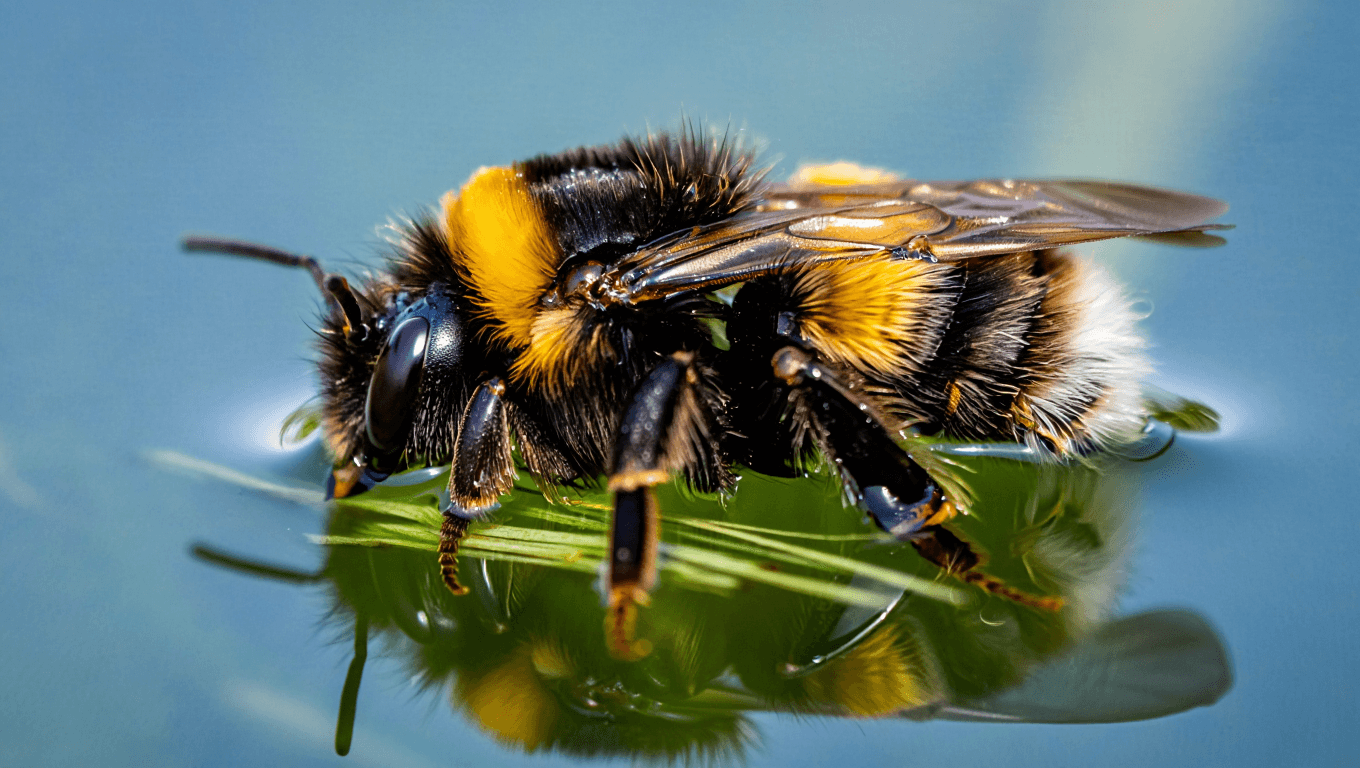
As heavy rains and melting snow increasingly flood ground nests, a new study finds queen bumblebees can survive being fully submerged for nearly a week — and they continue to respire while underwater. That ability helps explain how some colonies persist through winter extremes and raises fresh questions about insect survival in a changing climate.
Researchers at the University of Guelph stumbled on the discovery while investigating pesticide effects on overwintering queens. A lab setup meant to mimic winter conditions became flooded by condensation, leaving several queens completely submerged in soil-filled tubes.
Instead of perishing, the submerged queens recovered. Follow-up tests with more than 100 queens of the common eastern bumblebee, Bombus impatiens, showed many could remain underwater for about seven days and regain normal activity afterward.
What the measurements revealed
In controlled chambers, scientists tracked oxygen uptake and carbon dioxide output. The queens were not simply holding their breath: sensors recorded ongoing gas exchange, although at dramatically lower rates than a non-hibernating insect.
That drop in metabolic activity reflects diapause, the extended hibernation-like state queens enter after mating. During diapause their metabolism falls by roughly 99 percent, cutting oxygen demand to a fraction of normal levels. When submerged, the bees appear to slow further and supplement energy production through anaerobic metabolism, which does not rely on oxygen.
How they get oxygen while underwater remains uncertain. A leading idea is that a thin layer of trapped air around the body — a so-called physical gill — could allow dissolved oxygen from surrounding water to diffuse inward while carbon dioxide diffuses out.
- Survival time: About seven days submerged, with full recovery in many queens.
- Sample: Laboratory trials involved more than 100 Queens of Bombus impatiens.
- Metabolism: Roughly 99 percent reduction during diapause; additional metabolic adjustments when submerged.
- Respiration: Ongoing O2 consumption and CO2 production recorded during submersion.
- Proposed mechanism: Combination of extreme metabolic suppression, anaerobic pathways, and possible physical gill effects.
These findings shift how scientists view the vulnerability of overwintering pollinators. Flooded nests were long assumed to be lethal; the new evidence suggests at least some queens have physiological tools to survive episodic inundation.
Still, the research was conducted under laboratory conditions. Scientists caution that field validation is needed to see whether queens in natural burrows — facing variable temperatures, microbial threats and longer floods — show the same resilience. Future work will also test other bumblebee species and probe the anatomy behind the suspected physical gill.
Understanding these survival strategies matters beyond curiosity: queen survival determines spring colony establishment and, ultimately, pollination services that support crops and wild plants. As extreme weather events become more frequent, knowing which species can weather short-term flooding will help researchers and conservationists assess risks and prioritize monitoring.
Similar Posts
- Freediver Breaks World Record: Holds Breath for Unbelievable 29 Minutes!
- Astronaut constipation explained: study links problem to microgravity
- Bumblebees Crack Morse Code: Discover How These Insects Decode Messages!
- Shark fossils in Arkansas turn the state into a skeleton hotspot
- Giant Deep-Sea Volcano Eruption Delayed Until 2026: Scientists Reveal

Miles Harper focuses on optimizing your daily life. He shares practical strategies to improve your time management, well-being, and consumption habits, turning your routine into lasting success.