
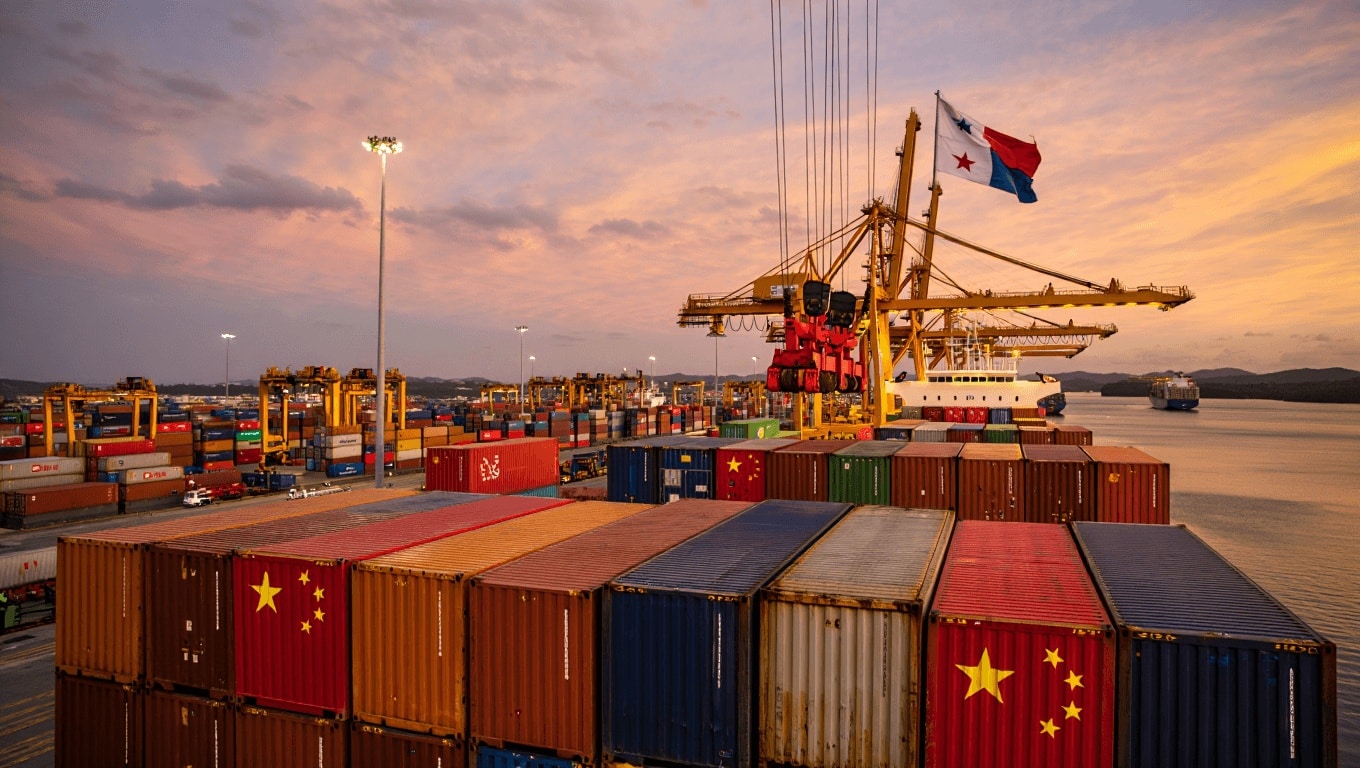
Panama’s port sector has moved into a more contested phase of geopolitical rivalry, and Beijing’s recent public warning has underscored how high the stakes have become. The dispute is no longer only about commercial contracts: it touches on supply chains, national sovereignty and the balance of influence between China and the United States in a region centered on the Panama Canal.
Why this matters now
As global shipping routes tighten and supply-chain resilience becomes a priority for governments and businesses, control over key terminals is taking on strategic significance. Any policy that limits or favors certain operators at Panamanian ports could ripple across regional trade and affect shipping schedules and costs worldwide.
What Beijing’s warning signals
Beijing’s statement — framed as a caution against measures that might disadvantage Chinese companies — serves multiple purposes. It communicates to Panama that Chinese investment is not merely commercial capital but part of a broader strategic footprint. It also signals to international observers that China expects preferential treatment or, at minimum, predictable rules for its firms.
The warning can be read as leverage in public diplomacy: raising the reputational and economic consequences of any decision that might curb access for Chinese operators could shape Panama’s choices without formal sanctions or coercive measures.
Where the competition is focused
Competition centers on a handful of issues that determine who runs, expands and profits from the region’s busiest docks:
- Port concessions and long-term leases that grant exclusive operating rights and shape revenue streams.
- Infrastructure upgrades — cranes, terminals and intermodal links that dictate throughput and efficiency.
- Customs and regulatory rules that affect operational costs and security clearances.
- Diplomatic ties and investment packages that accompany private-sector bids and sway local political debate.
Implications for Panama and the region
For Panama, the choices are immediate and consequential: foreign investment brings needed revenue and jobs, but deeper economic dependence on any single power can limit political maneuvering. The government must weigh short-term gains against long-term strategic autonomy.
Neighboring states are watching closely. Greater Chinese involvement in logistics could lower shipping costs for some traders but raise concerns in capitals that prefer closer alignment with the United States. In practice, this creates a layered contest: companies seek efficiency and profit, while governments balance strategic relationships.
What it means for shippers and businesses
Day-to-day impacts may be subtle at first: contract renegotiations, new security vetting procedures, or altered berth assignments. Over time, however, a shift in who controls key terminals can change carrier scheduling, influence freight rates, and affect routing decisions for cargo that transits the canal or uses Panamanian transshipment hubs.
Smaller importers and logistics firms are particularly exposed. They have less bargaining power to absorb delays or higher fees, and their operating margins can be squeezed quickly if uncertainty drives up costs.
Possible scenarios to watch
Several outcomes are plausible, each with different consequences:
- A negotiated equilibrium in which Panama enforces transparent rules for all bidders and avoids overt exclusions; foreign operators continue to compete under clearer guardrails.
- An escalation that leads to reciprocal measures or a toughening of investment screening, prompting diplomatic friction and possible disruptions to projects underway.
- A rapid consolidation where a dominant player—backed by state financing—secures critical terminals, shifting the economic and political balance in the logistics chain.
Signals to monitor next
Observers should track a handful of indicators that will reveal how the standoff evolves:
- Legislative moves in Panama related to foreign investment and port concessions.
- Public or private deals announced by major port operators and state-backed investors.
- Statements from Washington and regional capitals on security and trade policy toward Panama.
- Operational changes at terminals — new technology installs, security protocols, or staffing shifts.
Ultimately, Panama’s choices will reflect a balance between immediate economic needs and the long-term goal of maintaining independent control over critical infrastructure. Whatever path emerges, the dispute over ports illustrates a broader trend: maritime logistics have become a frontline in 21st-century geopolitics, where commercial contracts and national strategy increasingly overlap.
Similar Posts
- China threatens Panama over canceled 1990s port deals: warns of severe political, economic fallout
- New interoceanic corridor sidelines Panama Canal: global trade faces major disruption
- Panama Canal rival emerges in Latin America: nation shifts millions of tons of earth
- Port of Recife $19.7M dredging to allow 689-foot ships: could shift regional trade
- China secures 200,000 tons from Africa’s largest secret iron reserve: geopolitics at stake

Calvin Baxter is an economic analyst specializing in the evolving US labor market. He leverages real data to provide you with concrete recommendations and help you adjust your professional strategies.