
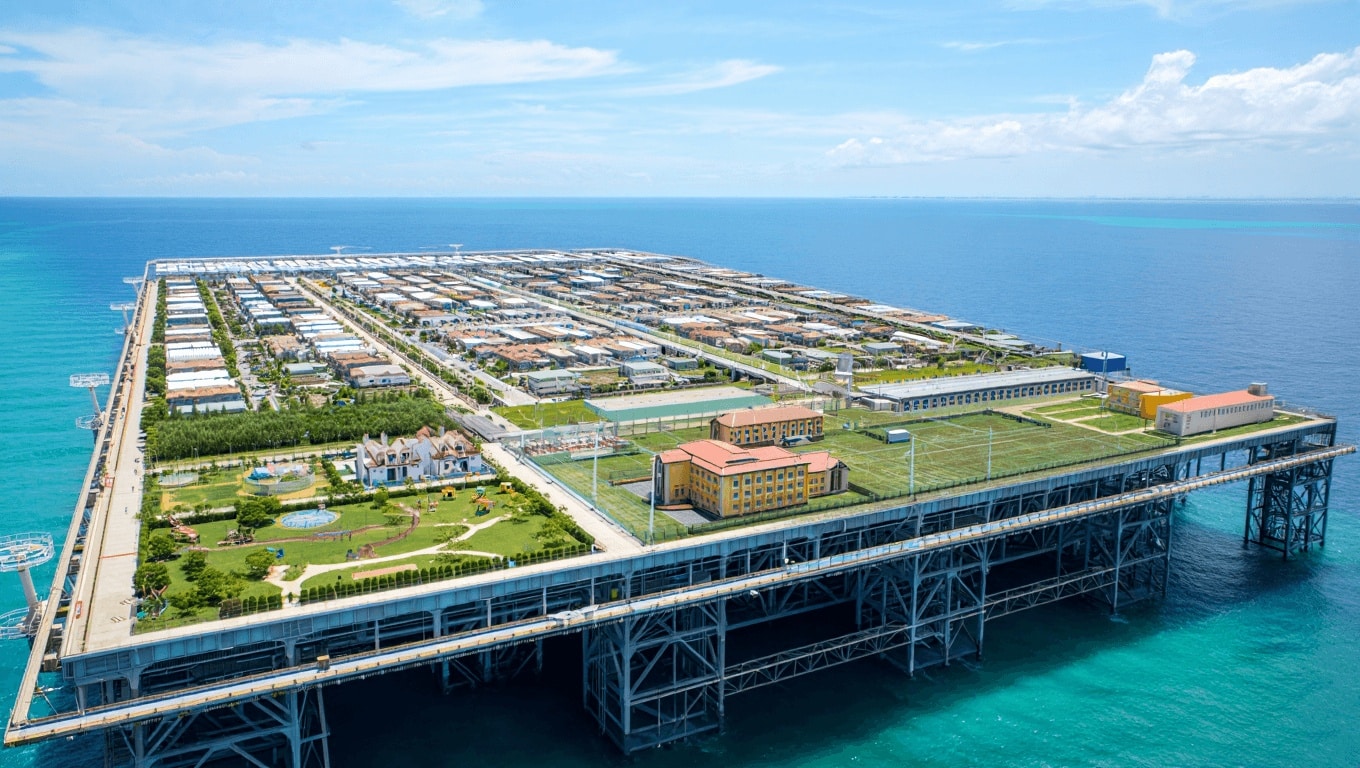
After years of delays and speculation, developers behind what they call the world’s largest floating city say the project is back on track — promising room for up to 80,000 residents and a slate of urban amenities that includes a stadium, schools and multiple helipads. The revival of the venture highlights a renewed interest in alternative urban models as coastal cities face growth pressures and climate-driven uncertainty.
What the developers are promising
The plan, as described by project officials, centers on a cluster of interconnected platforms designed to behave like a self-contained municipal zone. Key elements announced for the reopened effort include:
- Housing capacity: Facilities intended for tens of thousands of residents, with a mix of apartments and communal living spaces.
- Public infrastructure: A stadium capable of hosting large events, educational institutions, healthcare clinics and commercial districts.
- Transport links: Roadways across the platforms, water transit access and eight helipads for emergency and VIP movement.
- Renewable-energy systems and waste-management plans claimed to reduce the project’s environmental footprint.
Developers emphasize that the structure is not a single ship but a modular floating complex designed to remain moored while allowing for phased expansion. Officials present it as an alternative approach to city building that could be adapted to different coastal contexts.
Why this matters now
Urban planners and policymakers are watching because the idea intersects with multiple urgent trends — rising coastal populations, housing shortages in major metros, and the search for resilient infrastructure in the face of sea-level rise. If the project delivers even a fraction of its promises, it could influence how governments and private investors think about off-shore development.
At the same time, the revival comes amid increased scrutiny of large-scale maritime projects, from environmental assessments to safety regulations. That tension — opportunity versus risk — is central to the debate about floating urbanism.
Questions and challenges
Several unanswered practical issues remain prominent:
- Permits and maritime jurisdiction: Which authorities will regulate a city that sits at or beyond traditional coastal boundaries?
- Environmental impact: How will marine ecosystems respond to the construction and operation of large floating platforms?
- Cost and affordability: Will housing on a floating city be accessible to everyday residents or priced for niche markets?
- Long-term resilience: Can the engineering withstand storms, rising seas and unexpected maintenance needs?
Independent experts urge rigorous, transparent studies before residents move in. Environmental groups call for thorough baseline surveys and enforceable mitigation plans. Local governments will likely demand clear answers on emergency services, waste disposal and connections to mainland utilities.
What to watch next
Over the coming months, the story will hinge on a few concrete developments:
- Regulatory approvals and public hearings
- Release of detailed environmental and engineering reports
- Funding milestones and construction timelines
- Plans for transportation links and emergency response systems
Transparency around those milestones will determine whether the project becomes a model for future floating developments or another high-profile concept stalled by logistical and regulatory hurdles.
For now, the announcement serves as a reminder that engineers and developers continue to seek radical solutions to urban challenges — but turning ambitious prototypes into livable communities will require more than publicity, it will demand sustained proof that the plan can work safely, affordably and sustainably.
Similar Posts
- Floating city resumes life: home to 80,000 with stadium, schools and 8 helipads
- World’s largest floating city reopens: 80,000 residents, stadium, schools and eight helipads
- Sao Paulo immersed tunnel $1.35B project to upend how the city builds underwater
- Egypt plans new desert city with 1,312-foot tower: bold project aims to reshape urban growth
- Saudi Arabia buys overseas sand after desert grains prove too smooth for concrete

Calvin Baxter is an economic analyst specializing in the evolving US labor market. He leverages real data to provide you with concrete recommendations and help you adjust your professional strategies.