
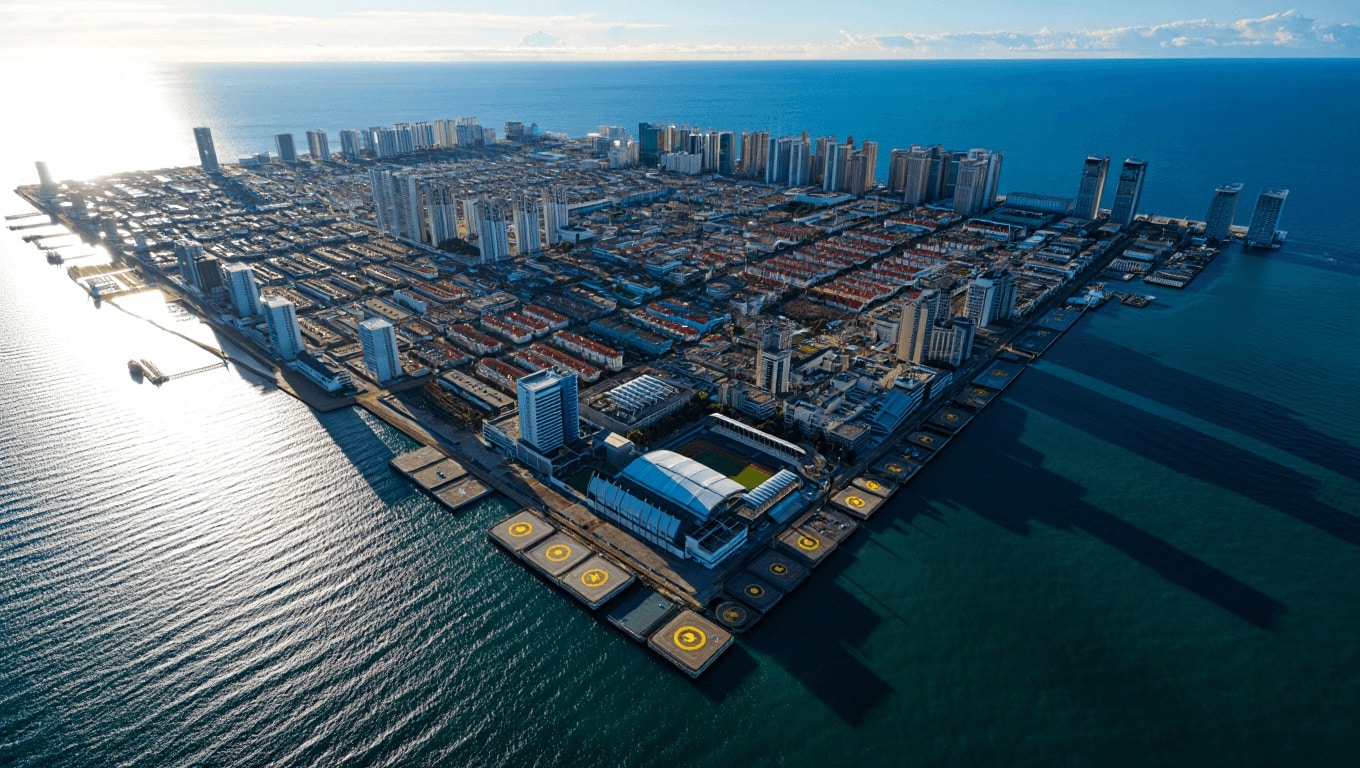
After years of fits and starts, a massive floating city project has restarted, its backers say — promising homes for as many as 80,000 residents, a sports stadium, multiple schools and even eight helipads. The revival comes as cities worldwide grapple with rising sea levels and acute housing shortages, raising fresh questions about feasibility, cost and environmental impact.
What the project would include
Developers describe the revived plan as a self-contained offshore community built from modular platforms. Public details are still limited, but the proposal highlights several headline features meant to make the development function like an ordinary city — only afloat.
- Housing capacity: Modular residential blocks intended to accommodate roughly 80,000 residents.
- Public amenities: A multiuse stadium, parks and retail strips designed for daily life and events.
- Education and services: Multiple schools, health clinics and community centers planned across the platforms.
- Transport links: Eight helipads for emergencies and VIP access, plus plans for ferries and internal electric transit.
- Energy and utilities: A combination of offshore renewables, microgrids and waste-management systems is proposed, though specifics remain sparse.
Why the restart matters now
Interest in large-scale offshore development is rising because coastal cities face twin pressures: a shortage of affordable housing and increasing flood risk. Proponents argue floating infrastructure could unlock new urban land without converting protected shorelines.
But the timing is significant for practical reasons: supply-chain rebounds after the pandemic, improved maritime engineering, and growing investor appetite for novel real-estate playbooks make a restart more plausible than a decade ago.
Engineering, costs and environmental questions
The technical challenges are substantial. Building stable, long-lasting platforms able to withstand storms, corrosion and wave action requires advanced materials and continual maintenance. That raises both upfront and long-term costs.
Environmental groups are cautious. Floating developments can avoid some coastline damage, but they bring new impacts: disruption to marine habitats, localized water-quality issues, and the carbon footprint of construction at sea.
With many details still undisclosed, independent engineers say realistic budgeting and transparent environmental assessments will determine whether the project can move from concept to a safe, durable community.
Governance, legal limits and services
Operating a city on the water invites complicated questions about jurisdiction, taxation and emergency response. Would residents fall under the laws of a nearby coastal state, or would novel governance structures be created? How would police, fire and health services be coordinated?
Previous seasteading and offshore proposals struggled when legal and insurance frameworks failed to keep pace with engineering ambitions. Any viable restart must address those gaps early.
Timeline, funding and practical risks
Project backers say work is resuming, but they have not publicly released a detailed schedule or complete financing plan. That means key milestones — from initial platform launches to full occupancy — remain uncertain.
- Early-phase construction: modular pilot platforms and utility hookups.
- Testing period: sea trials, storm resilience tests and environmental monitoring.
- Scaling: phased building of housing, schools, and public spaces as systems prove reliable.
Risks include funding shortfalls, regulatory delays, engineering setbacks and community opposition. Each could push the timeline out by years.
What to watch next
In the coming months, look for three concrete signals: a published environmental impact assessment, a clear financing plan naming lenders or public partners, and detailed designs for safety systems such as stormproofing and waste treatment.
If those items appear and withstand scrutiny, the project could be a serious test case for offshoring parts of urban life. If they don’t, the restart may join a long line of bold maritime visions that never reached scale.
The idea of a floating city captures the imagination: it promises new living space and resilience in an era of climate uncertainty. Whether it becomes a livable, legal and environmentally sound alternative to land-based expansion will depend on engineering rigor, transparent planning and public accountability.
Similar Posts
- Floating city resumes life: home to 80,000 with stadium, schools and 8 helipads
- World’s biggest floating city resumes operations: homes, schools and helipads for 80,000
- Egypt plans new desert city with 1,312-foot tower: bold project aims to reshape urban growth
- Zuckerberg funds $30M hardened compound: 30 rooms, 95,000L tanks, 13-meter walls and 8-ton doors
- Cincinnati veterans to get 14 $70K tiny homes on church land: move out of temporary housing

Calvin Baxter is an economic analyst specializing in the evolving US labor market. He leverages real data to provide you with concrete recommendations and help you adjust your professional strategies.