
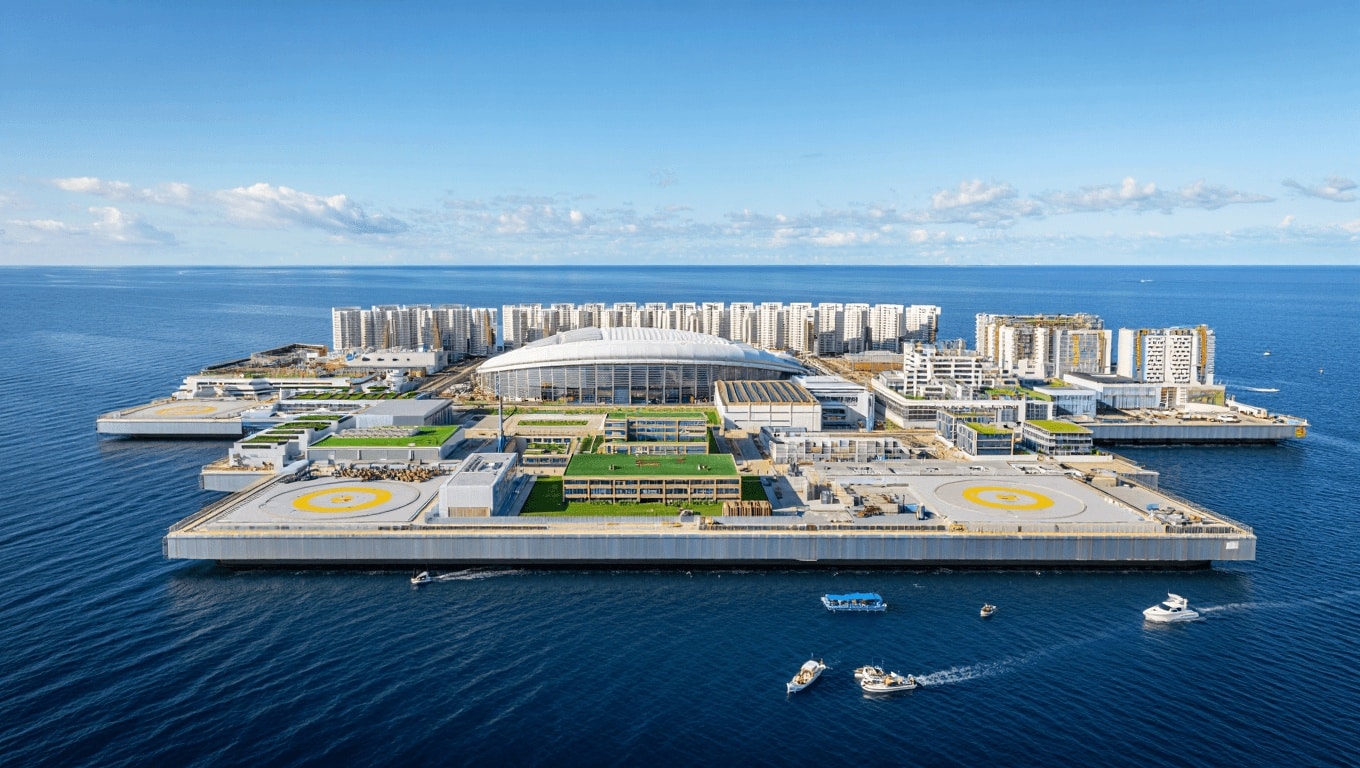
The ambitious floating city project that aims to house tens of thousands of people has resumed activity, its developers say, reviving plans for a self-contained urban platform with homes, schools, a stadium and multiple helipads. With coastal cities facing rising sea levels and chronic housing shortages, the proposal’s restart raises fresh questions about feasibility, regulation and who stands to benefit.
Officials and the engineering teams behind the development describe it as a modular, sea-based neighborhood designed to support roughly 80,000 residents. The plan, in outline, includes civic infrastructure such as a stadium, several schools, retail space, emergency facilities and a network of transport links including eight helipads.
What’s new and why it matters now
After a pause tied to financing and permitting, work on the project has reportedly picked up again — a shift that matters because coastal population pressures and climate risks are intensifying. If built at scale, a platform of this size would test engineering standards, urban governance and maritime law in ways smaller floating developments have not.
Proponents frame the idea as both an answer to land scarcity and a testbed for climate-resilient design. Critics question costs, environmental trade-offs and long-term livability, especially when placed against established options such as land reclamation or inland urban renewal.
Key features at a glance
- Capacity: Planned to house about 80,000 people across modular districts.
- Public amenities: A stadium for sports and events, multiple schools, medical clinics and commercial areas.
- Transport: On-platform roads, waterborne links to the mainland and eight helipads for rapid access.
- Structure: Modular, floating platforms designed to be expanded or reconfigured over time.
- Resilience: Intended to withstand storms and rising sea levels through adaptive engineering.
Not every detail is settled: construction timelines, total cost and the exact governance model remain under negotiation. That ambiguity is typical for projects that push beyond conventional urban planning and into maritime territory.
Benefits and complications
Advocates highlight potential benefits: additional housing supply without new landfills, opportunities for waterfront economic activity, and a chance to prototype low-carbon infrastructure. For cities strapped for space, floating neighborhoods could relieve some development pressure.
But the challenges are significant. Building a long-term, densely populated community on water means confronting waste management, freshwater supply, energy reliability and ecosystem impacts. Insurance and liability are also thorny: insurers have limited experience underwriting entire neighborhoods that float.
Regulatory clarity will be essential. Who provides policing, schooling and utilities on a platform beyond conventional city limits — and how those services are paid for — will shape whether the concept is a practical urban supplement or an expensive novelty.
What to watch next
Observers should look for several near-term signals: formal permits from coastal authorities, finalized funding commitments, detailed environmental impact studies and a public timeline for phased construction. Each of those milestones will reveal how realistically the project can move from concept to habitable reality.
For residents of flood-prone regions and policymakers grappling with housing shortages, the project’s revival is more than an engineering curiosity. It’s an experiment in how cities might adapt when land becomes scarcer and the climate grows more volatile — with consequences for planning, public finance and coastal ecosystems.
Similar Posts
- World’s largest floating city reopens: 80,000 residents, stadium, schools and eight helipads
- World’s biggest floating city resumes operations: homes, schools and helipads for 80,000
- Egypt plans new desert city with 1,312-foot tower: bold project aims to reshape urban growth
- Elon Musk faces major hiring snag at Starbase near Mexican border: married engineers won’t relocate
- New York misses out on world’s best city title in new report

Calvin Baxter is an economic analyst specializing in the evolving US labor market. He leverages real data to provide you with concrete recommendations and help you adjust your professional strategies.