
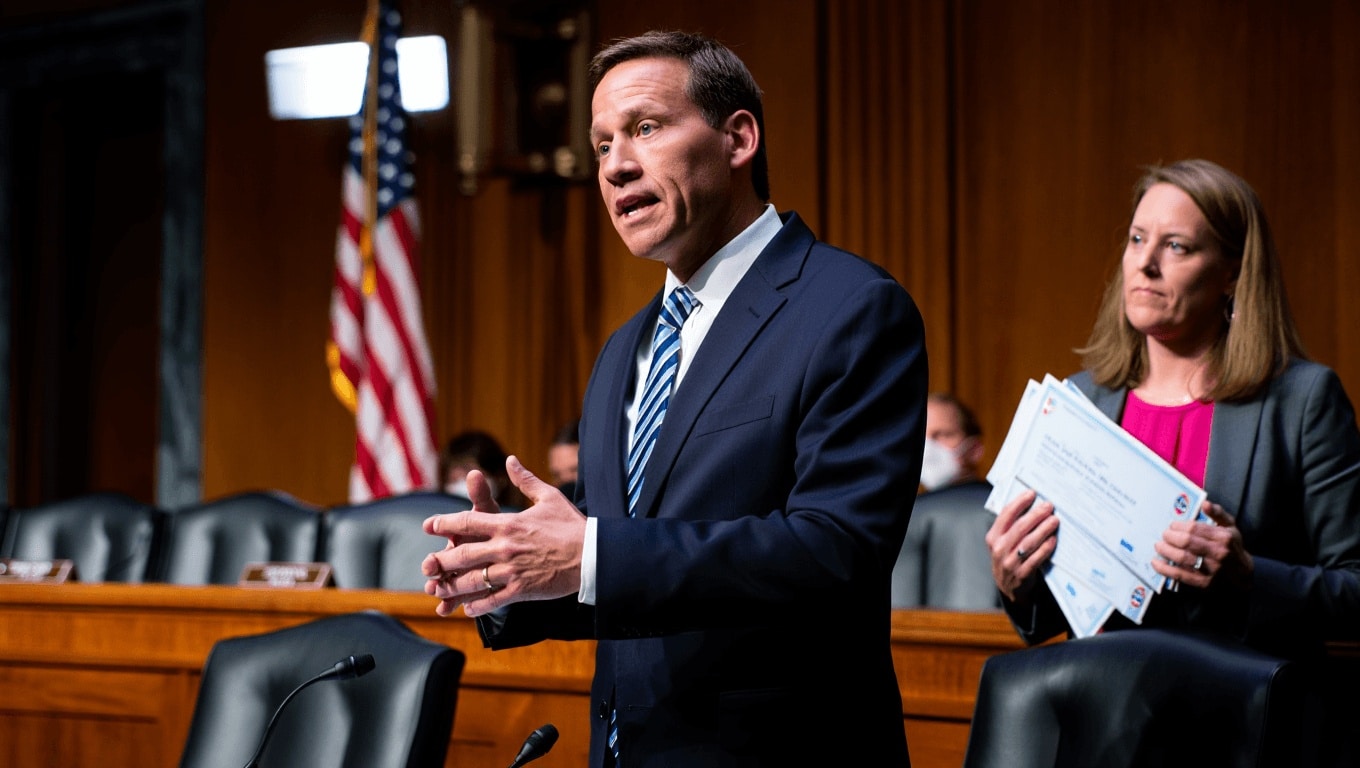
Sen. Martin Heinrich this week unveiled legislation that would send direct payments to Americans who faced higher grocery and goods prices after President Trump’s tariff program reshaped import costs. The proposal arrives as voters and lawmakers weigh affordability ahead of the 2026 midterms and after recent court rulings narrowed parts of the administration’s trade agenda.
Called the Tariff Refunds for Working Families Act, the bill would create a one-time tax rebate tied to tariff revenue, with payments beginning in the 2026 tax year if the measure becomes law. Under the draft language, married couples filing jointly with incomes below $180,000 would receive $1,200, and households would get an extra $600 for each dependent child.
Tariffs are collected on imports and can raise the cost of goods for U.S. businesses and consumers when companies pass along higher import expenses. A recent Federal Reserve Bank of New York study concluded that roughly 90% of the 2025 tariff burden landed on U.S. firms and households — a finding disputed by White House officials.
Tomas Philipson, a public policy professor at the University of Chicago and former acting chair of the White House Council of Economic Advisers, noted the Supreme Court’s decision last month did not resolve who is entitled to refunds. Under current law, he said, importers who paid duties would be the first in line for reimbursement even if they didn’t ultimately shoulder the cost.
- Who would qualify: Joint filers under $180,000 of annual income.
- Payment size: $1,200 per eligible couple, plus $600 per dependent child.
- Timing: Payments tied to the 2026 tax year if enacted as written.
- Rationale: Lawmakers proposing the refund say it would return money to households that absorbed higher prices tied to tariffs.
How big is the cost to households?
Estimates of the consumer hit vary. A Budget Lab at Yale analysis found tariffs in place through March 9 would raise prices enough to cost the average household between $450 and $570 in the short run; if tariffs enacted under Section 122 of the Trade Act of 1974 become permanent, the estimated loss rises to about $770–$940 per household. The Joint Economic Committee’s minority staff projected a larger impact, placing the 2026 cost per household at roughly $2,500.
Treasury Secretary Scott Bessent has argued that tariffs re-imposed under Section 122 will leave federal tariff revenue largely unchanged in 2026. That accounting shapes the pay-for logic behind rebate proposals: lawmakers point to tariff collections as a source to finance refunds without adding new deficit spending.
Policy trade-offs and politics
Economists are split on whether sending refunds is the right move right now. Some warn that pumping cash into households could add to inflationary pressure at a moment when global energy markets and trade tensions are already raising prices. Others say targeted refunds make sense because companies may not cut prices even if tariffs are rolled back, leaving households out of pocket.
Brett House, an economics professor at Columbia Business School, said directing relief to the consumers and businesses that absorbed tariff costs could be a pragmatic response. He also suggested refunds could find bipartisan backing given that lawmakers from both parties have floated similar ideas ahead of the midterms.
Republican proposals are already on the table: Sen. Josh Hawley introduced an American Worker Rebate bill in 2025, and President Trump had publicly promised dividend-style payments funded by tariff revenue. National Economic Council Director Kevin Hassett previously said the administration planned to present a Congressional proposal to distribute such funds.
Still, legal and legislative hurdles remain. The Supreme Court’s action narrowed the administration’s original tariff authorities, and lawmakers would need to pass a new statute to specify who gets repaid if collections are reversed or adjusted. That legal uncertainty helps explain why experts say importers — the entities that pay duties at the border — could be first in line for refunds unless Congress acts.
The next steps are procedural: Heinrich’s bill must move through committees and win support in both chambers. Even if it clears Congress, implementing a large, targeted rebate program raises administrative questions about eligibility verification and delivery timing. For households feeling the pinch at the checkout line, whether those checks arrive — and when — will determine the measure’s real-world impact.
Similar Posts
- Tariff refunds won’t trickle down to shoppers: CFO Council survey
- Tariff Shock: Discover Which Products Are Now 25% More Expensive!
- $600 Rebate Checks for Millions of Americans: Find Out If You Qualify!
- $2,000 Stimulus Checks in May: Everything You Need to Know Now!
- $2,000 ‘Trump Tariff Dividend’ Incoming: Who in New York Will Miss Out?

Jordan Keller specializes in analyzing the US financial markets. With concrete recommendations, he helps you secure and boost your investments by providing strategies that adapt to market fluctuations.