
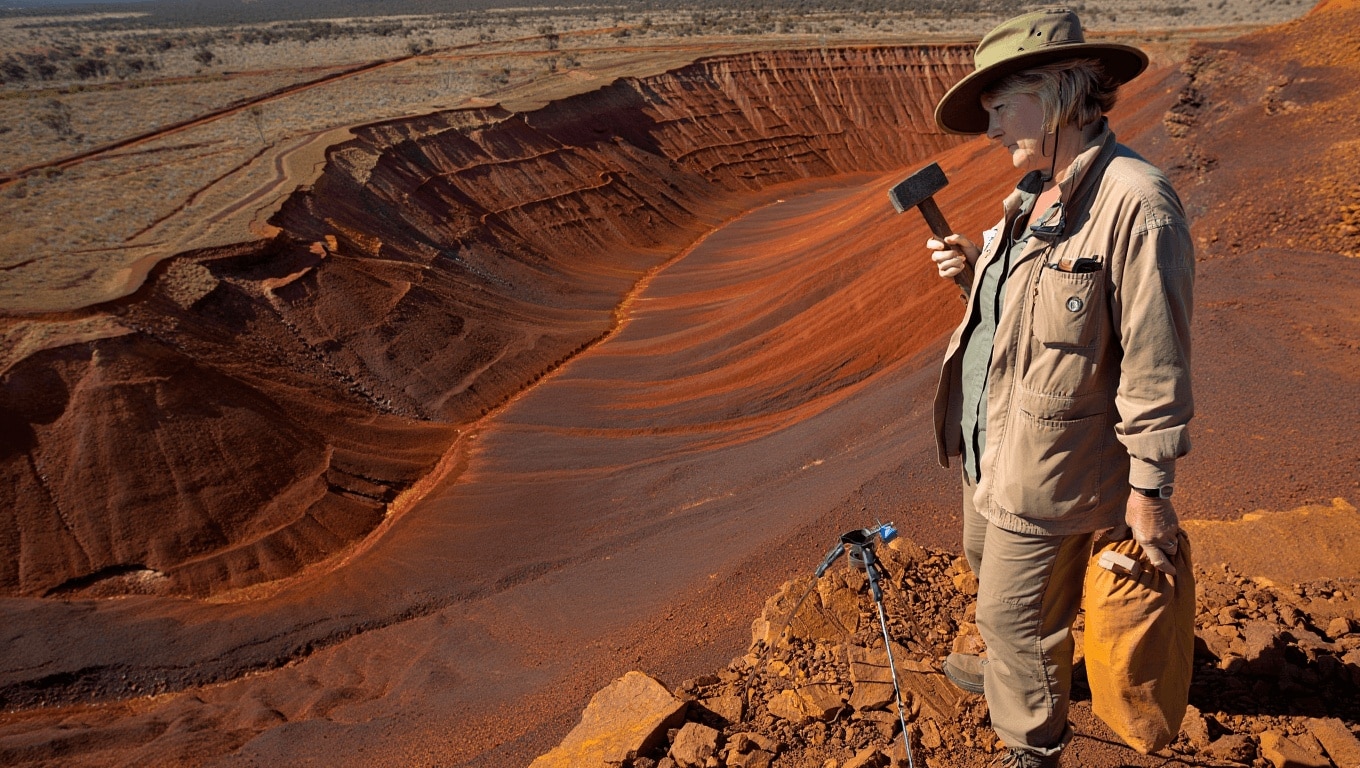
Australian geologists have identified what they say is the largest known iron deposit on record — a formation holding an estimated 5.7 billion tons of iron — but researchers say the real story is its antiquity. New dating places the ore’s origin in deep geological time, offering fresh clues about Earth’s early environment while raising immediate questions about industry, communities and the climate.
The find, detailed in a recent scientific report, was uncovered during regional mapping and follow-up drilling in a mineral-rich part of the continent. Geoscientists used radiometric dating and stratigraphic analysis to determine that the iron-rich layers crystallized well over two billion years ago, making the deposit not only vast but also unusually ancient.
Why the age matters
Iron deposits of this scale are often tied to dramatic shifts in Earth’s atmosphere and oceans. The new site appears to be a preserved example of those processes — a geological archive that could refine our understanding of when oxygen levels rose and how early microbial life affected the planet’s chemistry.
That kind of evidence matters to researchers: it helps reconstruct the timing and mechanisms of the Great Oxidation Event and the broader story of planetary habitability. For resource planners and policymakers, the age adds complexity, because older deposits can be deeply buried or structurally disrupted and therefore harder to exploit.
Immediate implications for industry and communities
The announcement will prompt a rapid reassessment of local and global iron-ore supply forecasts, but the path from discovery to production is long and uncertain. Before any mining can begin, companies must carry out detailed feasibility studies, environmental impact assessments and negotiations with landowners and traditional custodians.
- Market effects: A discovery of this scale could ease supply tensions for steelmakers in the long run, but new supply typically takes years to reach global markets and may not immediately lower prices.
- Regulatory hurdles: Permitting, water use approvals and rehabilitation planning can delay projects for a decade or more.
- Environmental risks: Large-scale extraction carries potential impacts to biodiversity, groundwater and carbon emissions from processing and transport.
- Indigenous and community rights: Early engagement with traditional owners and local communities will be crucial; social license can determine whether a project proceeds.
- Scientific value: As an exceptionally old deposit, the site is also a target for academic study before any irreversible disturbance.
Geologists caution against equating the headline figure with immediate mining potential. The 5.7 billion tons figure reflects total in-situ iron content; recoverable ore will depend on grade, metallurgy, depth and infrastructure costs. Preliminary reports suggest the ore occurs in thick, layered sequences that will require detailed metallurgical testing to determine smelting performance and concentrate yields.
What comes next
Exploration teams will expand drilling to better define the deposit’s geometry and grade distribution. Parallel environmental baseline studies will map sensitive habitats and groundwater systems. Mining companies typically take several years — sometimes decades — to move from discovery to operation, and some deposits remain undeveloped indefinitely because of economics or conservation concerns.
For researchers, the deposit is an invitation: its age and composition could shed new light on Earth’s transition from a largely oxygen-poor world to one where oxygen-bearing ecosystems became dominant. For industry and policymakers, it’s a reminder that large, strategically important mineral resources still emerge, reshaping long-term planning for steel production, supply chains and climate strategies.
The coming months will reveal whether the find becomes a major new mine or a key scientific site preserved for study. Either way, the discovery connects deep time to present-day debates over resources, environment and responsible development.
Similar Posts
- China gold find tops 1,000 tons, valued at $86 billion: could redraw global supply map
- China gold discovery valued at $85.9B found 2,000m deep: geologists probe if it tops 1,000 tons
- Pilbara high-grade iron deposit confirmed: 55 billion tons worth $6.52 trillion
- Gold deposit 2,000 meters underground may hide one of the world’s largest reserves
- China uncovers 1,444-ton gold cache worth $150 billion: largest find since 1949

Calvin Baxter is an economic analyst specializing in the evolving US labor market. He leverages real data to provide you with concrete recommendations and help you adjust your professional strategies.