
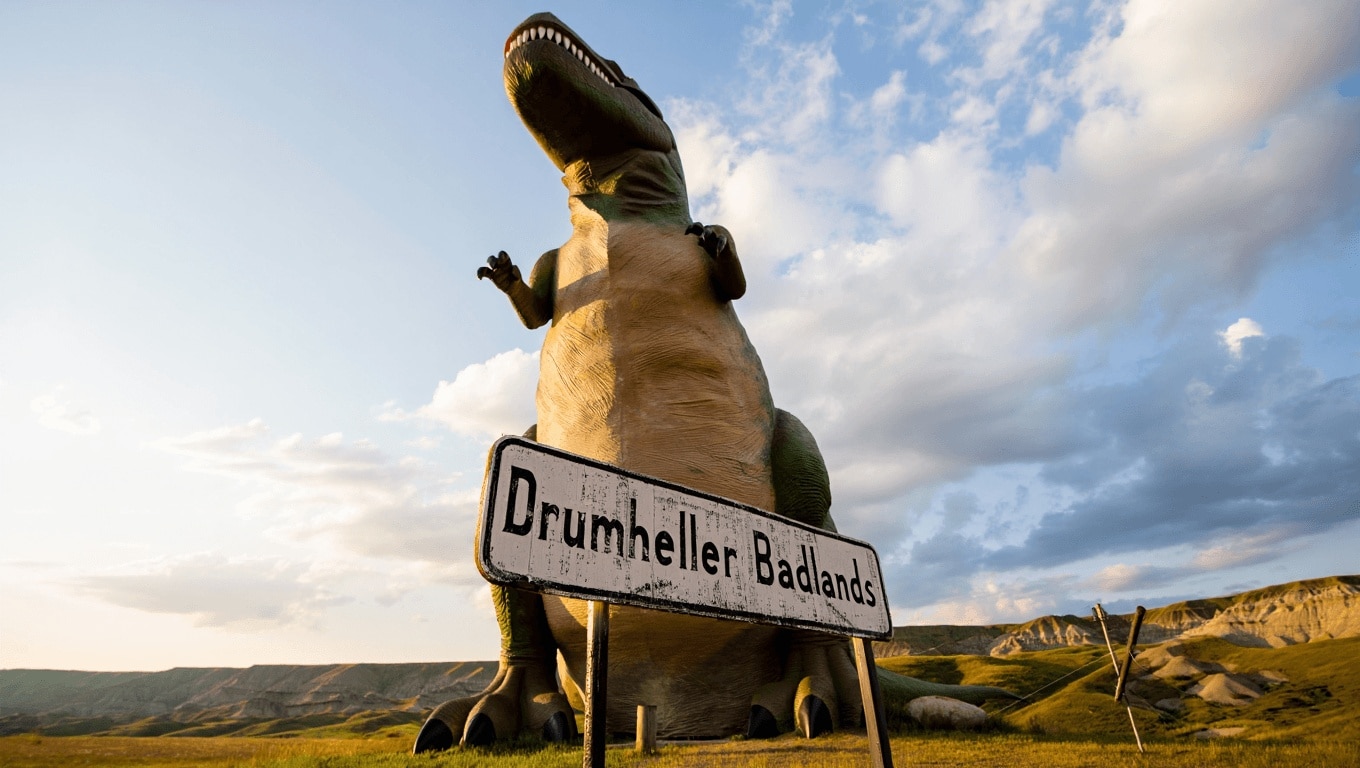
The giant roadside T. rex that has loomed over the Canadian Badlands for more than two decades may soon disappear — and the clock is already ticking. With the statue’s land lease ending in 2029, Drumheller officials are weighing whether to relocate, preserve or dismantle the 86-foot attraction, a decision that could ripple through the region’s tourism economy and local identity.
Known as Tyra, the fiberglass-and-steel replica towers over the town and has been a staple for families and highway travelers since it arrived in Drumheller in 2000. Visitors could climb inside the creature and stand in its open jaws, a quirky draw that helped put the town on many travel itineraries.
Why moving Tyra is harder than it looks
The statue is enormous: about 86 feet tall and roughly 145,000 pounds — far larger than any real T. rex. That scale is partly why officials say relocation is a formidable engineering and financial challenge. Transporting a structure of that size would require specialized equipment, route planning, permits and likely substantial roadwork.
A recent structural assessment found the statue is currently stable, prompting the town to invest in repairs. Drumheller has already spent more than $300,000 to shore up the landmark and make sure it remains safe for visitors — an interim step intended to preserve options while longer-term decisions are made.
Options on the table — and their limits
Local leaders say they are exploring several possibilities, but moving Tyra is increasingly viewed as unlikely. Extending the lease would require negotiations with the landowner, and finding a new permanent site would involve both cost and community planning. If no feasible solution emerges, the town faces the prospect of demolition.
- Height: 86 feet
- Weight: ~145,000 pounds
- Location: Drumheller, Alberta (Canadian Badlands)
- Installed: 2000
- Lease expiry: 2029
- Recent investment: Over $300,000 in structural repairs
- Visitor feature: Interior viewing platform inside the jaw
- Likely outcomes: Lease extension, relocation (difficult), or demolition
For residents and tour operators, the decision carries concrete implications. Drumheller markets itself as a destination for paleontology and roadside oddities; losing Tyra would remove a visible landmark that helped attract casual visitors stopping off the highway. Conversely, moving the statue could strain municipal budgets or require private fundraising and logistical partners.
The issue also raises practical questions about heritage and stewardship: who pays to preserve a piece of popular culture, and how should communities balance cost, safety and tourism value? Town officials say they are consulting engineers and stakeholders as the 2029 deadline approaches, but no final plan has been announced.
As the debate continues, Tyra — at 26 years in her current spot — has been stabilized for now. Whether she remains a Drumheller icon or becomes a cautionary example of what happens when high-profile roadside attractions outgrow their leases will be decided in the next few years.
Similar Posts
- Cambodia giant rat statue draws scrutiny after being awarded a medal
- Mount Etna lightning kills 29-year-old tourist in Sicily
- Stolen 800-year-old saint’s skull vanishes from Czech church
- Data center replaces donated parkland after town sells site for millions
- Jeddah Tower tops 100 floors: now racing to a 3,280-foot height by 2028

Miles Harper focuses on optimizing your daily life. He shares practical strategies to improve your time management, well-being, and consumption habits, turning your routine into lasting success.