
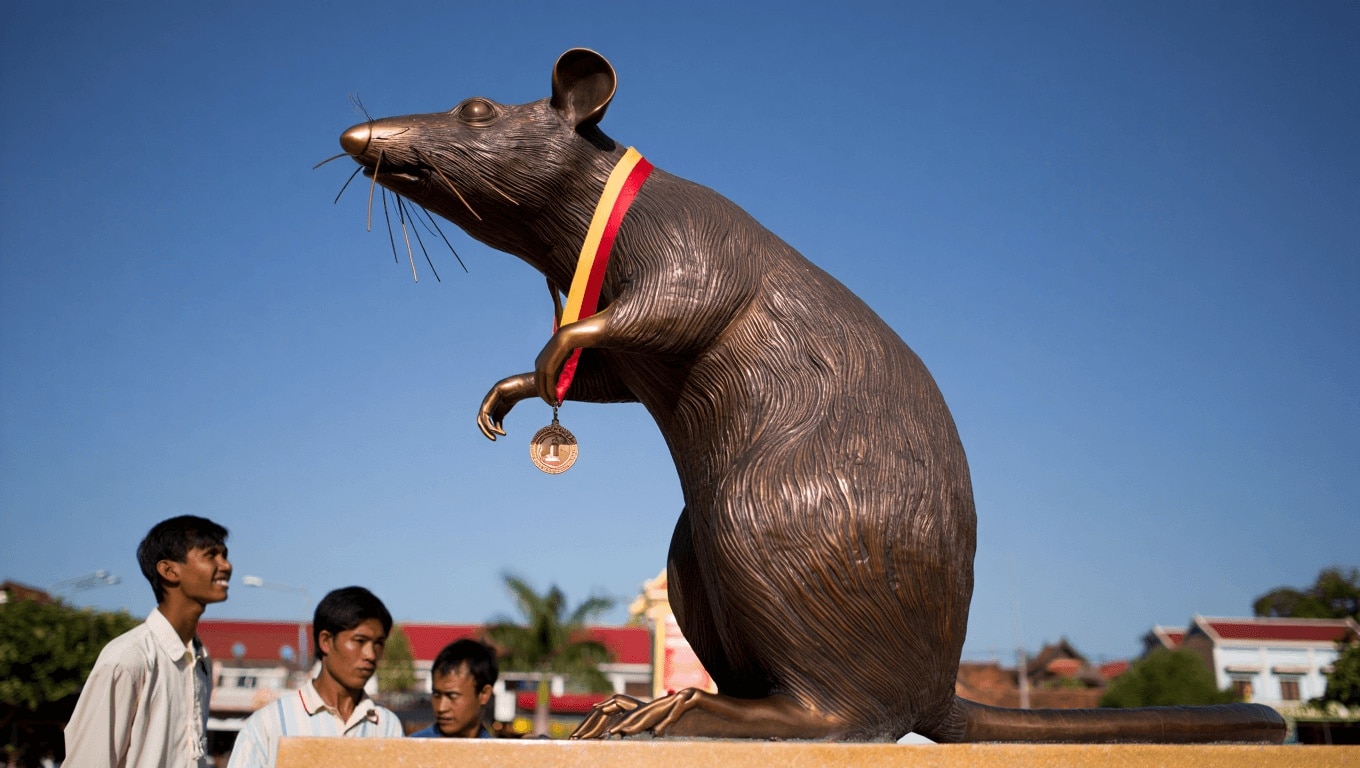
A seven-foot statue in Cambodia honors a rat whose work cleared hazardous ground and saved lives long after wars ended — a reminder that some dangers from past conflicts still shape daily life today. The memorial celebrates a single animal’s practical impact on communities where hidden explosives remain a persistent threat.
Cambodian officials unveiled the monument in 2026 to recognize Magawa, an African giant pouched rat trained by the nonprofit APOPO to detect buried explosives. The choice to immortalize an animal speaks to the scale of the problem: landmines and unexploded ordnance still rend farmland, pathways and neighborhoods across parts of the country, posing risks decades after fighting has stopped.
How one animal made formerly dangerous ground usable again
Magawa’s handlers trained him to sniff out the chemical signatures of explosives such as TNT. Because the species is light enough not to detonate most pressure-triggered devices, the rats can move across suspect areas and indicate finds with a simple scratch of the ground — a quiet, efficient signal compared with slower, more dangerous manual searches.
Over a five-year demining career, Magawa’s record drew international attention and helped change how people think about humanitarian mine clearance. His work freed up land for safe use and reduced the immediate danger for residents who live amid contaminated terrain.
- Land cleared: about 1.5 million square feet — roughly the size of 26 football fields
- Mines detected: more than 100 explosive devices located
- Award: recipient of the PDSA Gold Medal in 2020, a decoration for animal bravery and service
- Status: retired in 2021 and died in 2022; statue unveiled in 2026
APOPO has trained animals for humanitarian demining for years; Magawa’s achievements provided a high-profile example of the method’s potential to accelerate clearance in areas where conventional approaches are slow, costly or too risky for people.
Cambodia’s long history of conflict — including the Khmer Rouge era and other hostilities — left large swaths of land contaminated. Unexploded ordnance remains a real daily hazard for farmers, children and commuters. Removing these devices is painstaking work, and every cleared parcel translates to farmland, safe routes to school, or restored community space.
Marking Magawa’s service with a statue is both symbolic and practical: it highlights a successful humanitarian tool, and it keeps public attention on an issue that still affects millions worldwide. The image of a rat honored with a public monument underlines a pragmatic truth in post-conflict recovery: lives are protected, and communities rebuilt, by many different kinds of courage and care.
Magawa’s handlers often credited simple rewards — a slice of banana after a successful find — for motivation. That small gesture, and the animal’s training, combined to deliver measurable results in reducing the dangers of forgotten war zones.
Whether as a curiosity or a serious example of innovation in humanitarian work, the statue reminds visitors that demining is far from over and that unconventional solutions can have outsized effects on safety and recovery.
Similar Posts
- T. rex weighing 145,000 pounds needs new home: giant fossil up for relocation
- Bison Attack in Yellowstone: Florida Man Gored in Shocking Encounter!
- Connecticut Culprit Colors Squirrels Neon: Outrage Over Wildlife Vandalism!
- South Korea Bans Bear Bile Farming: 200 Moon Bears Seek New Homes
- Ancient Egyptian art stays vivid centuries later: scientists uncover preservation secret

Miles Harper focuses on optimizing your daily life. He shares practical strategies to improve your time management, well-being, and consumption habits, turning your routine into lasting success.