
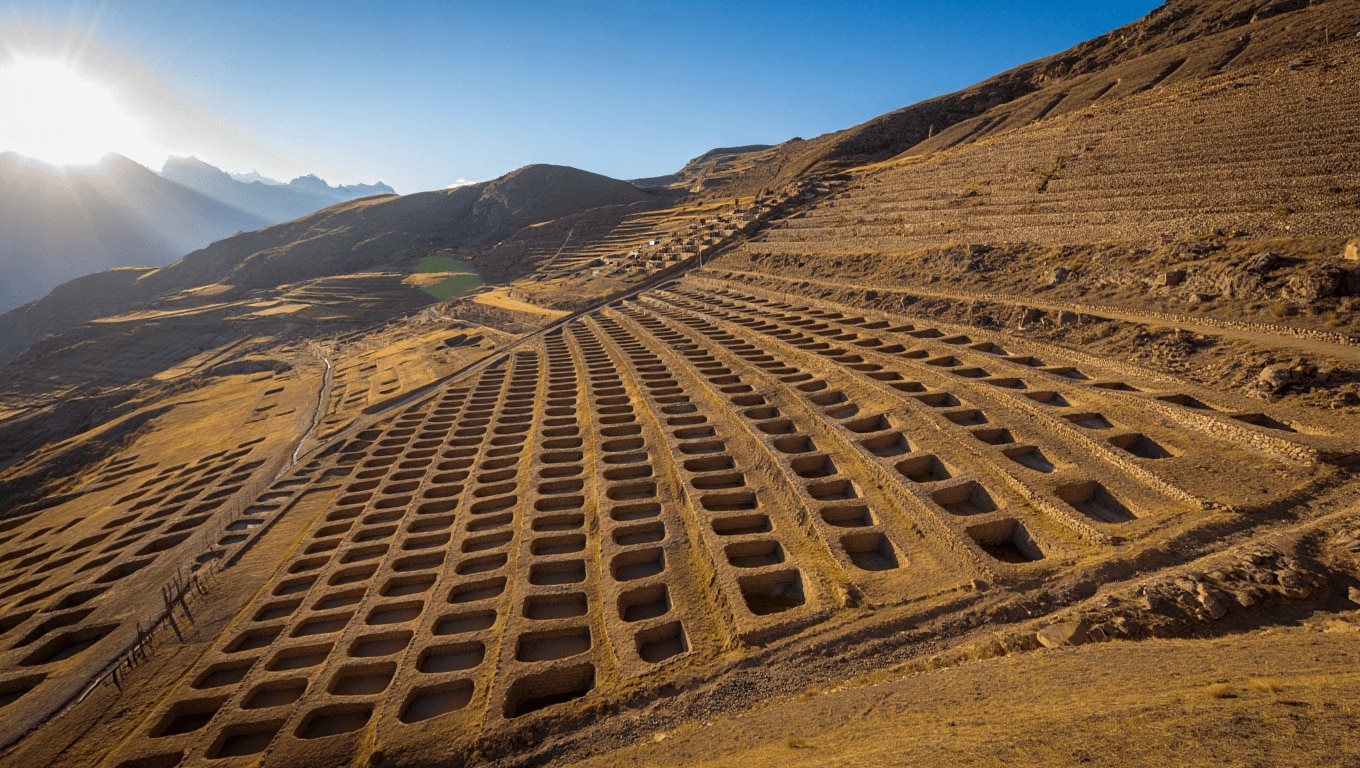
Archaeologists now say the 5,200 holes carved into a Peruvian mountainside were not ritual pits or natural erosion — they were part of a deliberate system for storing and managing agricultural goods. A new study argues these features reflect organized production and distribution strategies that reshape how scholars understand pre-Columbian Andean economies.
From mystery to method
The circular cavities, visible from aerial photos and long noted by local residents, attracted speculation for decades. Recent fieldwork combined excavation, soil chemistry, and microfossil analysis to move the conversation past guesswork. The team found evidence consistent with deliberate, long-term food storage rather than short-term refuse pits or purely ceremonial uses.
Researchers point to a set of telltale signs: compacted interiors, lining materials, and preserved plant residues that match tubers and grains known to have been staples in the high Andes. Spatial patterns — the number of pits, their distribution on terraces and slopes, and proximity to ancient paths — suggest this was an integrated system built to manage surplus and buffer against seasonal shortages.
What this says about the economy
Interpreting these features as storage changes the narrative about local societies. Rather than being limited to small-scale, household subsistence, communities appear to have coordinated at a larger scale to collect, preserve, and redistribute foodstuffs. That coordination implies planning, labor organization, and social arrangements able to support collective provisioning.
The shift in interpretation carries concrete implications. If these cavities were indeed used to hold dried or freeze-preserved crops, they would have allowed populations to withstand climatic shocks, support craft specialists who did not farm, and sustain longer trade networks across the highlands.
- Storage infrastructure: Thousands of engineered pits indicate systematic investment in preserving food.
- Surplus management: The scale suggests pooling of produce beyond immediate household needs.
- Risk buffering: Long-term storage would have reduced vulnerability to drought or frost.
- Economic integration: Distributed storage points align with evidence for regional exchange and labor specialization.
How the team reached this conclusion
Field investigators used a combination of microbotanical analysis (starch grains and phytoliths), residue chemistry in pit sediments, and contextual study of nearby archaeological features. Those methods helped separate natural deposition from human activity and identified plant remains consistent with tuber and grain processing.
The researchers were careful not to overstate certainties. While the evidence strongly favors a storage model, they acknowledge variation among pits — some may have served secondary tasks such as processing, short-term fermentation, or even ceremonial functions at certain moments.
Why it matters now
Beyond resolving an archaeological puzzle, the study alters how scholars think about social complexity in the Andean highlands before European contact. Recognizing widespread, purpose-built storage implies communities had mechanisms to produce and move surplus — a foundation for more hierarchical or market-like arrangements than previously credited in this region.
For modern readers the discovery also offers a timely reminder: agricultural societies innovate storage and distribution in response to environmental uncertainty. The ancient solutions — local networks of strategically placed caches — offer comparative insight for contemporary discussions about food security and climate resilience.
Follow-up work will aim to pin down chronology, identify which crops dominated stored assemblages, and map connections with settlement sites and travel routes. Those next steps will clarify whether the pits served chiefly communal planners, state institutions, or cooperative neighbor groups — and further refine our picture of how Andean peoples organized production and exchange.
Similar Posts
- Farmers near Maysville turn down $26 million for data center: pick food over tech
- Ancient humans habitually sucked nuts 25,000 years ago: dental evidence
- Argentina copper trail leads to treasure-like find: scientists stunned by unexpected ending
- Rarest mineral confirmed: a single 0.011 oz specimen reveals gaps in Earth’s catalog
- Celtic settlement spanning 62 acres found near Hradec Králové: gold, amber and workshops

Calvin Baxter is an economic analyst specializing in the evolving US labor market. He leverages real data to provide you with concrete recommendations and help you adjust your professional strategies.