
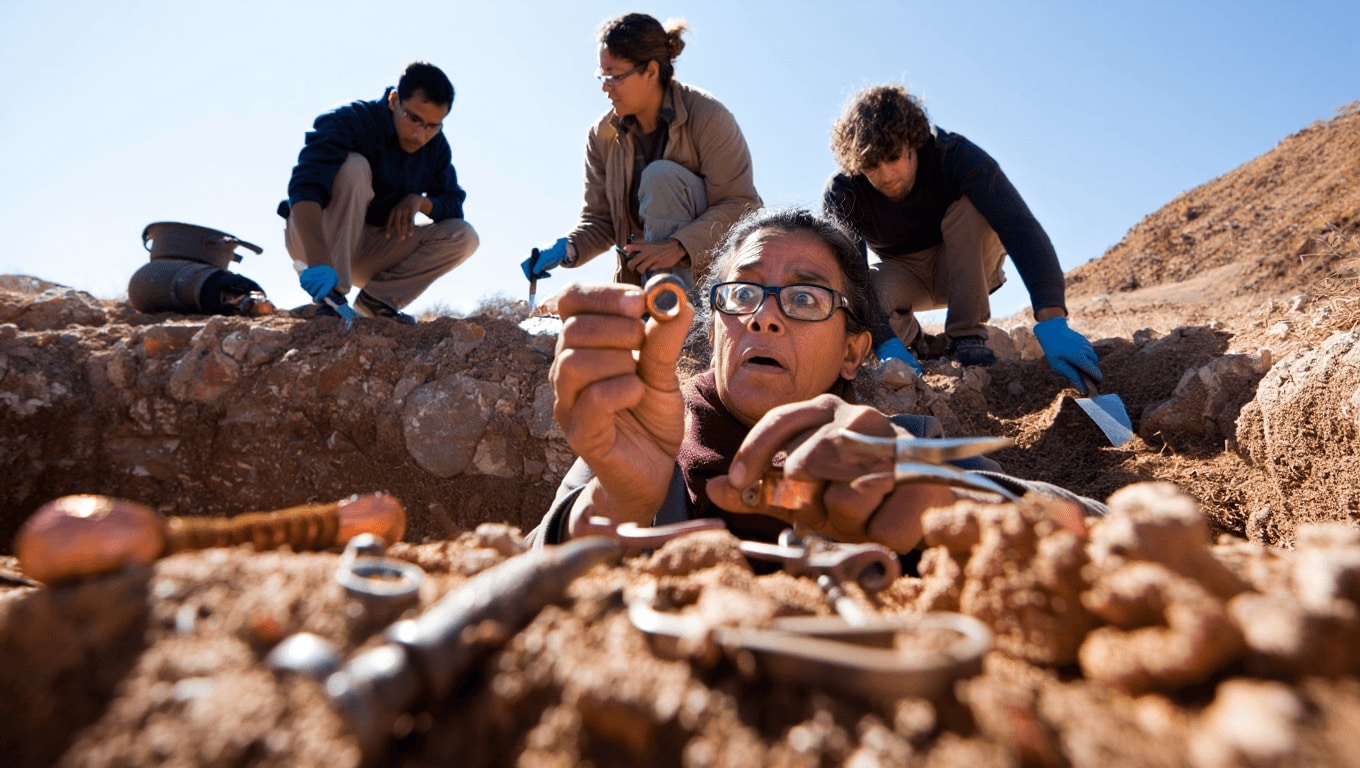
When archaeologists followed a string of copper beads long nicknamed the “Thread of the Sun,” they did not uncover a pirate‑style hoard or lost treasure. Instead, a recent line of investigation has revealed a network of workshops, mining traces and trade routes that rewrite parts of Argentina’s pre‑Columbian industrial map—and explains why those glinting beads mattered to the people who made them.
From shiny mystery to scientific trail
The object that sparked the search was a set of small copper ornaments found in several museum collections and scattered excavation reports. Their consistent shape and finish suggested a single manufacturing tradition, so a multidisciplinary team turned to geochemical analysis and field survey to follow the metal’s origin.
By comparing the chemical fingerprints of the beads with samples taken from copper outcrops across the region, researchers were able to match composition patterns and trace the metal’s likely sources. What they found along that route changed the narrative: instead of a single hidden cache, there were patchworks of production sites, slag heaps and short‑lived camps where metal was melted, shaped and distributed.
How scientists traced the copper
Fieldwork combined laboratory science and on‑the‑ground archaeology. Key steps included:
- Sampling of the ornaments for trace‑element and isotopic analysis to create a chemical profile.
- Comparative testing of rocks and ore from known copper deposits to seek matches in composition.
- Survey and excavation of suspicious sites identified by the chemical signatures and local topography.
- Mapping small hearths, slag concentrations and tool marks that point to repeated metallurgical activity.
These methods allowed the team to move beyond assumptions based on style and to locate the physical remains of metal production that had been invisible in the archaeological record until now.
What the discovery actually means
The headline takeaway is not a chest of gold but a different kind of cultural wealth: evidence for organized, mobile metallurgy and sustained exchange networks. The findings suggest that copper working in this part of South America involved specialized knowledge and coordination across communities.
Several consequences follow.
- Short, repeatable production sites imply itinerant metalworkers or seasonal workshops rather than centralized, urban factories.
- The distribution of similar ornaments across wide areas points to established trade networks and value systems that centered on copper objects for status or ritual use.
- Metallurgical expertise—smelting temperatures, flux use, tool finishing—appears more advanced and regionally shared than previously believed.
Why this matters now
Understanding where and how copper was made helps archaeologists reassess social complexity before colonial contact. It shifts attention from isolated artifacts toward the people, skills and pathways that produced them. For museums, collectors and researchers, the work also underscores the importance of scientific provenance studies: what looks like a rare treasure may instead be a key to past economies and identities.
At the same time, the discovery raises practical questions. Many production traces are fragile. Uncontrolled excavation or looting could erase the very evidence needed to interpret how these metal traditions functioned across landscapes.
Open questions and next steps
Researchers plan to widen sampling, refine chronological control with improved dating methods, and collaborate with local communities to protect sites. A fuller picture will require linking production centers to settlement patterns and ritual locations—work that could reveal how metal objects circulated alongside food, ideas and alliances.
For now, the “Thread of the Sun” serves as a reminder that archaeological value isn’t measured only in glitter. Tracing a metal’s chemistry led scientists to a different kind of treasure: detailed insight into ancient technologies, movements and relationships that survived only in scattered beads and the chemical traces they carry.
Similar Posts
- Celtic settlement spanning 62 acres found near Hradec Králové: gold, amber and workshops
- Roman denarii: 934 coins unearthed near Cologne in Germany’s largest Hadrian-era hoard
- Denmark’s largest Viking silver hoard found during patio work: 18.5 kg, runic word stumps experts
- Karnataka village yields 14 gold coins: soil hints at bigger archaeological find
- Ancient humans habitually sucked nuts 25,000 years ago: dental evidence

Calvin Baxter is an economic analyst specializing in the evolving US labor market. He leverages real data to provide you with concrete recommendations and help you adjust your professional strategies.