
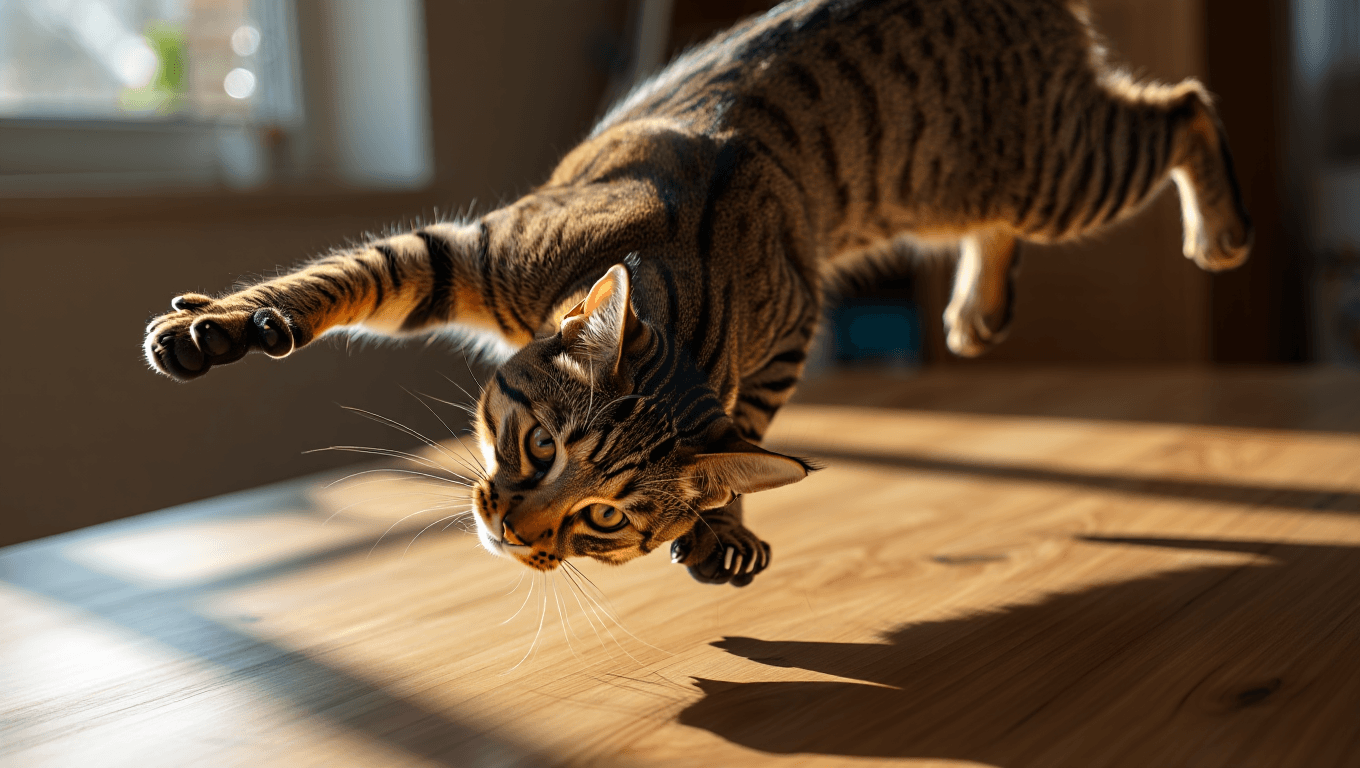
New research from Yamaguchi University sheds fresh light on how cats consistently land on their feet, revealing that spinal anatomy, not just nimble reflexes, plays a key role. The finding explains a long-standing biomechanical puzzle and has potential implications for robotics design and veterinary care.
Scientists have long been captivated by the so-called “falling cat problem” — how a falling feline can reorient itself midair without obvious external forces. The new study shows that the cat’s backbone is not uniformly flexible: the front part twists more readily, while the lower back stays comparatively rigid. That difference lets the body rotate in two phases, front then rear, producing a controlled midair turn.
What the researchers did
The team examined spinal columns taken from five donated cat cadavers, preserving ligaments and intervertebral discs to keep joint mechanics realistic. They measured torque, rotation angle, stiffness and the mechanical “neutral zone” — the small range where segments move with minimal resistance.
To match the lab work with living behavior, researchers also recorded two live cats dropped from roughly one meter onto soft cushions using a high-speed camera. The videos captured the sequence of rotation and the timing between the front and rear halves of the body.
Key findings
The mechanical tests revealed a clear contrast between regions of the spine. The thoracic segments — the upper and mid-back — showed about three times the rotation range of the lumbar segments in the lower back. The thoracic area also exhibited a sizeable neutral zone of roughly 47 degrees; the lumbar area had virtually none and was notably stiffer.
High-speed footage confirmed the two-stage rotation in live animals. In the trials, the front half of a cat rotated first, followed milliseconds later by the rear. Recorded delays between front and back rotations were about 94 milliseconds and 72 milliseconds in the two animals filmed.
- Thoracic spine: greater flexibility and a large neutral zone, allowing the front body to pivot with little resistance.
- Lumbar spine: stiffer and less rotatable, which helps the rear follow in a controlled way rather than twisting as a single rigid unit.
- Live observations: sequential rotation timing aligns with the mechanical differences measured in cadaver spines.
Why this matters
Understanding this front-first, back-second rotation clarifies a century-old curiosity and anchors it in measurable anatomy. For designers of agile robots and drones, the study points to a compact mechanical strategy for midair reorientation: variable stiffness along a central structure can produce coordinated, efficient turns without external control surfaces.
For veterinarians and animal biomechanists, the results refine how we think about spinal function in cats — relevant for diagnosing injuries, planning surgeries, or improving rehabilitation approaches. The work also underscores that small regional differences in flexibility can produce large effects on whole-body movement.
While the sample size was limited and live trials were few, the combination of mechanical measurement and high-speed observation gives a cohesive picture of how cats exploit spinal mechanics to perform their famous landings. Further studies with more animals and dynamic modeling will help translate these insights into practical applications.
Similar Posts
- Fisherman Survives Terrifying Attack: Impaled by 60-Pound Fish Through Skull and Throat!
- Amsterdam’s New Tiny Staircases: A Lifeline for Stray Cats in Iconic Canals!
- Secrets Unveiled: Why Orange Cats Boast Their Vibrant Coats!
- 5 Essential Life Lessons From My Cat: Discover Feline Wisdom!
- Cats Prefer Men Over Women? Discover Why Your Feline Meows More!

Miles Harper focuses on optimizing your daily life. He shares practical strategies to improve your time management, well-being, and consumption habits, turning your routine into lasting success.