
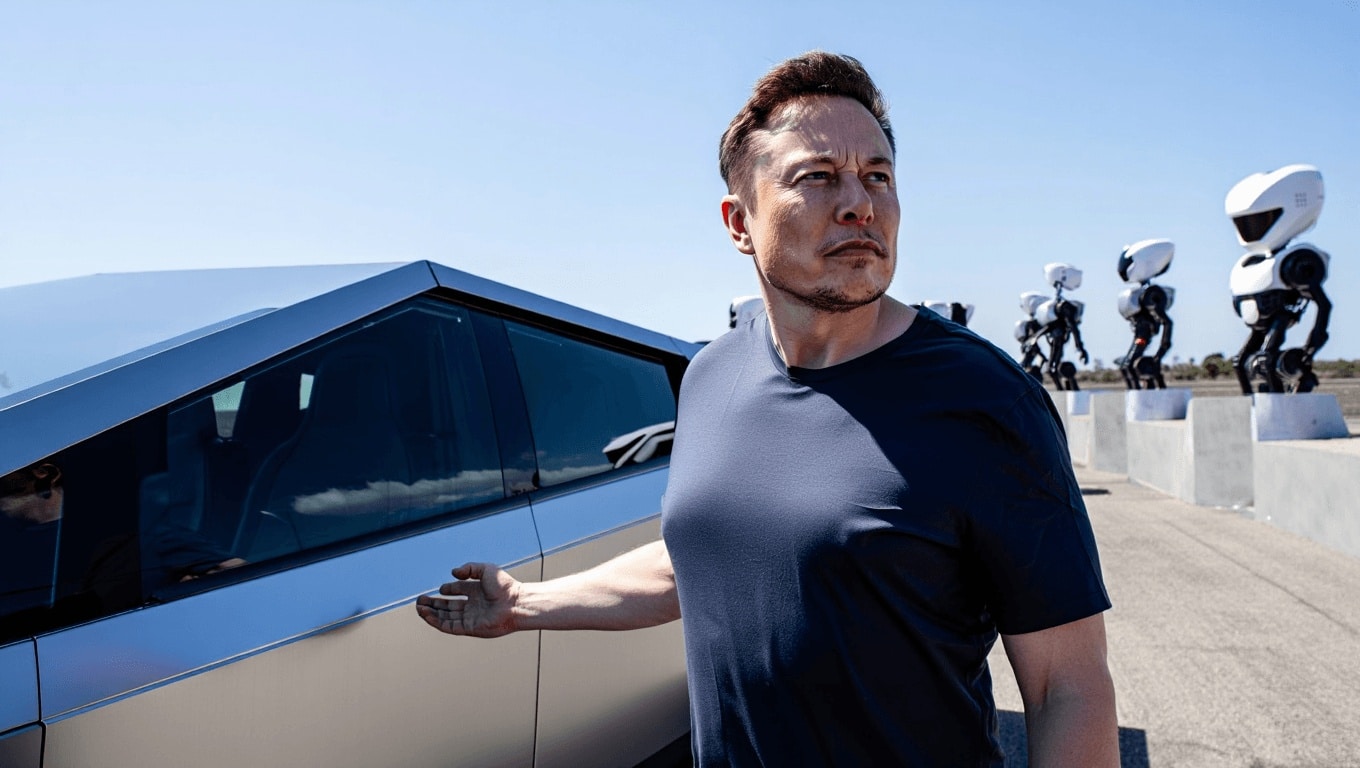
Elon Musk told followers on X this week that two of Tesla’s most hyped projects—the proposed Cybercab robotaxi and the Optimus humanoid—are not yet ready for mass production, a setback that could have sizable financial and strategic consequences for the automaker. The admission underlines growing uncertainty about whether Tesla can translate years of demonstrations and lofty promises into sustainable revenue streams from robotics and autonomous mobility.
What Musk acknowledged
In a post on X, Musk conceded that neither the Cybercab nor Optimus has reached a production pace he considers viable. He framed the issue as a manufacturing and engineering challenge rather than a change in long-term commitment, but the public admission from Tesla’s CEO marks a rare, direct acknowledgment of missed expectations on two headline-grabbing initiatives.
The significance goes beyond optics. Both projects have been pitched as future growth engines—robotaxis that could lower the unit cost of ride services and humanoid robots that could address labor shortages and create new revenue streams. Delays push those potential revenue sources further into the future, even as development costs continue.
Why this matters now
Tesla is juggling several capital-intensive priorities: ramping electric vehicle production, expanding energy storage and solar businesses, and advancing its Full Self-Driving software. Slower-than-expected progress on Cybercab and Optimus increases the risk that investment in those programs won’t pay off quickly, which can drag on margins and investor confidence.
- Financial pressure: Continued R&D and factory readiness costs without corresponding sales can increase near-term cash burn.
- Timing gap: Delayed rollouts postpone any revenue contribution from robotaxis or humanoid units.
- Competitive dynamics: Rivals focused on autonomous ride-hailing or robotics could seize market share while Tesla works through production hurdles.
- Regulatory and operational risk: Even when production begins, rules and safety validation for robotaxis may slow commercial deployment.
Engineering complexity and factory realities
Bringing a robotaxi or humanlike robot to mass production involves distinct hurdles rarely encountered in traditional auto manufacturing. Software, sensors, custom chassis designs and entirely new assembly processes must all be integrated and made reliable at scale.
Manufacturing lines optimized for cars are not necessarily suited to build robots, and retooling or building new facilities consumes capital and management focus. That tension—continuing to develop novel products while maintaining high-volume EV output—helps explain why Musk framed the issue as a production problem rather than a strategic retreat.
Market implications and investor reaction
Investors have long priced Tesla’s future growth beyond electric vehicles into the valuation. Public setbacks on highly anticipated projects can prompt reassessment of those assumptions. Short-term stock volatility is possible, but the longer-term effect depends on how quickly Tesla can demonstrate a credible path to scalable production.
Meanwhile, competitors and partners in the autonomous and robotics spaces will be watching for signs of technical or regulatory win points. Any delay gives others time to close technical gaps or secure commercial partnerships that may make it harder for Tesla to dominate those markets later.
What to watch next
Key indicators that will signal progress or deeper trouble include prototype validation milestones, announced factory investments specific to robotic production, third-party testing results for autonomy, and any shift in Tesla’s financial disclosures that outlines incremental spending on these initiatives.
For now, Musk’s message is a reminder that turning bold prototypes into mass-produced products is rarely easy—or quick. The company can still succeed with Cybercab and Optimus, but the timeline and cost to get there are likely to be longer and larger than many had expected.
Similar Posts
- Tesla Sued by French Drivers: Anger Over Elon Musk’s Right-Wing Politics
- Musk to Exit Government Role? White House Issues Urgent Statement
- Elon Musk humanoid robots to overhaul factories: AI-run 12-hour shifts with no breaks
- Waymo Robotaxis Collide: Confusion Leads to Third Taxi Incident, Street Blocked!
- Chicago candy factory files bankruptcy: century-old maker at risk after massive losses

Calvin Baxter is an economic analyst specializing in the evolving US labor market. He leverages real data to provide you with concrete recommendations and help you adjust your professional strategies.