
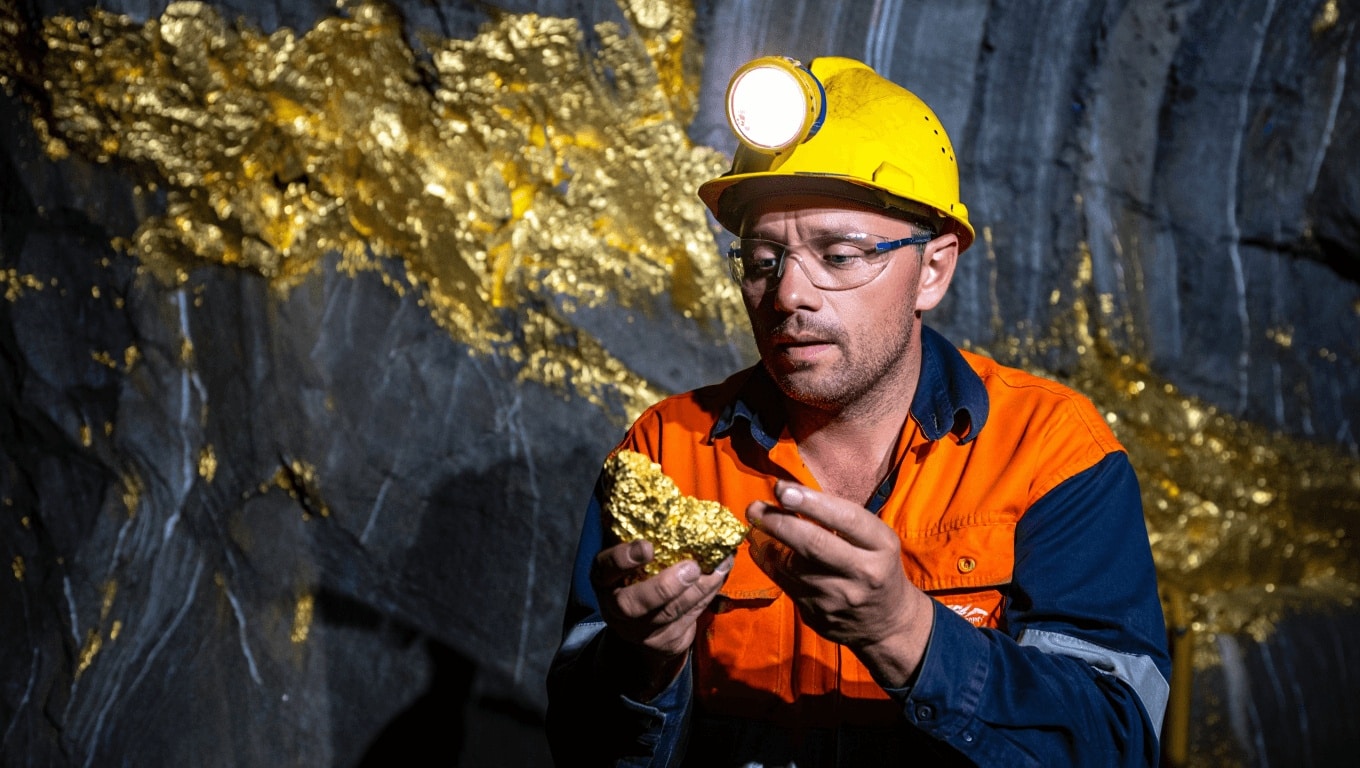
A newly identified gold-bearing zone lying about 2,000 meters beneath the surface has sparked renewed attention across the mining sector and among policy makers. Preliminary geophysical surveys and early drilling suggest the deposit could rank among the world’s largest, a finding that matters now for markets, local economies, and long-term resource planning.
How the deposit was found
Exploration teams used a combination of advanced seismic imaging, gravity surveys and targeted core drilling to map the structure. The work focused on deep-seated mineralization rather than the near-surface deposits most commonly exploited by open-pit methods.
The initial data indicate a concentrated zone of sulfide-hosted mineralization at depth. While the discovery is technically promising, industry analysts caution that substantial additional work is required before the site can be classified as a recoverable reserve.
What this could mean
If follow-up drilling and feasibility studies confirm the current signals, the deposit could reshape regional mining prospects and long-range gold supply forecasts. That potential drives interest from investors, governments and companies already active in deep mining.
- Economic implications: large projects can bring investment and jobs but demand long lead times and significant capital.
- Technological demands: mining at 2,000 meters requires specialized equipment for hoisting, cooling and ventilation.
- Environmental and social considerations: deeper operations change tailings, water and energy profiles and require stronger oversight.
- Market impact: discovery does not automatically change short-term prices, but it can alter long-term supply expectations.
Technical and operational hurdles
Extracting ore from such depth is expensive and complex. Temperatures rise, rock stresses increase, and access becomes more constrained the deeper a mine goes. That raises both engineering challenges and safety considerations for any future operation.
Energy consumption and ventilation alone can be major cost drivers. Companies would need to evaluate whether the ore grade and volume justify the required investment in shafts, pumps, and refrigeration systems to manage heat.
Environmental and regulatory scrutiny
Deep mining changes the environmental footprint of a project. Tailings management, groundwater protection and seismic monitoring become higher priorities when operations extend far below the water table.
Permitting processes typically lengthen for projects of this scale. Local communities and regulators will expect thorough environmental impact assessments and clear plans for long-term monitoring and remediation.
Context and comparison
Large gold deposits are rare and historically develop into multi-decade operations. While the new find has been compared in scale to some of the world’s major mines, such comparisons remain provisional until the deposit’s extent and recoverable grade are firmly established.
Experts note that a discovery’s value depends on more than size: ore quality, accessibility, political stability and infrastructure all determine whether a deposit becomes a producing mine.
Next steps and timeline
Industry-standard progression includes expanded drilling programs, metallurgical testing to gauge recovery rates, and phased feasibility studies. Even under optimistic projections, it can take several years—often a decade or longer—from discovery to production.
During that period, stakeholders will weigh economic benefits against technical difficulties and environmental obligations. How those trade-offs are managed will determine whether the deposit moves from a promising find to a long-term source of gold.
For now, the discovery highlights how advances in exploration technology are uncovering resources that were previously invisible—and how those finds force a re-evaluation of what deep mining can mean for economies, communities and the metals market worldwide.
Similar Posts
- China gold deposit found 3,000 meters down could be worth more than a country’s entire GDP
- China gold discovery valued at $85.9B found 2,000m deep: geologists probe if it tops 1,000 tons
- China uncovers 1,444-ton gold cache worth $150 billion: largest find since 1949
- China gold find tops 1,000 tons, valued at $86 billion: could redraw global supply map
- Largest iron deposit found in Australia: 5.7 billion-ton reserve dates back billions of years

Calvin Baxter is an economic analyst specializing in the evolving US labor market. He leverages real data to provide you with concrete recommendations and help you adjust your professional strategies.