
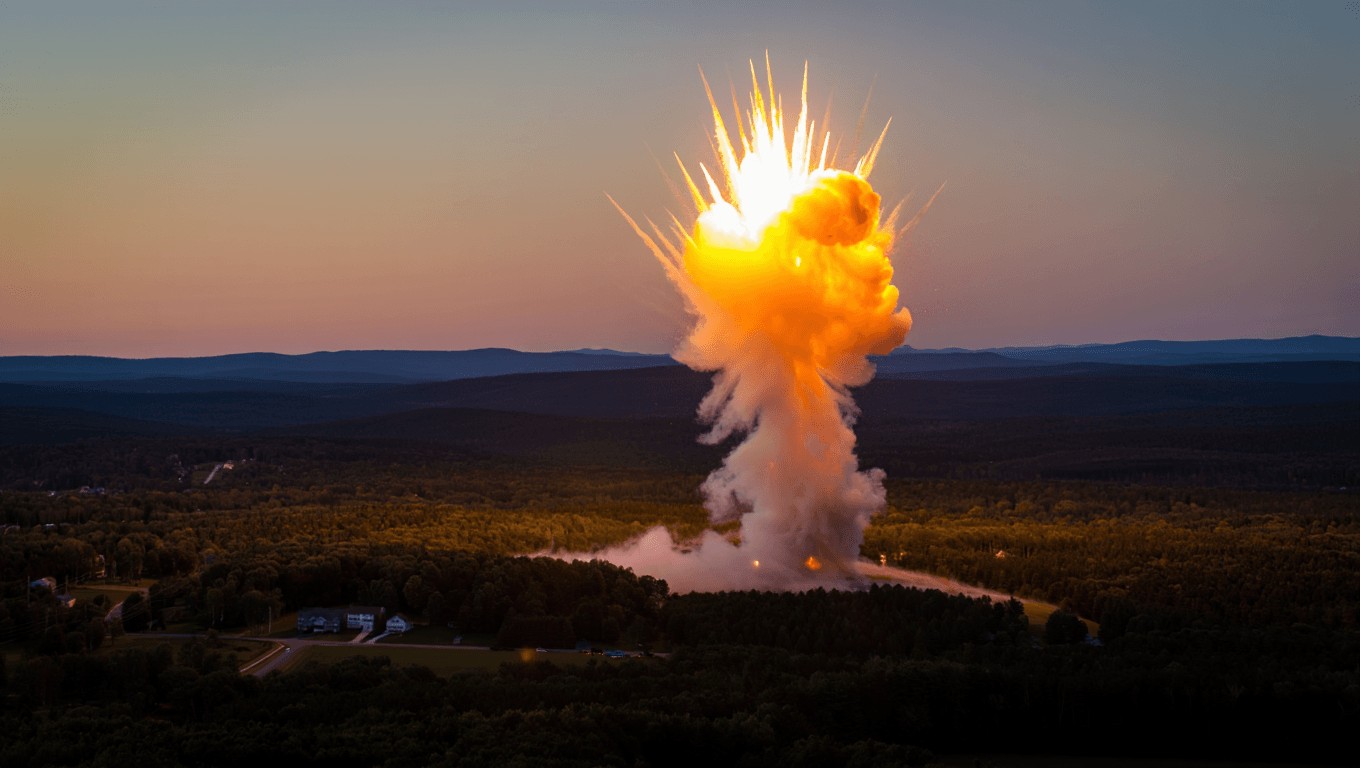
Residents across northeastern Massachusetts and southeastern New Hampshire were startled Saturday afternoon by a thunderous blast and trembling ground that turned out not to be an earthquake but a meteor exploding high above the region. Authorities and satellite data confirmed the event posed no danger to people on the ground, but it underscores how often small space rocks intersect Earth’s atmosphere—and how visible those encounters can be.
What happened in the sky
Shortly after 2 p.m., a bright fireball tore across the New England sky at extremely high speed. Scientists say the object was traveling on the order of tens of thousands of miles per hour before it broke apart in the upper atmosphere.
The disintegration occurred at an altitude roughly equivalent to 40 miles, releasing energy comparable to several hundred tons of TNT. Because the blast happened so high, no fragments reached the surface and there were no reports of injuries or property damage.
How experts confirmed the blast
Both eyewitnesses and instruments registered the event. Weather satellite imagery from GOES-19 captured the glowing streak as it moved across the sky, while ground reports logged a loud shock and ground shaking that felt like a small tremor.
The U.S. Geological Survey checked seismic records and found no earthquake activity tied to the reports; instead, officials described the phenomenon as a widespread sonic boom caused by a suspected bolide—a very bright meteor that explodes as it passes through the atmosphere. State emergency managers also received multiple calls about the blast and subsequent vibrations.
- Time: About 2:06 p.m. local time on Saturday
- Speed: Roughly 75,000 miles per hour (as estimated by scientists)
- Altitude of breakup: Approximately 40 miles above the surface
- Estimated energy: About 300 tons of TNT equivalent
- Impact on ground: No debris reported; no injuries or damage
Why this matters now
Most small meteors burn up harmlessly, but explosions high in the atmosphere can still create startling effects on the ground — loud booms, windows shaking, and social media buzz that prompts emergency calls. Events like Saturday’s provide useful data for atmospheric scientists and improve models used to track incoming objects.
Routine monitoring by satellites and detection networks helps differentiate natural meteors from man-made reentries, which can behave differently and occasionally pose a risk of surviving debris. In this case, agencies determined the event was a natural space rock, not a piece of human-made space junk.
What scientists and officials are watching next
Researchers will comb through satellite imagery, infrasound and other sensor data to refine estimates of the meteor’s trajectory, composition and energy release. Those analyses help improve early-detection systems and inform public-safety messaging for future events.
For residents, the takeaway is straightforward: loud, brief explosions in the sky often have tranquil outcomes on the ground, but they are worthy of verification by officials so authorities can confirm there’s no lingering hazard.
Shortly after the blast, agencies posted updates to reassure the public and to collect any additional sightings that could sharpen scientists’ calculations. Expect follow-up notes from NASA and regional emergency managers as the event is logged into global meteor databases.
Similar Posts
- Near-Earth objects that could end life: how close they’ve come to striking Earth
- Greenland’s Ice Catastrophe: 23 Billion Gallons of Water Released in Massive Melt
- Asteroid skims past Earth after late detection: scientists caught off guard
- Asteroid Threatens Moon with Massive Crater in 2032: City-Killer Impact Looms
- Pilot Hurt as Mystery Space Object Hits Plane: Shocking Mid-Air Collision!

Miles Harper focuses on optimizing your daily life. He shares practical strategies to improve your time management, well-being, and consumption habits, turning your routine into lasting success.