
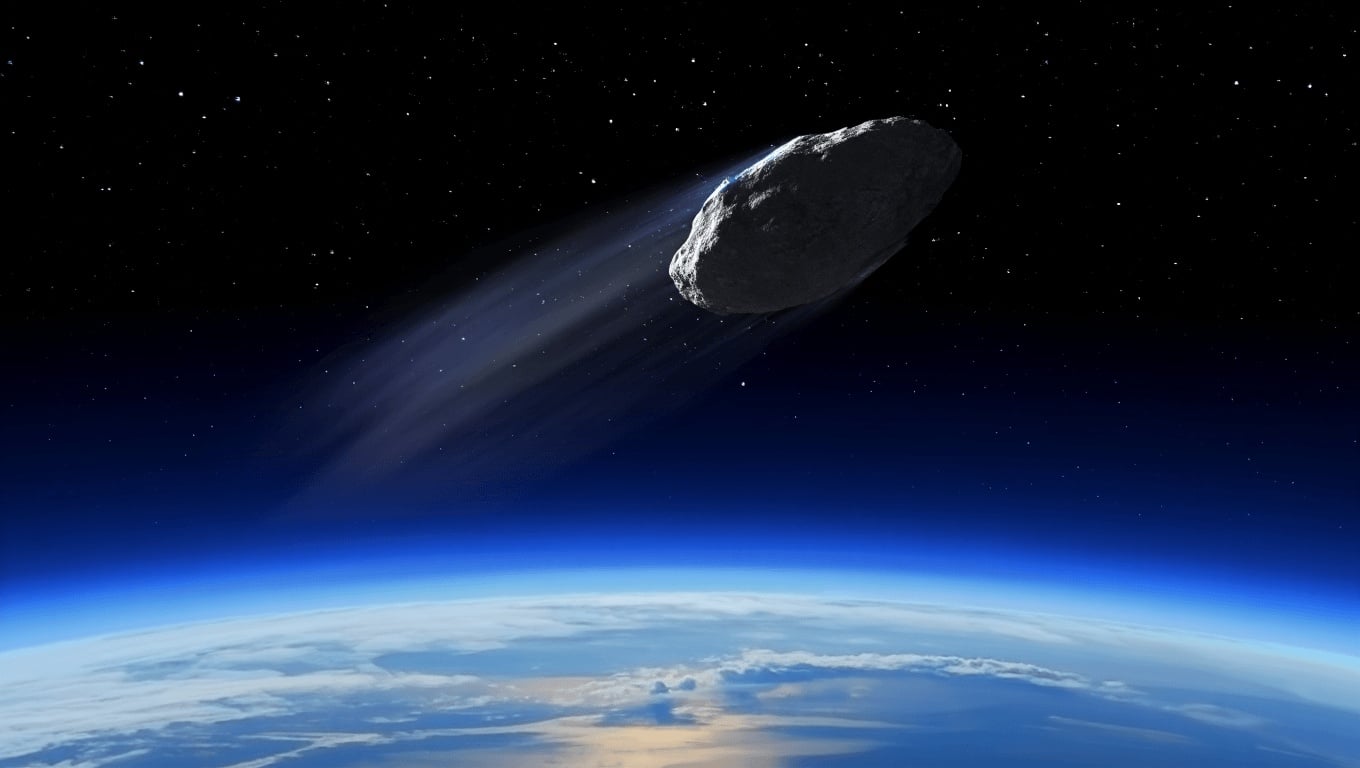
A bus-sized asteroid swept past Earth within about 56,000 miles this week, a close shave that underscores persistent gaps in our early-warning systems. Scientists confirmed the object posed no threat, but it was not identified until just days before its nearest approach — a reminder that short lead times remain a real problem for planetary defense.
The space rock, cataloged as 2026 JH2, is estimated between roughly 50 and 115 feet across and was moving at more than five miles per second when it passed by. Ground-based observers in Arizona, Kansas and New Mexico reported the detection only days ahead of the flyby.
- Closest approach: ~56,000 miles from Earth — about one-quarter of the distance to the Moon.
- Size estimate: 50–115 feet (roughly the length of a small bus to a city block).
- Speed: just over 5 miles per second.
- Detection timeframe: discovered days before the pass by several survey telescopes.
- Context for 2026: one of the closest known asteroid flybys recorded this year; dozens of near-Earth passages are expected annually.
Why the near-miss matters
Objects in this size range are capable of causing widespread damage if they strike a populated area. The 2013 Chelyabinsk event — an airburst from a smaller asteroid — injured more than a thousand people and damaged buildings across a wide region of Russia. That incident, like this week’s close pass, arrived with little or no warning.
Detecting these rocks is difficult because they are relatively small and dim against the star field. Current survey networks do find many near-Earth objects, but most are discovered only when they’re already close. That short notice severely limits response options if a different trajectory puts a city or region at risk.
There is a bright spot: recent missions have shown that altering an asteroid’s path can work. NASA’s DART mission successfully changed the trajectory of a test target, proving deflection is feasible — but that only helps if we know about the threat early enough to act.
Experts and space agencies continue to expand search capabilities by deploying more sensitive telescopes, wider sky coverage, and infrared systems that can spot dark, hard-to-see objects. International coordination is also advancing so detection leads into practical response plans more quickly.
Still, this close pass is a clear reminder that discovery does not always come far enough in advance. Short-notice detections of sizable rocks are likely to continue until survey speed and coverage improve, meaning preparedness and investment in early warning remain priorities for planetary safety.
Similar Posts
- Asteroid Threatens Moon with Massive Crater in 2032: City-Killer Impact Looms
- Near-Earth objects that could end life: how close they’ve come to striking Earth
- Mysterious Interstellar Object Nears Earth: Scientists Baffled by Odd ‘Heartbeat’ Pulse!
- Meteor explodes over New England: blast equal to 300 tons of TNT lights up sky
- Mysterious Glowing Object Spotted in Our Solar System: Could It Be Interstellar?

Miles Harper focuses on optimizing your daily life. He shares practical strategies to improve your time management, well-being, and consumption habits, turning your routine into lasting success.