
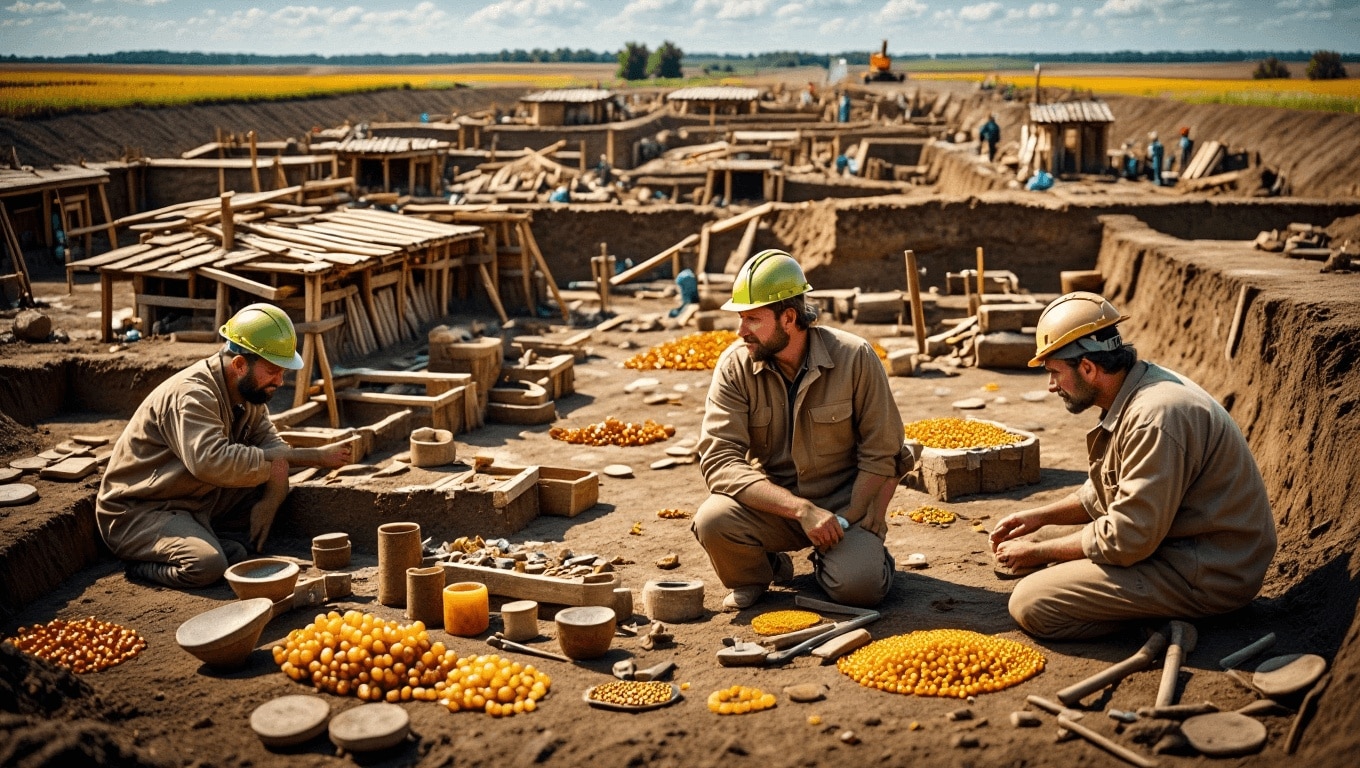
What began as a standard survey ahead of highway work outside Hradec Králové has revealed one of Bohemia’s most significant Celtic sites: a sprawling settlement covering roughly 62 acres. The discovery — which unearthed coins, Baltic trade goods and signs of organized craft production — could rewrite how archaeologists view regional trade and industry in the Iron Age.
A routine check turns into a major find
Archaeologists who were surveying the area prior to construction uncovered concentrations of artifacts over a wide area, prompting a larger excavation. What initially looked like scattered remains quickly revealed a densely occupied settlement with structural traces and workshop debris rather than a transient stopping point.
On the ground, the picture is clear: this was a settled community engaged in more than simple subsistence. The scale and diversity of material recovered point to a place with sustained economic activity and far-reaching connections.
Key discoveries
- Gold and silver coins — numismatic finds indicate monetary exchange and possible links to broader Celtic networks.
- Baltic amber — the presence of this imported material suggests long-distance trade routes extending to northern Europe.
- Crafting debris and workshop layouts — evidence of metalworking and specialized production, implying this site functioned as a production center, not merely a transit hub.
- Spatial spread — the site’s large footprint challenges expectations for settlement size in this part of Bohemia during the presumed period.
What this changes
If current interpretations hold, the site alters several assumptions about Iron Age Bohemia. A settlement of this size with organized workshops signals a higher degree of economic complexity and suggests it played a role in regional distribution networks.
Importantly for modern planners and heritage managers, the find underscores how infrastructure surveys can reveal major archaeological resources. Early-stage investigations are proving vital to preserving and studying buried landscapes before construction alters them irreversibly.
Broader implications
Beyond academic interest, the discovery has practical consequences. It may affect ongoing and future development plans in the area, prompt expanded excavations, and attract international collaboration to study trade links — especially the movement of Baltic amber and metal goods across Europe.
Local tourism and cultural programming could also change if the site is conserved and interpreted for the public, creating opportunities — and responsibilities — for regional authorities to balance preservation with access.
Next steps
Archaeologists will continue systematic excavation and analysis to refine dating, map the settlement’s layout, and better understand production processes identified at the workshops. Specialists in archaeometallurgy and trade networks are likely to be brought in to trace material sources and manufacturing techniques.
For now, the find serves as a reminder that routine checks can yield transformative insights into the past — and that the ground beneath contemporary development projects may still hold unexpected chapters of Europe’s ancient history.
Similar Posts
- Karnataka village yields 14 gold coins: soil hints at bigger archaeological find
- Roman denarii: 934 coins unearthed near Cologne in Germany’s largest Hadrian-era hoard
- Denmark’s largest Viking silver hoard found during patio work: 18.5 kg, runic word stumps experts
- Ancient Pleasure Boat Uncovered: 2,000-Year-Old Shipwreck Off Egypt’s Coast Revealed!
- War elephants unearthed in Spain: bones tied to 2,200-year-old conflict

Calvin Baxter is an economic analyst specializing in the evolving US labor market. He leverages real data to provide you with concrete recommendations and help you adjust your professional strategies.