
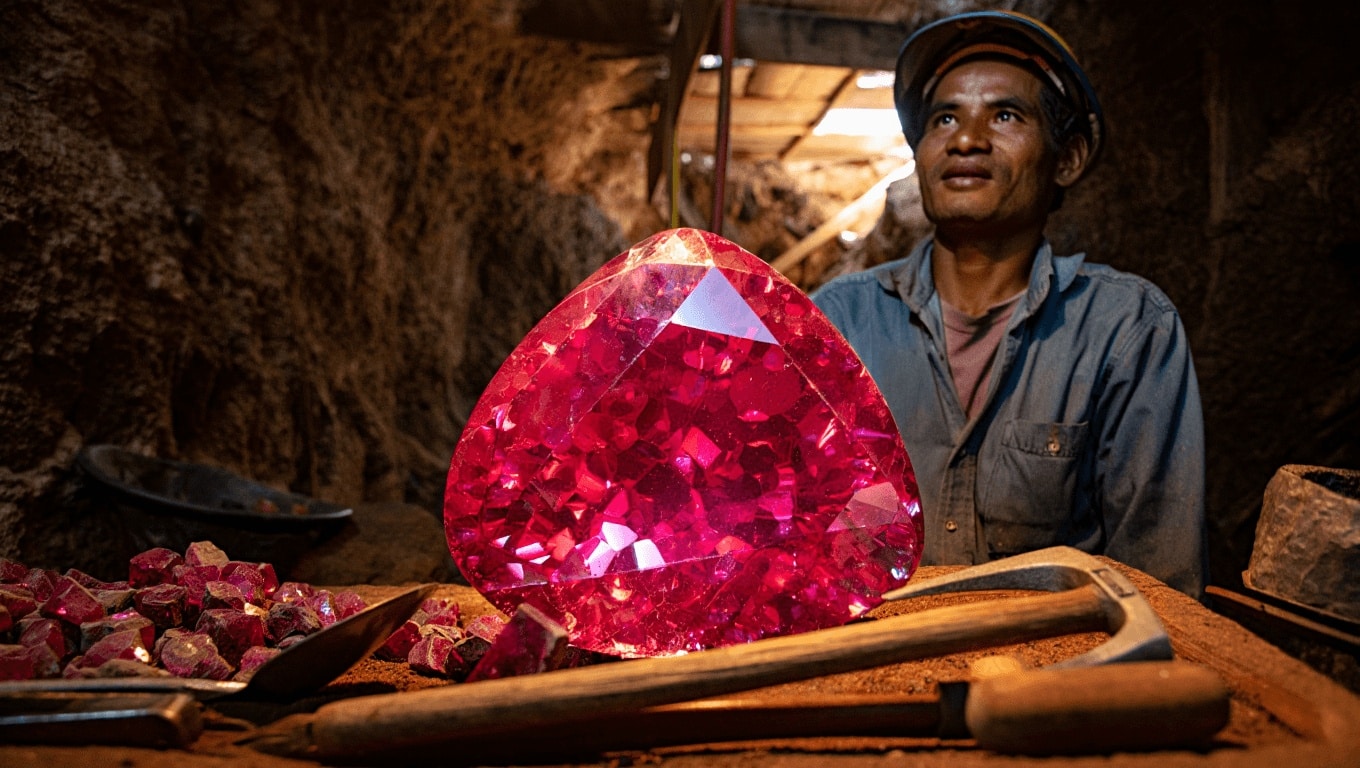
The discovery of an 11,000-carat ruby in Myanmar — roughly 4.85 pounds — has reopened urgent questions about how high-value gemstones are priced, tracked and brought to market. Beyond the headline number, the find matters now because it exposes long-standing gaps in provenance, regulatory oversight and the economic stakes for buyers, sellers and communities where gems are mined.
The stone’s sheer size makes it newsworthy, but its market path is anything but straightforward. Very large rough rubies rarely sell as a single finished gem: decisions about cutting, certification and ownership will determine whether it becomes a museum-quality jewel, a set of smaller stones, or a privately held curiosity. Each route carries different risks for valuation and for the traceability that consumers increasingly demand.
Why a single discovery can ripple through the market
Gem prices don’t scale linearly with weight; they depend heavily on color, clarity and cut potential. A massive rough ruby may contain pockets of weakness that reduce yield, or it might reveal a gem of exceptional color that draws collector-level bids. That uncertainty makes early estimates of value speculative at best.
More immediately, the news forces a reappraisal of how the industry verifies origin. For years, Myanmar (also known as Burma) has been a major source of high-quality rubies, but the country’s political situation and longstanding concerns about labor and governance complicate the flow of gemstones into international markets. For buyers and policymakers, the practical question is not only “How much is it worth?” but “How do we know where it came from?”
Traceability, certification and practical limits
Efforts to improve transparency have accelerated across the jewelry supply chain, but a single giant stone highlights the limitations of current tools. Lab reports and gemological grading can confirm physical characteristics, while documentation and export records can suggest origin, yet neither solves every problem.
In many mining areas, especially artisanal operations, records are sparse and verifying a continuous chain of custody from mine to market is challenging. Technologies like blockchain and digital tagging are being piloted, but widespread adoption remains uneven and costly.
- Buyers: Collectors and high-end retailers face higher scrutiny and potential reputational risk if provenance is unclear.
- Insurers: Large, uninsured or poorly documented gems create valuation headaches and higher premiums.
- Regulators: Authorities must balance trade restrictions, sanctions and the need for traceable exports.
- Local communities: Mining income can be significant, but opaque supply chains may divert value away from workers and landowners.
- Market intermediaries: Cutting, grading and consigning decisions will shape final value more than the initial carat weight.
How the market typically handles giant finds
| Characteristic | Large rough ruby (e.g., 11,000 ct) | Typical gem (1–5 ct) |
|---|---|---|
| Primary buyers | Collectors, museums, private investors | Retail customers, bridal market |
| Certification path | Extensive lab analysis, provenance documentation | Standard grading reports |
| Traceability difficulty | High — requires rigorous chain of custody | Lower — often sold through established retail channels |
| Price volatility | High — value sensitive to cutting outcome and rarity | Moderate — more predictable based on market benchmarks |
The choices made in the coming weeks — who acquires the stone, how it’s documented and whether it is cut — will inform market signals for months. Auctions and private sales both play out differently: auctions can set headline prices but may not guarantee transparent provenance; private deals can preserve confidentiality but obscure origin and terms.
What this means for consumers and the industry
For everyday buyers, the immediate takeaway is practical: provenance matters more than ever. A gem’s reported carat weight is only one piece of its value story. Increasingly, consumers and retailers are asking for clear documentation that ties a stone back to its source and confirms ethical supply-chain practices.
For the industry, the find is a reminder that governance, certification and investment in traceability infrastructure are not optional extras. High-profile stones draw public attention and regulatory scrutiny, and they can accelerate calls for standards that were previously easy to ignore.
Watch for a few concrete developments in the near term: auction or sale announcements, lab reports clarifying quality and origin, and statements from industry groups or regulators about export and certification requirements. Those signals will shape not just the fate of this single ruby, but market expectations for other high-value gemstones.
The 11,000-carat discovery is both a rarity and a test case: it spotlights how value is created and measured in an old industry still grappling with modern demands for transparency. How the stone is handled will set precedents that affect prices, policy and consumer trust long after the headlines fade.
Similar Posts
- Gold bars, almost 1,000 coins up for auction in France: lot tops $2 million
- Rare 1943 coin resurfaces: millions once hunted it during currency changeover
- Vietnam frozen whitefish exports to U.S. rise 4% Jan-Apr 2026, easing supply crunch
- Electric cars and wind power costs driven by rare-earth magnets: AI unveils magnet-free fix
- Rare earths: Sweden’s 2.2 million-ton Per Geijer find threatens China’s processing monopoly

Calvin Baxter is an economic analyst specializing in the evolving US labor market. He leverages real data to provide you with concrete recommendations and help you adjust your professional strategies.