
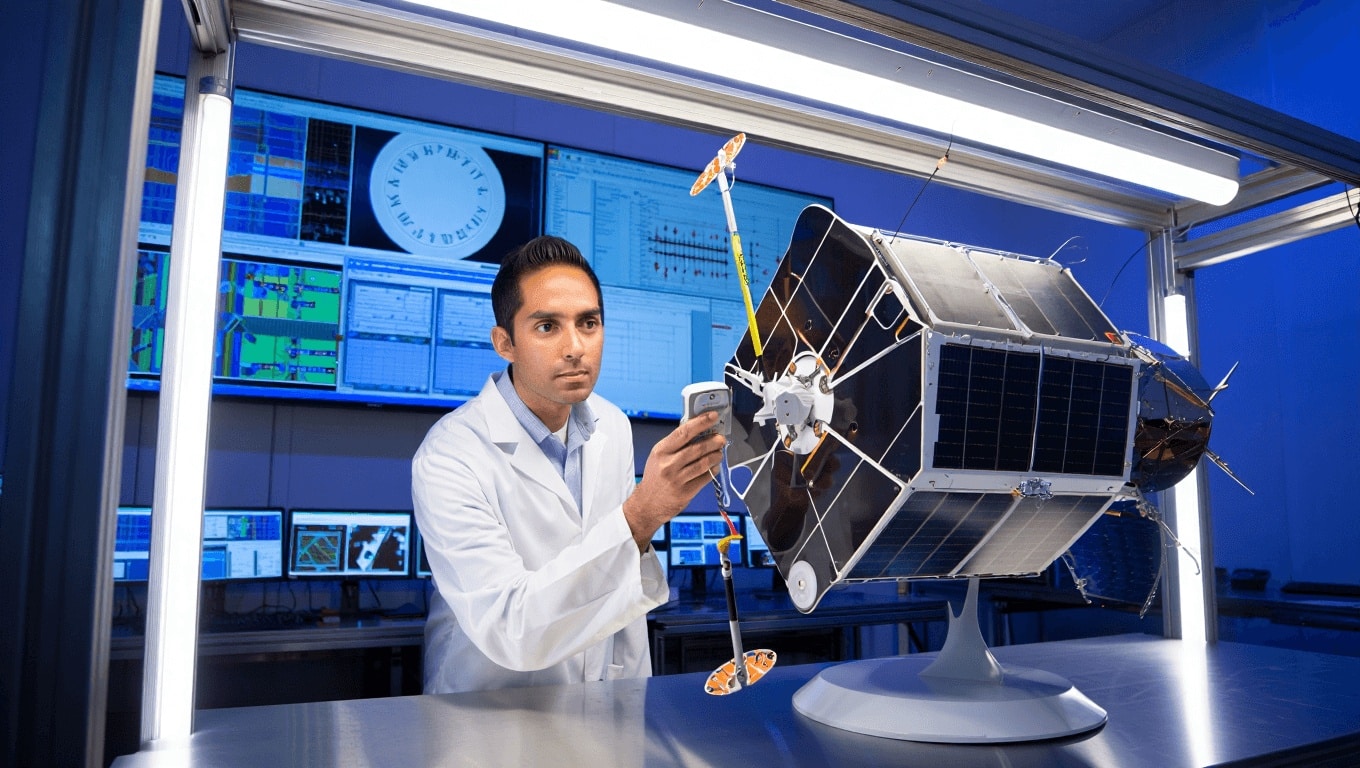
A new study from an MIT researcher outlines a way to check whether a satellite is carrying a nuclear device — a capability that would close a long-standing verification gap in space arms control. The proposal relies on natural radiation belts around Earth and, if practical, could let inspectors detect a weapon without detonating anything or opening the satellite.
Current treaties, notably the 1967 Outer Space Treaty, ban nuclear weapons in orbit, but enforcing that ban is difficult because there is no routine, reliable way to inspect satellites. That uncertainty has long been a blind spot for arms-control experts: satellites can be maneuvered and their contents are opaque to observers on the ground.
Detecting a signature in the Van Allen belts
MIT physicist Areg Danagoulian lays out a theoretical approach that uses the charged-particle environment of the Van Allen radiation belts. These belts are populated by energetic protons and electrons trapped by Earth’s magnetic field. When those protons strike fissile materials — uranium or plutonium — they can eject neutrons in a process known as spallation.
Those neutrons form a distinct signal compared with the normal background radiation around a satellite. Danagoulian’s calculations indicate that a detector package equipped with sensitive neutron detectors could pick out that signature while distinguishing it from other sources of radiation in space.
Physically, the proposed inspector would be compact: roughly the size of a large reference book. Performance estimates cited by the researcher suggest a detection probability near 99 percent after the inspector orbits within about 4,000 meters of a target for roughly a week. Closer approaches — on the order of 1,000 meters — or deploying multiple inspector satellites could reduce that time to hours.
- Device footprint: approximately the volume of a large encyclopedia or reference book.
- Detection range and time: ~4,000 meters for ~one week to reach ~99% confidence; ~1,000 meters or several inspectors can cut detection time to hours.
- Signal mechanism: neutron bursts from spallation when energetic protons hit fissile material.
- Current status: theoretical feasibility study, not a ready-to-launch system.
The study is strictly theoretical: it examines whether the physics and instrumentation could, in principle, produce a clear and measurable signal. It does not present a flight-ready design or address the full engineering challenges of long-duration operation in low-Earth orbit.
Beyond the technical feasibility, deploying such an inspection capability raises practical and political questions. Getting within a few kilometers of another nation’s satellite involves complex proximity operations that carry collision and debris risks. It would also require diplomatic agreements or new norms to authorize inspections without being seen as hostile or intrusive.
Policy experts point out that a verification tool like this could strengthen arms-control regimes by providing tangible evidence, not just declarations. But translating a lab calculation into a usable verification asset would demand funding, on-orbit testing, and legal frameworks that balance transparency with national-security concerns.
There are also strategic considerations: a reliable way to detect fissile material in orbit could deter covert deployment, but it might spur countermeasures, such as shielding or evasive maneuvers, that complicate inspection. Any operational program would have to weigh these second-order effects.
For the public, the practical takeaway is immediate: a nuclear detonation in low-Earth orbit would not look like a conventional attack; it would produce a burst of radiation that can cripple communications, navigation, and weather and Earth-observation systems, potentially disrupting modern life for months or years. That consequence underlines why some researchers see value in pursuing verification tools even before they are technically mature.
Danagoulian’s paper, recently published in Nature, opens a path from theoretical physics to a possible inspection capability. The concept will need follow-up work — prototype detectors, simulation and test flights, and international dialogue — before it could become part of any verification regime. Still, the proposal reframes a basic question for space security: if a clear, non-destructive method exists to confirm whether a satellite carries a weapon, should the international community pursue it?
Similar Posts
- Satellite debris threatens global services: one major solar storm could spark cascading collisions
- Space Garbage Crisis: Scientists Propose Plasma Trash Collector to Clean Up
- Meteor explodes over New England: blast equal to 300 tons of TNT lights up sky
- Near-Earth objects that could end life: how close they’ve come to striking Earth
- 9 Deadly Dangers of Space: How the Cosmos Can End Your Life

Miles Harper focuses on optimizing your daily life. He shares practical strategies to improve your time management, well-being, and consumption habits, turning your routine into lasting success.