
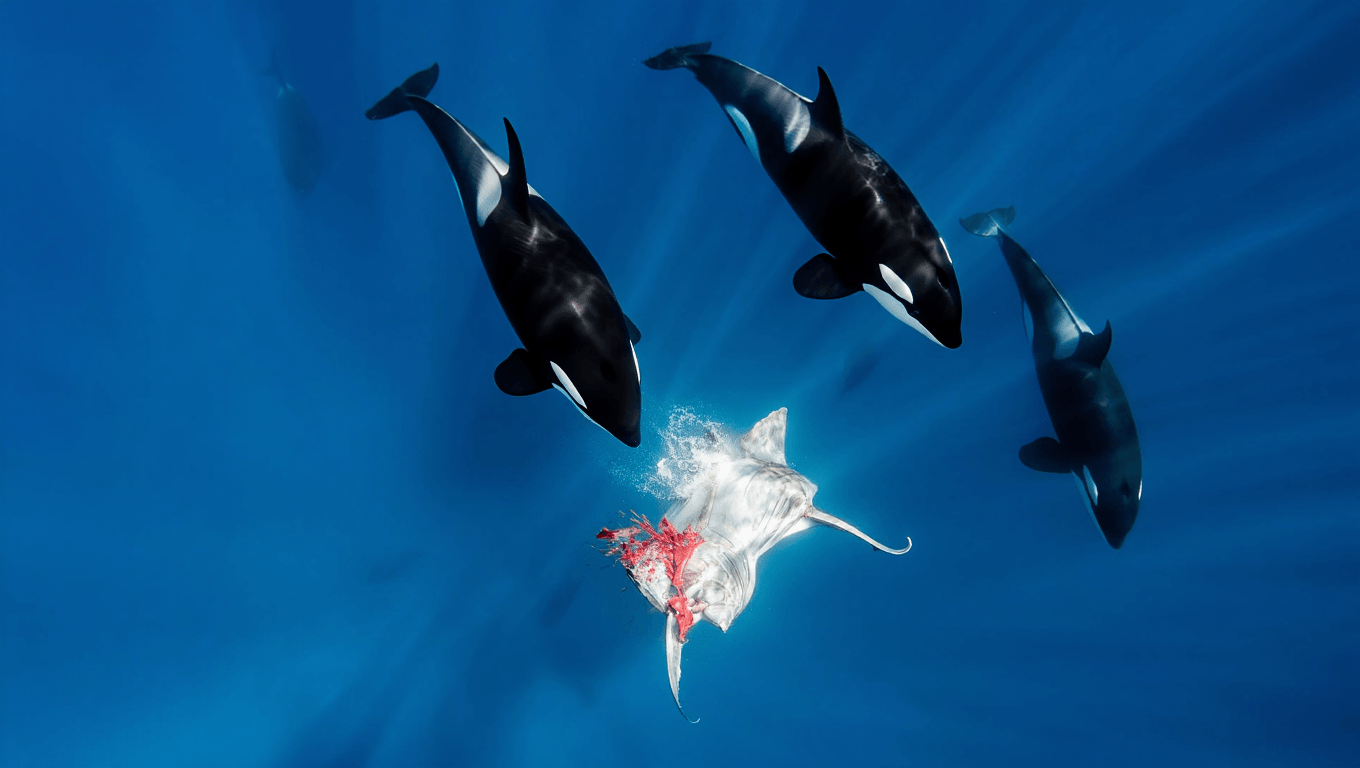
Scientists have reported a striking new hunting and butchery method by orcas in the Gulf of California: coordinated ramming of giant sunfish that breaks the animals apart, allowing the whales to feed. The behavior, recorded in a study published this year, offers fresh evidence of orca innovation and may shed light on how hunting techniques spread within pods.
Researchers documented three incidents — in December 2021, and again in 2024 and 2025 — in which pairs of orcas worked together to fragment large sharptail mola, a species of sunfish that can exceed a ton in weight. The observations, described in Frontiers in Ethology, show a repeatable, highly choreographed sequence that appears aimed at overcoming the mola’s unusually tough outer layer.
How the tactic unfolds
Video analysis shows the same pattern each time: one whale pins or stabilizes the fish while a second builds speed and slams into the carcass. The collision is so forceful that the sunfish’s dense tissues rupture, scattering pieces that the pod then consumes.
- Hold: One orca secures the sunfish, preventing it from drifting away.
- Launch: A partner swims back to gain momentum.
- Impact: The charging orca strikes the carcass, shattering the collagen-rich skin.
- Feed: Whales — including juveniles in at least one case — move in to eat the fragments.
Researchers note an important detail: the sunfish were already dead and partly disemboweled before the ramming. That suggests the high-speed collisions serve less as a killing method and more as a practical way to access meat from an otherwise impenetrable carcass.
What makes sunfish tough to eat
Sharptail mola have an unusually dense, collagen-saturated hide that resists tearing. Conventional biting or tugging doesn’t reliably open the body cavity. By converting kinetic energy into localized shattering, the orcas effectively bypass the need to peel or puncture the skin.
That physical constraint appears to have driven a behavioral workaround: using one whale as an anvil and the other as a hammer to concentrate force at impact points. The result is a fast, efficient breakage of tissue into pieces small enough for consumption.
For scientists studying social learning in cetaceans, the presence of young whales feeding immediately after impacts is notable. It supports the idea that complex hunting techniques are taught within pods rather than invented independently by every individual.
How this fits into orca culture
Orcas are known for regional and pod-specific hunting strategies — from the coordinated “carousel” feeding on herring in northern waters to wave-washing small seals in polar regions. The Gulf of California ramming behavior may be a local innovation in the early stages of diffusion across a group.
Because the observations are limited to three events so far, researchers caution against overgeneralizing. More footage and longer-term monitoring are needed to determine whether the tactic becomes a stable tradition, spreads among neighboring pods, or remains a rare, opportunistic method.
Why this matters now
Understanding these tactics helps scientists map how orcas adapt to different prey and environments — information that matters for conservation planning and for interpreting shifts in marine food webs. Behavioral flexibility can influence which species are vulnerable to predation and how energy flows through local ecosystems.
It also sheds light on orca cognition and social learning: a method that involves timing, coordination, and role differentiation suggests advanced problem-solving and cultural transmission — traits that affect how populations respond to changing oceans.
Researchers plan to keep monitoring the area and to compare this behavior with other documented hunting cultures worldwide. If the ramming technique recurs, it will offer a living example of how a novel feeding method can emerge and possibly become entrenched within a whale community.
Similar Posts
- Orcas Attack: Stunning Photos Capture Deadly Hunt of Endangered Blue Whale!
- Killer Whales and Dolphins Team Up: Watch Their First Joint Hunt Filmed Live!
- Humpback whales opening wide: researchers explain viral mouth-opening clips
- Scientists Discover Youngest Mammoth Bones Ever: They Turned Out to Be Whales!
- Spiders Trap Fireflies to Attract More Prey: See How They Do It!

Miles Harper focuses on optimizing your daily life. He shares practical strategies to improve your time management, well-being, and consumption habits, turning your routine into lasting success.