
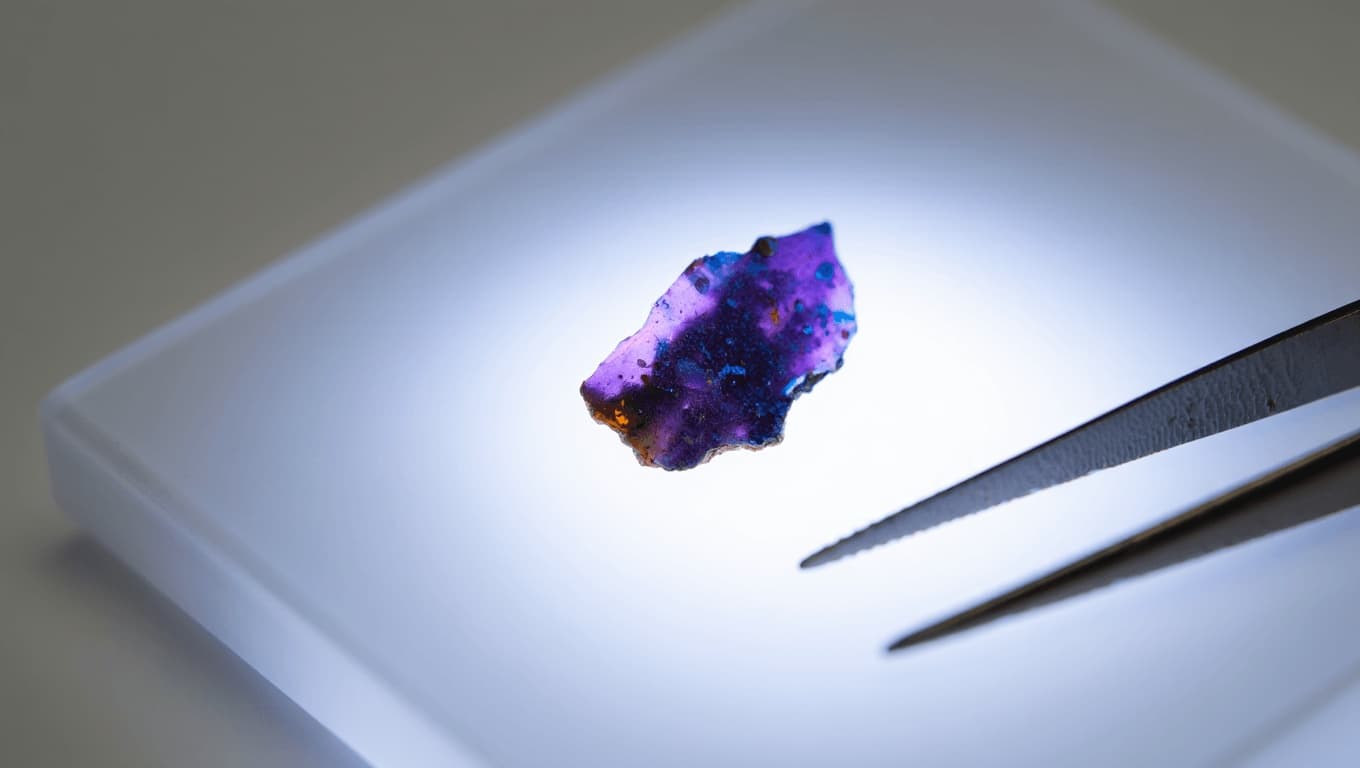
A newly recognized mineral species weighs just under 0.011 ounces—about 0.31 grams—and is known from a single naturally occurring sample. That tiny fragment highlights how incomplete and vulnerable the scientific inventory of Earth’s minerals still is, and why even the smallest finds matter for geology, conservation and museums.
The mineral was recently accepted into the formal registry used by mineralogists, a process that requires detailed description and review by the scientific community. Because only one natural specimen is known, researchers now face a narrow window to study its chemistry, structure and origin before that sample is damaged, lost or becomes otherwise inaccessible.
To put its size in perspective: the specimen weighs less than a standard paperclip. Although many mineral species are identified from millimeter-scale grains, the fact that a new species exists as a sole natural example makes it especially fragile as a source of scientific data.
Why the recognition matters now
The formal acceptance of a mineral into the scientific record is not merely symbolic. It establishes a type specimen, a reference that other researchers rely on when comparing and classifying materials. When that reference exists only once, the stakes rise: any loss or contamination can erase crucial evidence about how that mineral formed and what environments create unusual chemistry in Earth’s crust.
At the same time, the find underlines a broader truth about mineralogy: despite decades of fieldwork and analysis, scientists have cataloged only a fraction of what the planet may contain. Today there are roughly six thousand recognized mineral species, but new discoveries—often from micro‑samples, mine tailings, or overlooked museum holdings—continue to emerge.
What this reveals about scientific practice
Several routine facts of modern science make single‑specimen discoveries both possible and precarious. Advanced imaging and microanalysis allow researchers to identify distinct atomic arrangements from tiny fragments. Yet the same technologies also expose how much of our knowledge depends on the survival and accessibility of a few curated objects in collections around the world.
- Restricted access: A solitary natural sample limits opportunities for independent verification and repeated analyses.
- Conservation risk: Physical degradation, improper storage, or damage during study could permanently remove the only natural example.
- Provenance concerns: Incomplete collection records complicate efforts to place the mineral in its geological context.
- Research bottlenecks: Laboratories must balance destructive testing with preserving the specimen for future study.
| Attribute | Detail |
|---|---|
| Approximate weight | 0.011 ounces (≈ 0.31 grams) |
| Number of known natural specimens | 1 |
| Recognition body | International mineralogy community registry |
| Research implications | Limited sampling; urgent need for high‑resolution, non‑destructive study |
Preserving scientific value in cases like this requires careful handling and clear documentation. That includes depositing the reference piece in a secure, publicly accessible repository, creating detailed digital records—high‑resolution imagery and spectral data—and encouraging collaborative studies that minimize destructive testing.
Beyond laboratory work, the situation touches on policy and funding: natural history collections often operate on tight budgets, and micro‑specimens can be overlooked in favor of larger, more visually striking items. A single tiny mineral thus becomes a test case for how well the scientific community safeguards rare natural information.
Ultimately, a pebble no heavier than a fingernail serves as a reminder. The steadily growing list of recognized minerals masks gaps in sampling, documentation and preservation. Protecting those small, fragile entries in Earth’s catalog is essential if researchers hope to reconstruct planet‑scale processes—and to avoid losing pieces of geological history before they can be understood.
Similar Posts
- Aletai meteorite fragment seized in Russia: 2.8-ton, $4.2M piece smuggled as garden ornament
- Oldest octopus record overturned: specimen isn’t an octopus
- Fossil discovery reveals prehistoric giant: researchers call it the last titan
- Sahara’s Volcanic Crater Resembles a Giant Skull: See the Stunning Images!
- Satellites hiding nukes: scientists unveil plan to detect nuclear weapons in orbit

Calvin Baxter is an economic analyst specializing in the evolving US labor market. He leverages real data to provide you with concrete recommendations and help you adjust your professional strategies.