
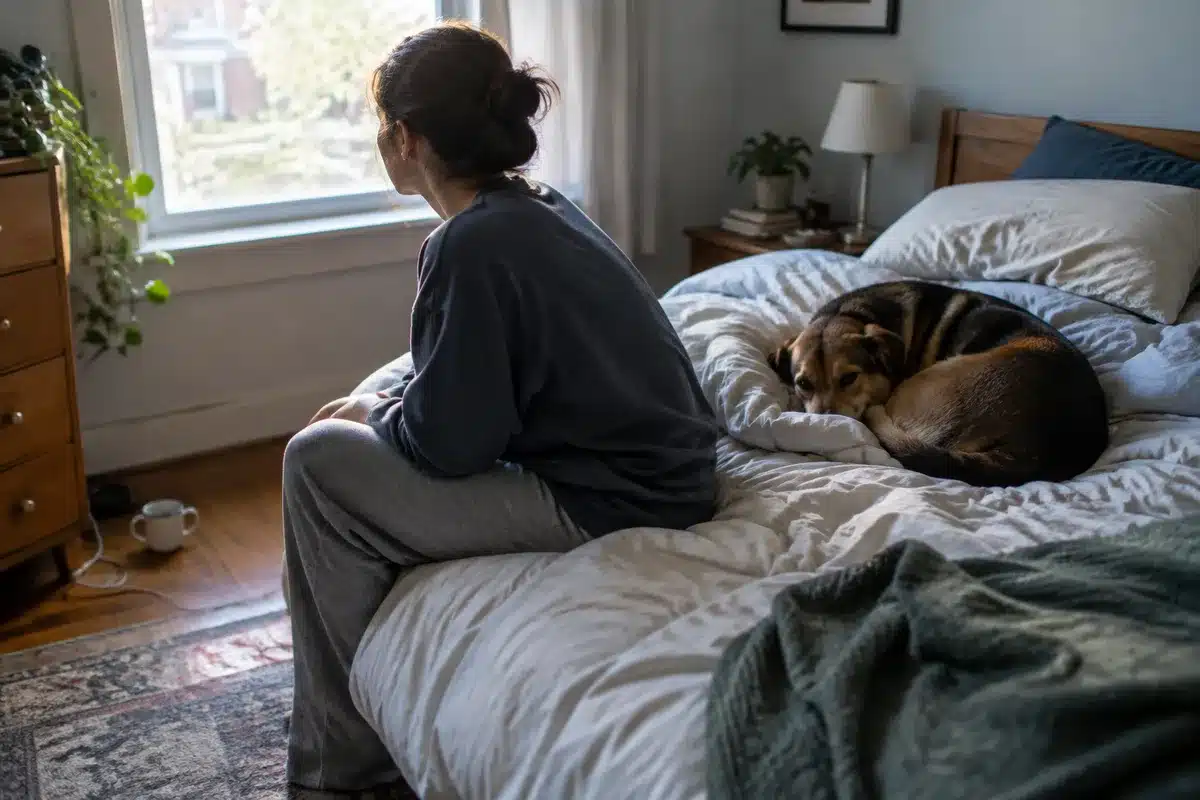
Many dog owners wake up convinced their pet is the reason for a restless night. A new study published in PLOS One, however, flips that assumption: wearable sensors suggest people are more often the ones disturbing their dogs’ sleep. That finding could change how owners think about bed-sharing and nighttime routines.
Who moved first?
Researchers at the University of Toronto and Duke University tracked sleep activity in 25 people and 38 sled-type dogs — mostly huskies and malamutes — over four weeks using fitness trackers. When both the human and the dog stirred at the same time, the data showed the person moved first in 45 percent of those paired events. Dogs initiated only 18 percent of simultaneous disturbances.

The contrast between perception and measurement was striking: many owners reported in surveys that their pets disrupted their rest, especially when more than one dog shared the home. But objective metrics such as total sleep time and overall sleep efficiency did not differ depending on whether the dog slept on the bed, on the floor, or in another room.
What this means for pet owners
Far from being a nuisance, dogs may actually help anchor human sleep patterns. The study describes them as informal biological cues — a kind of natural zeitgeber — that can encourage consistent bedtimes. That stability can be beneficial for people who struggle to maintain a regular sleep schedule.

That said, the findings don’t erase all nighttime trade-offs. Certain breeds or health conditions can still cause problems: a bulldog with breathing issues or a very large dog that monopolizes the mattress may create genuine sleep disturbances for their owners.
- Sample: 25 humans, 38 dogs (huskies and malamutes).
- Duration: Four weeks of tracking with wearable sensors.
- Key result: In joint movements, humans moved first 45% of the time; dogs only 18%.
- Objective sleep measures: Total sleep time and sleep efficiency were unchanged by where the dog slept.
Experts in sleep and animal behavior say this research should prompt a nuanced view of bed-sharing. For many people, a pet can be a comfort that helps establish a bedtime routine. For others, individual circumstances — breed, size, health — will still determine whether sharing the bed helps or harms rest.
Limitations and next steps
The study’s relatively small sample and focus on huskies and malamutes mean its conclusions may not apply to all dogs. Additional research across a wider range of breeds and household types would help clarify how broadly these patterns hold.
Until then, owners should weigh the personal benefits of nighttime closeness against any real sleep problems. If poor rest is persistent, a talk with a veterinarian about a pet’s health or a sleep specialist about human sleep habits is a practical next move.
In short: if you blame your dog for tossing and turning, the sensors suggest it’s worth checking the mirror — your rest might be the source of theirs.
Similar Posts
- Dog owners’ odd habits sparking neighbor complaints: what it means for you
- 5 Warning Signs of Dementia in Dogs: Spot the Symptoms Early!
- Better sleep linked to specific dream type: study finds
- Doctors Reveal: Worst Sleeping Position for Adults—Perfect for Babies!
- 5 Sleep Tips That Could Worsen Your Insomnia: Here’s What to Avoid!

Miles Harper focuses on optimizing your daily life. He shares practical strategies to improve your time management, well-being, and consumption habits, turning your routine into lasting success.