
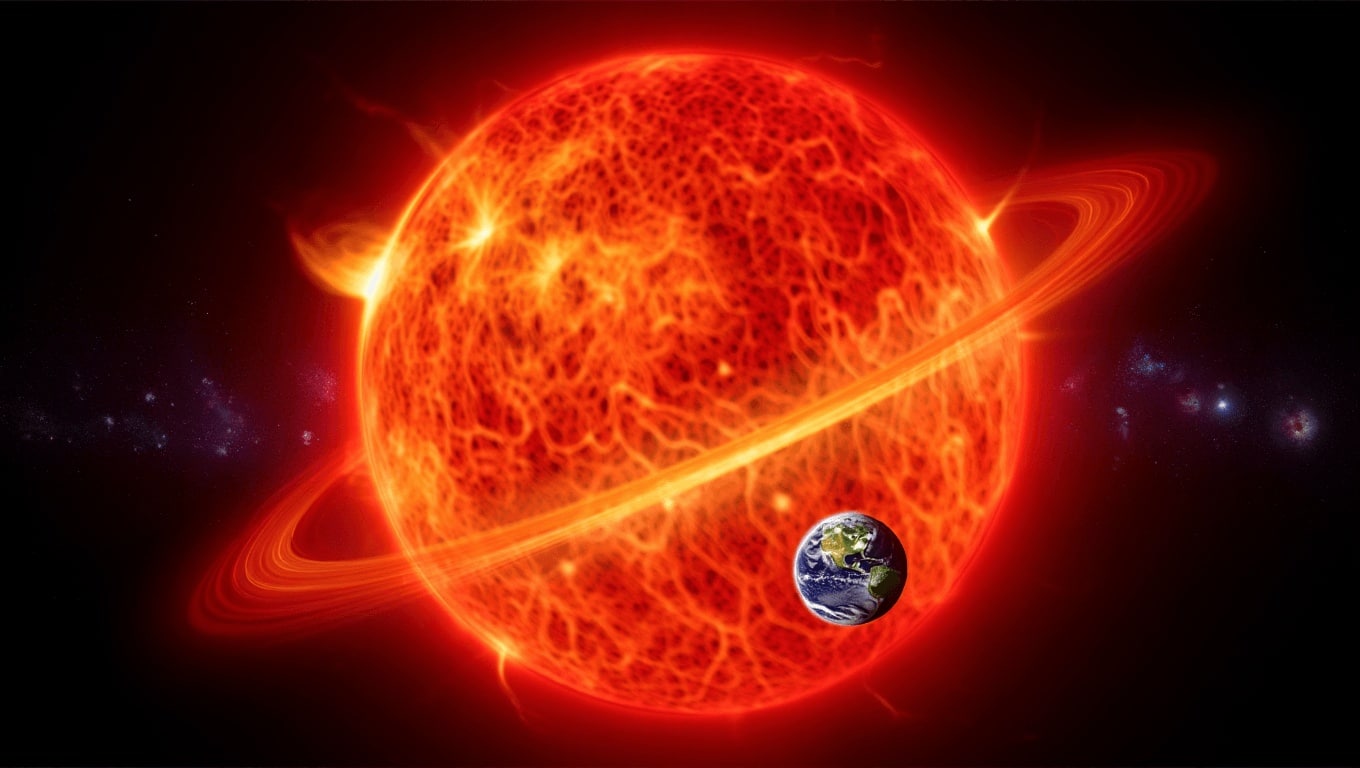
A fresh analysis published in Astronomy & Astrophysics suggests Earth may avoid being swallowed when the Sun puffs up into a red giant in roughly 5 billion years. That shifts a long‑standing picture of the solar system’s late stages—but it doesn’t mean our planet will remain hospitable.
For decades, standard models predicted the Sun’s expansion would overrun the inner planets, ultimately consuming Mercury, Venus and Earth. The new work uses updated simulations and observations of a nearby Sun‑like star, L2 Puppis, to revisit that forecast and to weigh two competing effects that decide a planet’s fate.
How the cosmic tug‑of‑war plays out
The future depends on a balance between two forces. As the star expands, its outer layers draw planets inward through tidal forces. At the same time the aging star sheds mass via powerful stellar winds, weakening its gravity and allowing planetary orbits to drift outward.
The revised models suggest those tidal interactions are less effective than earlier calculations implied. With stronger mass loss and weaker tidal drag, Earth’s orbit could widen enough to remain outside the Sun’s swollen envelope. Under the same scenarios, Mars is likely to escape engulfment as well; Mercury and Venus, however, would almost certainly be lost.
Researchers reached these conclusions by combining improved physics in their numerical models with empirical data from L2 Puppis, a nearby star that appears to be in a late evolutionary stage similar to what the Sun will experience. That observational anchor helped constrain assumptions about how fast mass is lost and how the star’s outer layers behave.
Why “not swallowed” isn’t the same as “safe”
Even if Earth avoids being physically engulfed, survival is not the same as habitability. Long before the Sun reaches its maximum size, rising luminosity will evaporate the oceans, strip the atmosphere, and sterilize the surface.
In short: the planet may remain intact as a rocky body, but it will no longer support life as we know it. Any biological or technological civilization still present would face conditions far harsher than today.
- Timescale: The relevant changes occur on a timescale of billions of years—roughly around the 5‑billion‑year mark for the Sun’s red‑giant phase.
- Likely casualties: Mercury and Venus are expected to be consumed; Earth and Mars may survive the engulfment phase under the new models.
- Main drivers: The competition between tidal forces pulling planets inward and mass loss from stellar winds pushing them outward determines the outcome.
- Scientific impact: The findings refine models of late stellar evolution and inform expectations for the fates of exoplanets orbiting aging stars.
Beyond satisfying curiosity about a distant future, this study has immediate relevance for astronomers. More accurate treatments of mass loss and tides will change predictions for many star‑planet systems and help interpret observations of evolved stars with surviving planetary companions.
Finally, while the results give a different ending than the classic “Sun swallows Earth” narrative, they don’t improve short‑term prospects for life on our planet. The message for now is scientific: our picture of the solar system’s finale is being refined, not reversed.
Similar Posts
- Astronomers spot inverted planetary system: planet formation theories upended
- Twenty-seven candidate planets orbiting two suns could rewrite exoplanet rules
- Venus Unveiled: Massive Subterranean Tunnels Could Redefine Alien Search!
- Jupiter Outshines All Stars This Weekend: Best Tips to Witness the Spectacle
- Supernova Alert: Witness a Star Explode This Week—Find Out How!

Miles Harper focuses on optimizing your daily life. He shares practical strategies to improve your time management, well-being, and consumption habits, turning your routine into lasting success.