
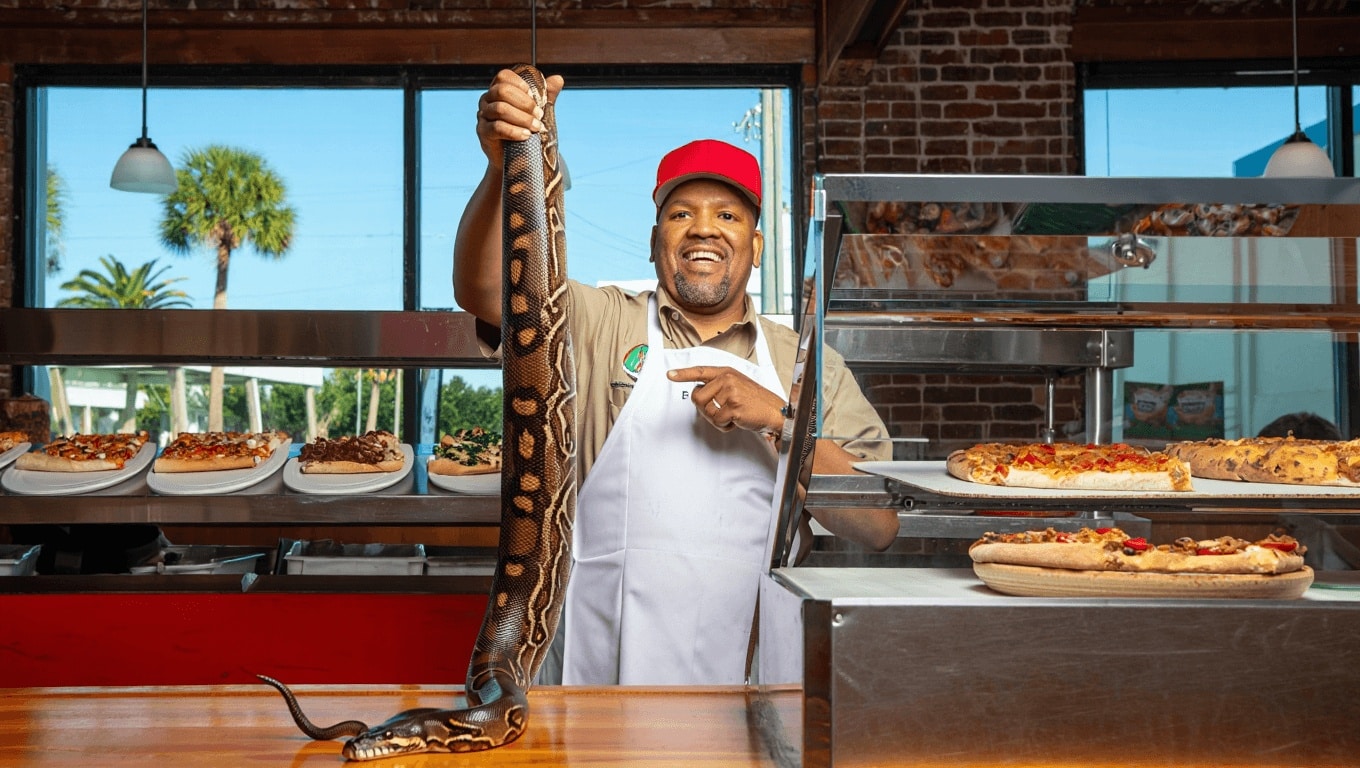
During the recent Florida Python Challenge, a small Everglades City eatery turned carcasses into cuisine — trading free specialty pizzas for recently and humanely killed Burmese pythons. The stunt drew attention because it paired a quirky local initiative with a statewide effort to curb a growing ecological crisis.
Dustin Crum, who runs Wildman’s Pizza, Pasta and Python, spent about ten days accepting dead snakes in lieu of payment while the state competition ran through July 19. The annual event, which this year offered roughly $25,000 in prize money, invites hunters to comb the Everglades for Burmese pythons and other invasive reptiles.
From carcass to crust
Crum says he repurposes nearly every part of the animals brought to his counter. He uses rendered fat for topical products, turns bones into jewelry, and incorporates python meat into pizzas and other dishes that patrons receive at no charge — a constraint he attributes to local health regulations that limit how such meat can be sold.
- How it worked: Bring a recently and humanely killed python; exchange it for a free large specialty pizza.
- Reuse and recycling: Fat for skin creams and soaps, bones for keepsakes, meat used in complimentary menu items.
- Legal limits: Health rules prevent direct sale of python meat, so the restaurant gives it away rather than charging customers.
Local participants — including many young people who joined hunts but didn’t always know what to do with the carcasses — benefited from a hot meal, while Crum gained materials for his craft and products. He framed the offer as a practical way to ensure nothing was wasted.
Where this fits into a larger fight
The effort comes against a backdrop of mounting concern over an established invasive predator in South Florida. Wildlife biologists estimate there may be between 100,000 and 300,000 Burmese pythons in the state, animals that have drastically reduced native bird, mammal and reptile populations since their introduction decades ago.
Female pythons can lay around 70 eggs in a single clutch, a reproductive capacity that helps explain why small eradication campaigns struggle to make a dent. Officials and conservation groups consider the infestation among the toughest invasive-species problems anywhere on Earth.
State-organized removal contests have expanded since they began in 2013. The most recent full event drew scores of volunteers from across the country and topped out last year with nearly 1,000 participants traveling from more than two dozen states and Canada; those teams removed a record number of snakes, and the top hunter that year reported hauling in 60 pythons over ten days.
Still, experts warn that even large, organized hunts remove only a sliver of the population. Creative local responses like Crum’s are drawing attention and encouraging participation, but they are not a substitute for the broad, sustained management strategies conservationists say are needed.
For now, the exchange at Wildman’s is a snapshot of how some communities are trying to adapt: practical reuse, community engagement, and a dose of local flair. It’s a reminder that confronting an ecological challenge as large as Florida’s python invasion will require a mix of scaled-up policy action and the small, inventive efforts unfolding at the ground level.
Similar Posts
- Alligators Unveiled: The Unsung Heroes Protecting the Everglades
- Why Vegans Infuriate People: Science Explains the Rage
- Top 5 Unsafe Foods to Skip at Restaurants: Safety Experts Advise
- SNAP Overhaul Alert: 8 States Announce Major Changes Impacting Millions
- Home Cafes Surge in Popularity: Is Coffee Outing Becoming a Luxury?

Miles Harper focuses on optimizing your daily life. He shares practical strategies to improve your time management, well-being, and consumption habits, turning your routine into lasting success.