
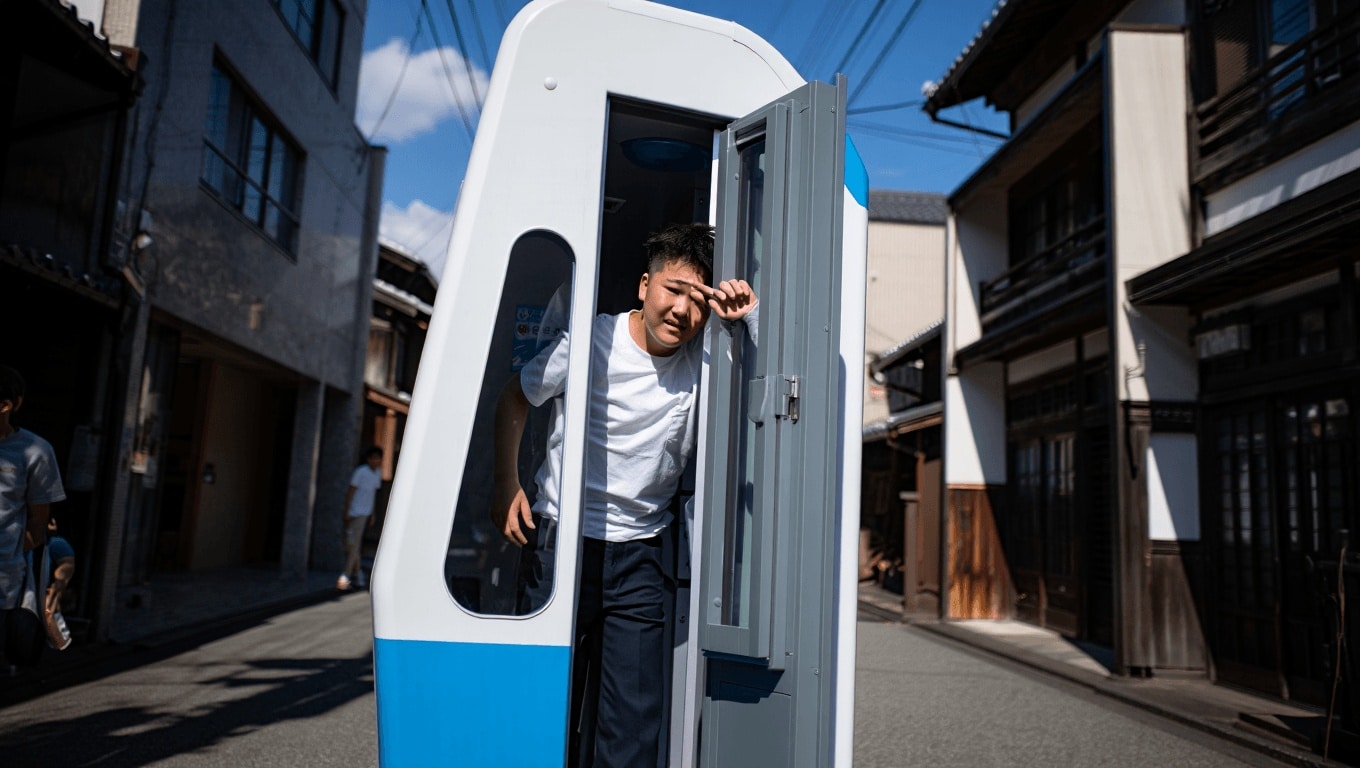
Japan is testing a new way to beat record summer heat: a walk-in cooling booth shaped like a vending machine that chills a person for a short period. The device is designed to bring down core temperature quickly, a response to soaring heat-related hospitalizations that health officials say have reached historic levels.
Engineered by SDRS and marketed through industrial supplier Trusco Nakayama, the unit — called the Do Hiemon Box — resembles a glass-fronted vending machine and is built to cool a seated person rather than an entire room. Users sit inside while jets of air, chilled to roughly 5°C (41°F), are directed at the head, neck, shoulders and upper back; the cabin itself stays near 15°C (59°F). Manufacturer testing indicates about 10 minutes inside can lower body temperature and ease symptoms associated with heat exhaustion.
How the device works
The Do Hiemon Box offers several airflow intensities and automatically shuts off after 20 minutes to avoid overcooling. It’s mobile — mounted on casters — so it can be moved without installation and placed where workers or the public need relief.
- Airflow settings: three levels
- Targeted air temperature: ~5°C (41°F) directed at the upper body
- Cabin ambient temperature: about 15°C (59°F)
- Automatic shutoff: 20 minutes
- Energy use: roughly half that of a typical portable air conditioner
- Price and market: about ¥1.5 million (roughly $9,200); currently aimed at businesses and public agencies
Designed for places where rapid localized cooling is useful, the box is intended for construction sites, warehouses, factory floors and outdoor events. One unit has already been donated to Maebashi City Hall in Gunma Prefecture and is available free to visitors during municipal business hours.
These kinds of appliances are part of a broader trend in Japan toward human-scale cooling and convenience technologies. Earlier this year, companies brought an automated bathing pod to market for home use, showing a willingness to rethink conventional equipment when extreme weather becomes more frequent.
Why this matters now
Japan’s move toward novel cooling solutions follows alarming public-health signals. Between May and September 2025, ambulance crews transported more than 100,000 people to hospitals for heatstroke, the highest total since nationwide records began in 1898. The previous year saw an estimated 2,000 heat-related deaths, and officials have introduced new terminology for days that reach or exceed 40°C (104°F).
The immediate implication is practical: employers and local governments are under pressure to protect workers and the public without requiring major infrastructure changes. Portable booths offer a low-installation option to cool individuals quickly, potentially reducing emergency visits during peak heat.
At the same time, the shift raises questions about cost, access and long-term strategy. The current price point puts the unit out of reach for many households; its initial rollout focuses on commercial and municipal buyers. If summers continue to warm, the market for personal and workplace cooling solutions could expand, prompting further product adaptations and policy decisions about public cooling centers and worker protections.
For now, the Do Hiemon Box is a concrete example of how technology and urban planning are adapting to extreme heat — a development that could shape public-health responses and everyday life if high-temperature days become more common.
Similar Posts
- Purple fabric outperforms white in heat tests: new study explains why
- Blood pressure responds better to an easy daily tweak than to exercise, study finds
- Pompeii Disaster: Volcano Blast Turns Man’s Brain to Glass!
- Revolutionary Menstrual Pad Not Only Collects Blood: It Analyzes It Too!
- Yellowstone supervolcano study finds faster magma rise: what it means for you

Miles Harper focuses on optimizing your daily life. He shares practical strategies to improve your time management, well-being, and consumption habits, turning your routine into lasting success.