
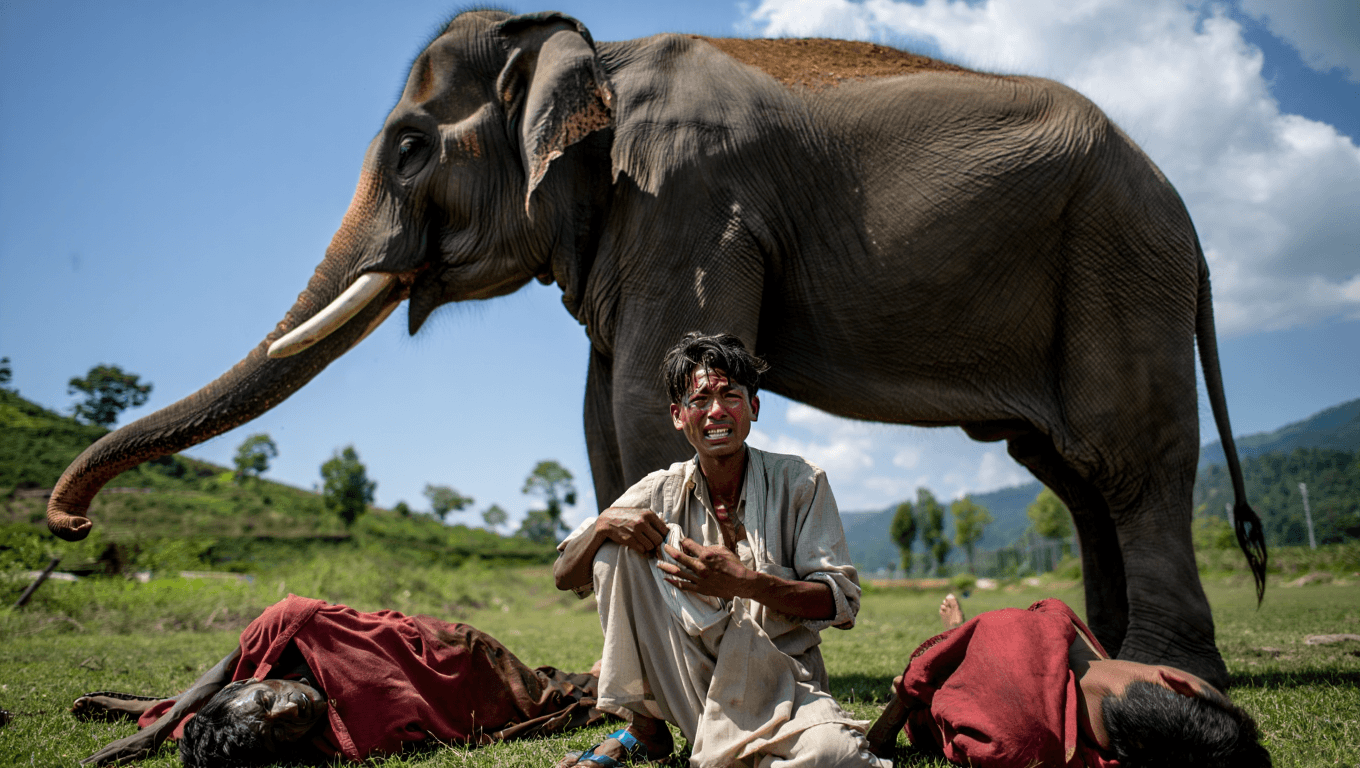
A man in the Jagatpur area of Nepal watched a nightmare he thought he’d escaped unfold again: the same elephant that once killed his parents returned years later and fatally attacked two members of his family. The episode underscores growing tensions between people and elephants as habitat shrinks and monitoring systems struggle to prevent predictable attacks.
The elephant, known locally as Dhurbe, has been linked to multiple deaths over more than a decade and is tracked by wildlife officials. Authorities say a satellite collar placed on the animal recorded his presence around the Bote family home on the night of the most recent attack, and villagers report the animal had been circling the settlement for days beforehand.
How a solitary bull becomes a repeated threat
Research and park officials point to a common pattern behind lethal encounters with elephants: when young males mature, stronger bulls push them away from family groups. Isolated and forced to forage where food is available, these solitary bulls often range near human settlements and crops, increasing the chance of deadly clashes.
Chitwan National Park data show the scale of the problem. Over roughly the last 11½ years, park records attribute about 127 human deaths in the Chitwan area to wildlife incidents. Officials working on Nepal’s Elephant Conservation Action Plan for 2025–2035 warn that more than half of the region’s potential elephant habitat in the Chure-Tarai landscape now lies outside formally protected zones, bringing people and elephants into regular contact.
After Dhurbe was blamed for killing a member of the Bote family in 2012, a major operation involving 93 soldiers tried to track and shoot the animal; he was believed wounded but escaped. Dhurbe resurfaced in later years and has been fitted with tracking collars—replacements were installed in 2020 and 2023 after earlier devices failed. The collars send hourly location pings, which officials say confirmed the elephant’s proximity during the recent attack.
Local leaders and residents say the pattern was foreseeable. Lal Bahadur Dawadi, chairman of a nearby buffer-zone committee, told reporters that Dhurbe follows a roughly annual route and that his return to villages has been predictable. Families living at the forest edge say they have been asking for better protection for years.
- Dhurbe’s toll: Park officials attribute at least 25 human fatalities to this elephant since 2010.
- Monitoring: A satellite tracking collar pings Dhurbe’s location hourly; new promises aim to move to real‑time tracking.
- Habitat loss: More than half of potential elephant range in the Chure-Tarai region lies outside protected areas, increasing overlap with villages and farms.
- Community impact: After the most recent attack, a family set fire to thatch to drive the animal away; the emergency measure destroyed what remained of their home and left nine people displaced.
The human cost is immediate and personal. Shanichara Bote, whose family has moved twice to escape elephant violence, told the Kathmandu Post that after selling their first home and crossing two rivers they believed they were safe—only to be found again by the same animal years later. His words, translated in reporting, reflect exhaustion and a sense that relocation alone cannot guarantee safety.
What officials say and what’s next
Park authorities have pledged to take more decisive action: officials say they will intensify efforts to contain Dhurbe and upgrade monitoring to provide faster, more actionable warnings. Conservationists and local leaders say that containment and real-time tracking are only part of the response needed.
Long-term solutions being discussed include expanding protected corridors, improving early-warning systems for villages, investing in non-lethal deterrents and barriers, and ensuring prompt compensation and shelter for families displaced by wildlife incidents. Experts emphasize that without reducing the overlap between human settlements and elephant habitat, incidents like this are likely to continue.
The Bote family’s experience highlights a wider policy dilemma: as habitat pressure rises, so do repeat encounters between a few high‑risk animals and vulnerable communities. For residents living at the forest edge, predictable monitoring that fails to translate into rapid protection offers little comfort—and the consequences are sometimes fatal.
Similar Posts
- Bison Attack in Yellowstone: Florida Man Gored in Shocking Encounter!
- Lion Attack: Escaped Pet Mauls Mother and Two Kids in Shocking Incident!
- War elephants unearthed in Spain: bones tied to 2,200-year-old conflict
- Horrific Alligator Attack: Woman Killed While Canoeing with Husband
- Scientists Use Poop to Rescue Endangered Animals: Innovative Conservation Efforts Unveiled!

Miles Harper focuses on optimizing your daily life. He shares practical strategies to improve your time management, well-being, and consumption habits, turning your routine into lasting success.